
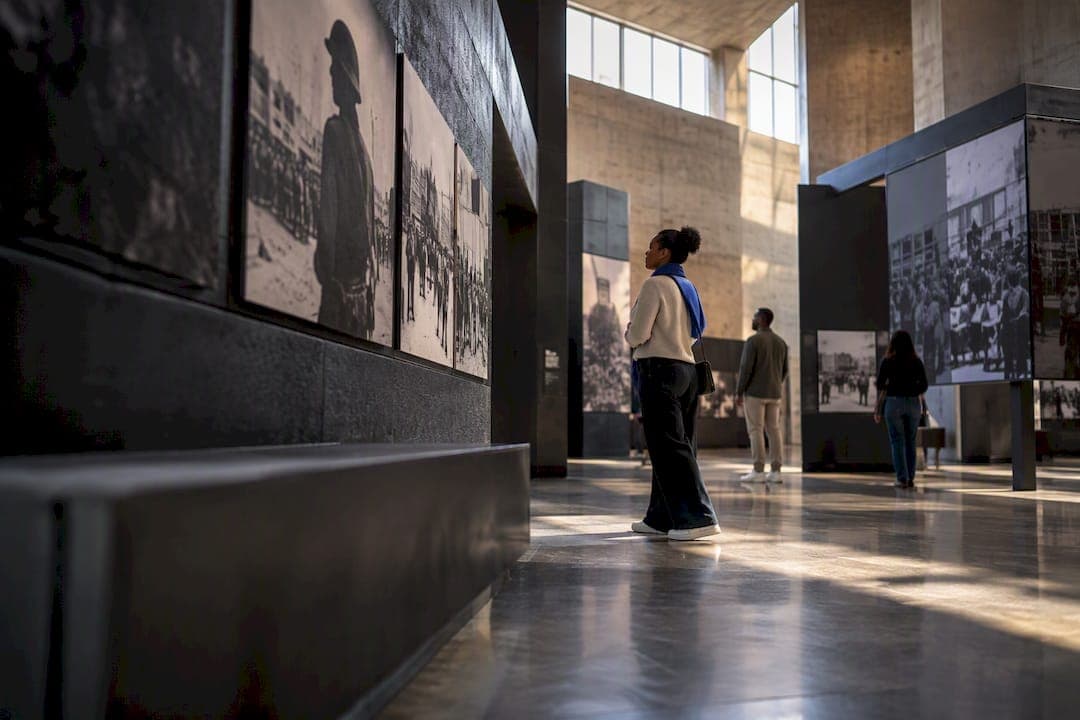
The Apartheid Museum is one of the most essential stops in Johannesburg, and skipping it means missing the clearest, most unflinching account of how South Africa built and then dismantled a system of legal racial oppression. Plan for three to four hours, book your tickets online before you arrive, and go on a weekday morning if your schedule allows it. Bring time to sit with what you see.
TL;DR:
- Arrive at least 15 minutes early and book tickets online to avoid long queues during peak times, especially public holidays.
- Most visitors spend three to four hours exploring the permanent exhibition, with testimony and Rivonia Trial sections demanding extra reflection time.
- The museum's layout and heavy content require a slow, intentional pace, and a brief pause after intense sections enhances understanding.
- Visiting on Tuesday through Thursday mornings provides a quieter experience, while weekends and holidays tend to be more crowded.
- Combining the museum with Soweto or Constitution Hill offers a comprehensive understanding of South Africa’s history, ideally in that sequence for maximum impact.
Table of Contents
- Apartheid Museum Guide: Hours, Ticket Prices, and Booking
- How Long to Spend at the Apartheid Museum
- How to Get to the Apartheid Museum From the Airport
- What to See Inside: Exhibits and Museum Layout
- Is the Apartheid Museum Suitable for Children or Visitors With Mobility Needs?
- Best Times to Visit and Photography Rules
- Combining Your Visit With Soweto and Constitution Hill
- A Travel Writer's Take on Pacing Through Difficult History
- Book a Guided Tour or Plan It Yourself With Im-at
- Sources
- FAQ
Apartheid Museum Guide: Hours, Ticket Prices, and Booking
Before anything else, check the museum's own visitor page. Opening days, hours, and prices shift periodically, and the Apartheid Museum's official visitor information is the only source that reflects real-time changes, including holiday closures or special event schedules that could affect your visit.
That said, here's what you need to know to plan realistically:
- Opening days and hours: The museum operates on a fixed weekly schedule, closed on Mondays, with last entry typically enforced well before closing time. Confirm exact hours for your travel dates before booking transport or activities around your visit.
- Ticket prices: Recent visitor guides put adult admission around ZAR 220 and child tickets around ZAR 100, though these figures shift over time and concession rates for students and pensioners are usually available. Treat any number you read, including this one, as a starting estimate and verify the current rate directly on the museum's site before you travel.
- Booking online versus at the gate: Buying tickets in advance through the official site is the smarter move, especially during school holidays or South African public holidays when queues at the gate can stretch long. Walk-up tickets are generally available, but you're gambling with your schedule if you arrive during a peak period without a booking.
- Audio guides: Multilingual audio guides are available on-site for an additional fee, and they matter more here than at a typical museum because so much of the exhibition relies on recorded testimony, radio broadcasts, and archival footage that written wall text alone doesn't fully capture.
- On-site services: There's a café for a coffee break or light meal, a gift shop with books and educational material, restrooms, and parking. None of these are elaborate, but they're enough to get you through a multi-hour visit without needing to leave the grounds.
The museum sits inside the Gold Reef City complex on the southern edge of Johannesburg, a detail that surprises some visitors who expect a standalone building in the city center. The museum's own homepage lays out its location and general visitor guidance, and it's worth a quick read even if you think you already know the basics.
Pro Tip: Book your ticket for a specific time slot if the museum offers one during your travel dates. Even a rough time commitment helps you sequence the rest of your Johannesburg day around it, especially if you're combining it with a Soweto tour or a flight later that evening.
Practically speaking, your pre-visit checklist looks like this: check the official hours for your exact travel dates, book online if the option exists, and plan to arrive at least 15 minutes before your intended entry time to handle security screening. Prices can and do change year to year, so don't rely on a number you saw in an old blog post, including one you might have read before landing on this page.
How Long to Spend at the Apartheid Museum
Most visitors need three to four hours to walk through the permanent exhibition at a pace that lets the material actually register. That's the number worth building your day around. If you're pressed for time, a highlights-only pass through the most pivotal sections can work in 90 to 120 minutes, but you'll be skimming past testimony and context that gives the museum its weight. Add the audio guide and you should budget another 45 to 60 minutes on top of whichever pace you choose, since the audio content is dense and testimony-heavy in ways that reward slowing down rather than rushing through.

The permanent exhibition is broken into roughly 22 distinct sections that move chronologically from 1948 through 1994. That structure is exactly why the recommended visit length sits where it does: you're not wandering through a handful of large rooms, you're moving through two dozen smaller, tightly focused spaces, some of which are little more than a corridor of photographs and others of which contain multiple video installations you could watch for 20 minutes each if you let yourself.
Three sections tend to slow visitors down the most. The testimony rooms, where recorded survivor accounts play on loop, pull people in longer than they expect. The section covering the Rivonia Trial and Robben Island imprisonment draws a crowd because it directly covers Nelson Mandela's incarceration. And the 1976 Soweto uprising section, with its documentary footage of the student protests and the violence that followed, is one many visitors replay before moving on.
Here are three ways to structure your time, depending on your schedule:
- Highlights-only half-day (90 to 120 minutes): Move directly through the chronological spine of the exhibition, pause at the Rivonia Trial and 1976 uprising sections, and skip the audio guide. This works if you're squeezing the museum between other Johannesburg commitments or arriving with a flight later that day.
- Standard self-guided visit (3 to 4 hours): Walk the full permanent exhibition at a natural pace, read the wall panels, and watch most of the video content without rushing. This is the visit most first-time travelers should plan for, and it's what the museum itself is built around.
- Full day with combined attractions (5 to 7 hours total): Add the audio guide for testimony-heavy sections, take a proper break at the café midway through, and pair the museum with a Soweto tour either before or after, treating the two as one connected day of South African history rather than separate errands.
Pro Tip: Give yourself five quiet minutes after the 1976 uprising section and again after the detention and torture exhibits before moving on. Rushing straight from those rooms into the next section does a disservice to what you just saw, and most visitors report needing that pause whether they planned for it or not.
However you pace it, use the audio guide selectively rather than for the entire exhibition if you're short on time. It adds the most value in the testimony and Rivonia sections, where hearing an actual voice recount an event lands differently than reading a paragraph on a wall.
How to Get to the Apartheid Museum From the Airport
Getting to the museum comes down to three realistic options, and which one makes sense depends on your budget, your patience, and whether you're traveling solo or with a group.
- Direct rideshare or taxi from OR Tambo: This is the fastest door-to-door option and the one most first-time visitors should default to, particularly if you're arriving with luggage or on a tight schedule. Transport guides for the route generally put this as a straightforward single-leg trip, and Uber and Bolt both operate reliably in Johannesburg.
- Gautrain plus a short rideshare: This combination is cheaper during daytime hours but involves a transfer, since the Gautrain doesn't stop directly at the museum. It works well if you're already budget-conscious or traveling during the day when connections are smooth, but it's a worse choice late at night.
- Private transfer for groups: If you're traveling with three or more people, a private transfer often costs about the same per person as rideshare while sparing you the coordination of matching pickup times across multiple cars.
If you're driving yourself, parking at the museum sits separately from the main Gold Reef City theme-park parking, which trips up some visitors who follow signage toward the casino and amusement park instead. Museum parking fees are modest, generally in the ZAR 30 to 50 range according to detailed visitor guides, and the lot rarely fills up outside of major public holidays.
Using Uber or Bolt for pickup after your visit is usually painless, but the pickup zone near the museum entrance can get busy right around closing time when multiple tour groups leave at once. If you notice surge pricing kicking in, walking a short distance toward the main Gold Reef City entrance sometimes gets you a better rate, since more drivers cycle through that pickup point.
On arrival, expect a standard security and bag check at the entrance, similar to what you'd encounter at an airport but faster. Ticket desk lines move quickly if you've already booked online, since staff mainly need to scan your confirmation rather than process payment on the spot. If the museum is running timed entry during your visit, arrive close to your slot. Arriving too early just means waiting outside, and arriving late can mean losing your place in that entry window.
What to See Inside: Exhibits and Museum Layout
The exhibition begins the moment you enter, before you've even reached the first formal display. Visitors are randomly assigned an entrance marked either "white" or "non-white" based on their ticket, a deliberate device meant to give a small, immediate taste of how race-based classification governed daily life under apartheid. It's disorienting by design. Some visitors barely notice it, others find it the most striking five minutes of the entire visit, and both reactions are exactly what the museum intends.
From there, the exhibition unfolds chronologically. It opens at the Pillars of the Constitution, a set of concrete columns representing the values in South Africa's post-apartheid constitution, then moves backward in time to build the historical case for why those values mattered so much once democracy arrived. The rest of the museum tracks forward again through segregation, resistance, and eventual negotiation.
Here's what to prioritize if your time is limited:
- Race classification entry experience: The randomized entrance mentioned above, plus early exhibits on how the apartheid government legally defined and enforced racial categories.
- Journeys: A section covering the movement of people, migration, and forced relocation under apartheid-era laws.
- Segregation and pass laws: Displays covering the pass book system that restricted where Black South Africans could live, work, and travel, one of the most oppressive mechanisms of daily control under the regime.
- 1950s resistance: Coverage of early organized opposition, including the Defiance Campaign and the growth of the African National Congress as a political force.
- The Rivonia Trial and Robben Island: The section most visitors linger in longest, covering Nelson Mandela's trial and subsequent 27-year imprisonment.
- The 1976 Soweto uprising: Documentary footage and photographs from the student protests against Afrikaans-language instruction, and the violent government response that followed.
- Detainees and torture: A harder section to walk through, documenting the treatment of political prisoners under apartheid-era security laws.
- Negotiations and the 1994 inauguration: The exhibition's closing arc, tracking the transition to democracy and ending with footage from Nelson Mandela's 1994 inauguration as president.
Beyond the permanent collection, the museum runs temporary exhibitions and hosts at least five annual commemorative events marking milestones in the end of apartheid and the arrival of multiracial democracy. What's on display can change significantly depending on when you visit, so check current programming on the museum's site rather than assuming the layout described here is exactly what you'll find. A section on rotating art installations or a special anniversary exhibit might be running during your trip, adding content beyond the fixed chronological path.
Is the Apartheid Museum Suitable for Children or Visitors With Mobility Needs?
The museum involves a fair amount of walking across a large single-story layout, with some sections requiring you to move through narrow corridors and stand for extended periods watching video content. If you or someone in your group has mobility limitations, plan a slower pace and add extra time on top of the standard three to four hour estimate. There isn't a shortcut through the exhibition. The chronological design means you move through most sections in sequence.
Wheelchair access is available throughout the main route, and there are seating areas at intervals where you can rest, particularly near the longer video installations. Staff are generally available to help if you need directions or assistance navigating a specific section, though it's worth asking at the front desk when you arrive rather than assuming help will find you.
On age suitability, the content here is genuinely heavy. The museum's own guidance and standard school-group policy generally discourage bringing children younger than Grade 5 age, and for good reason. Sections on detention, torture, and violent suppression of protest aren't sanitized for younger audiences, and they shouldn't be. If you're traveling with younger children, consider splitting your group so one adult tours the museum while another manages a shorter visit or an alternative activity nearby.
- Allow extra time and a slower pace if mobility is a concern; the layout doesn't have a compressed alternate route.
- Wheelchair access is available, with rest points at intervals through the exhibition.
- Children younger than roughly Grade 5 age are generally not recommended for a full visit given the content.
- If you find a section overwhelming, exit points exist throughout. You don't have to complete every room in sequence to leave the building.
Pro Tip: If you're visiting with a teenager who's studying South African history in school, read up on the Rivonia Trial and the 1976 uprising beforehand. Having context going in changes how much they get out of those specific rooms.
Best Times to Visit and Photography Rules
Weekday mornings, particularly Tuesday through Thursday between 9 and 11 AM, tend to offer the quietest experience, giving you room to actually stand with the material rather than shuffle through with a crowd. Weekends and school holiday periods bring noticeably more visitors, including tour groups and school trips, which can make the more intimate testimony rooms feel crowded and rushed.
Photography is generally permitted in most of the museum, but treat certain sections with more restraint than others. Testimony rooms and displays involving survivor accounts of detention or torture are not the place for casual photos or selfies. Follow posted signage in each section, since some specific exhibits do restrict photography outright, often where original archival material is fragile or where the subject matter calls for a quieter kind of attention than a phone camera invites.
What to bring: comfortable shoes for a few hours of walking, a bottle of water, your ID if it's needed for ticket verification, and a fully charged phone or device if you're using a digital audio guide. Beyond the physical checklist, give yourself permission to plan emotionally. This isn't a museum you rush through between lunch and a shopping trip. Several sections are genuinely difficult, and pretending otherwise going in usually backfires.
- Visit Tuesday through Thursday mornings for the quietest experience; weekends and school holidays draw larger crowds.
- Keep photography respectful in testimony and detention sections, and follow posted restrictions exactly.
- Bring water, comfortable shoes, and a charged device for the audio guide.
- Follow staff guidance throughout, and keep noise levels down out of respect for other visitors processing difficult material.
Respectful conduct matters more here than at most attractions. This is a documentary record of real suffering and real political struggle, not a backdrop for a quick photo. Most visitors instinctively understand this once they're inside, but it's worth setting that expectation before you arrive.
Combining Your Visit With Soweto and Constitution Hill
The Apartheid Museum pairs naturally with two other Johannesburg sites: a Soweto tour and Constitution Hill. Soweto extends the history you just walked through into a living neighborhood, with stops often including Vilakazi Street and sites connected to the 1976 uprising you saw documented inside the museum. Constitution Hill, home to South Africa's Constitutional Court, connects directly to the Pillars of the Constitution you encountered at the start of your museum visit, closing a loop between the country's oppressive past and its constitutional present.
A sensible order is museum first, then Soweto, since the museum gives you the historical framework that makes a Soweto tour land with more weight. Constitution Hill can go before or after, depending on your day's logistics, though pairing it right after the museum reinforces the throughline between the two most directly.
One combination to avoid: don't schedule the Apartheid Museum back to back with Gold Reef City's theme park on the same half-day. They sit on the same grounds, which makes it tempting to treat them as a single stop, but the emotional tone of the museum doesn't transition well into roller coasters an hour later. Give yourself a buffer, even if that just means lunch and a walk between the two.
- Half-day combo: Apartheid Museum in the morning, Soweto tour in the afternoon, using the museum as historical groundwork.
- Full-day combo: Add Constitution Hill either before the museum or as your final stop, transport permitting.
- Multi-day approach: Split the museum and Soweto across two mornings if you're spending several days in Johannesburg, giving yourself recovery time between two emotionally demanding experiences.
If you're extending your Gauteng trip beyond Johannesburg, Pretoria offers its own set of family-friendly stops worth folding into a longer itinerary.
A Travel Writer's Take on Pacing Through Difficult History
The instinct at most museums is to keep moving, to treat a room as something you clear before advancing to the next one. That instinct works against you here. The sections on detention and the 1976 uprising aren't built for a quick pass through, and visitors who try to power through them on a schedule tend to leave feeling like they saw everything and absorbed very little.
The better approach is to build in small pauses on purpose. Sit for a minute after the testimony rooms. Let the Rivonia Trial section actually register before moving into the next chronological block. The audio guide earns its cost specifically in these testimony-heavy sections, where a recorded voice does something a wall panel can't.
If you're combining the museum with a Soweto tour, as many Johannesburg visitors do, look at combined itinerary options that sequence the two properly rather than treating them as separate bookings you have to coordinate yourself. The connection between what you see inside the museum and what you encounter in Soweto afterward is part of what makes the day work.
— Mikahil
Book a Guided Tour or Plan It Yourself With Im-at
If self-planning transport, tickets, and pacing sounds like more coordination than you want on vacation, Im-at handles it in a single booking. The Soweto and Apartheid Museum day tour bundles both sites into one curated itinerary with transfers included, so you're not separately arranging a rideshare, buying museum tickets, and then booking a Soweto guide on three different platforms.

That single-checkout convenience is the real advantage here. You pay once, get a sequenced itinerary that already accounts for pacing between the museum and Soweto, and skip the logistics of matching pickup times across separate bookings. Im-at works as a marketplace, not a mandatory gatekeeper, so if you'd rather buy museum tickets directly and arrange your own transport, that's a completely reasonable path too. For travelers who want the coordination handled, browse guided tours and experiences across Johannesburg and check current availability for the dates you're in town.
Sources
Prices, hours, and programming at the Apartheid Museum change periodically, so confirm details directly before you travel rather than relying solely on this guide or any other secondhand source.
- Visitor Information – Apartheid Museum
- Apartheid Museum — Wikipedia
- Apartheid Museum Johannesburg: the complete visitor guide
FAQ
How much time do you need at the Apartheid Museum?
Most visitors need three to four hours to walk through the permanent exhibition at a comfortable pace. Add extra time if you're using the audio guide, and budget a shorter visit only if focusing on highlights.
How much does it cost to visit the Apartheid Museum?
Recent guides put adult admission around ZAR 220 and child tickets around ZAR 100, though prices are subject to change and should be confirmed on the official museum site before you travel. Concession rates for students and pensioners are typically available as well.
Who owns the Apartheid Museum?
The Apartheid Museum operates as a nonprofit institution and sits within the Gold Reef City complex in Johannesburg, as described on the museum's official homepage. It was established with a public education mandate rather than as a commercial venture.
What can you see inside the Apartheid Museum?
The permanent exhibition covers South African history from 1948 to 1994 across roughly 22 chronological sections, including segregation, pass laws, the Rivonia Trial, the 1976 Soweto uprising, and the 1994 transition to democracy. It also runs temporary exhibitions, so check current programming before your visit.
Can I book a combined tour instead of visiting the museum alone?
Yes. Im-at offers a Soweto and Apartheid Museum day tour that bundles both experiences with transfers in a single booking, which suits travelers who'd rather not coordinate transport and tickets separately.