

Lion's Head is a short, moderately challenging hike in Cape Town that most reasonably fit hikers finish in a couple of hours round trip. The trail circles and then climbs the distinctive 669-meter peak above the Atlantic Seaboard, delivering 360-degree views of Table Mountain, the Twelve Apostles, and the ocean. The one decision that shapes your experience: near the summit, the route splits into the Staples/chains section (a short technical scramble using fixed iron rungs) and the Alternative route (longer but ladder-free). Both reach the top.
- Distance: roughly 5 km round trip
- Difficulty: moderate, with one technical section requiring upper-body effort
- Best timing: sunrise or sunset for the views and cooler temperatures
Pro Tip: If you're unsure about your balance on exposed ledges, take the Alternative route up and save the Staples for descent when you've warmed up — or skip them entirely.
Key Takeaways
Lion's Head is a 5 km round-trip hike with 350 meters of elevation gain that most fit hikers complete in under two hours, with sunrise timing and the Staples vs. Alternative route decision being the two choices that most affect your experience.
| Point | Details |
|---|---|
| Timing matters most | Sunrise offers cooler air and lighter crowds; sunset delivers dramatic light but needs a headlamp for descent. |
| Route decision at the split | Take Staples up and Alternative down to avoid ladder congestion; skip Staples entirely in wind or wet conditions. |
| Arrive early for parking | The Signal Hill Road lot fills before 6 AM on summer weekends; rideshare is the smarter option for sunset hikes. |
| Safety kit minimum | Carry 1.5 liters of water, a headlamp, grip shoes, and SPF 50+ sunscreen regardless of cloud cover. |
| Im-at for guided bookings | Im-at connects you with vetted local guides for Lion's Head and Table Mountain hikes, bookable in minutes online. |
Pro Tip: Download the AllTrails or Trailforks map for offline use before you leave your accommodation — cell signal on the upper trail can be patchy.
Table of Contents
- Quick facts for planning your Lion's Head hike
- How the Lion's Head trail actually unfolds
- Getting to the trailhead: parking, rideshares, and transport
- When to hike Lion's Head: sunrise, sunset, and seasonal timing
- Safety on Lion's Head: what to bring and how to behave
- Maps, GPX files, and navigation apps for Lion's Head
- When a guided hike makes sense and how to book one
- What the hike actually feels like: a realistic picture
- Book a guided Lion's Head hike through Im-at
- Sources
Quick facts for planning your Lion's Head hike
| Detail | Info |
|---|---|
| Round-trip distance | ~5 km |
| Typical duration | a couple of hours depending on fitness |
| Summit elevation | the peak elevation is 669 meters above sea level |
| Elevation gain | approximately three hundred meters of climb |
| Difficulty | Moderate (scrambling/ladders at summit) |
| Trail type | Loop |
| Park authority | Table Mountain National Park (SANParks) |
| Entry fee | Check SANParks for current rates; conservation fees apply |
| Main trailhead GPS | Signal Hill Road parking area |
| Open | Year-round (subject to closure in high winds) |
AllTrails lists the Lion's Head Summit trail as one of the most reviewed city hikes in South Africa, with over 3,600 user reports confirming the ladders, scrambling, and year-round access.
The summit sits at 669 meters — modest by mountain standards, but the exposed ridge and technical sections make it feel bigger than the numbers suggest.
How the Lion's Head trail actually unfolds
The trailhead sits at the Signal Hill Road parking area. From there, a wide, well-graded gravel path winds upward through fynbos for the first kilometer, giving your legs a gentle warm-up before the gradient steepens.
Key waypoints and timing:
- Trailhead to first viewpoint (0–1 km): Wide gravel path, moderate incline. Clear views of Signal Hill open up within 15 minutes. This section is accessible for most fitness levels.
- First viewpoint to route split (1–2.5 km): The path narrows and becomes rockier. You'll pass several natural ledge viewpoints with unobstructed Atlantic views. A signpost marks the split between the Staples/chains route and the Alternative route.
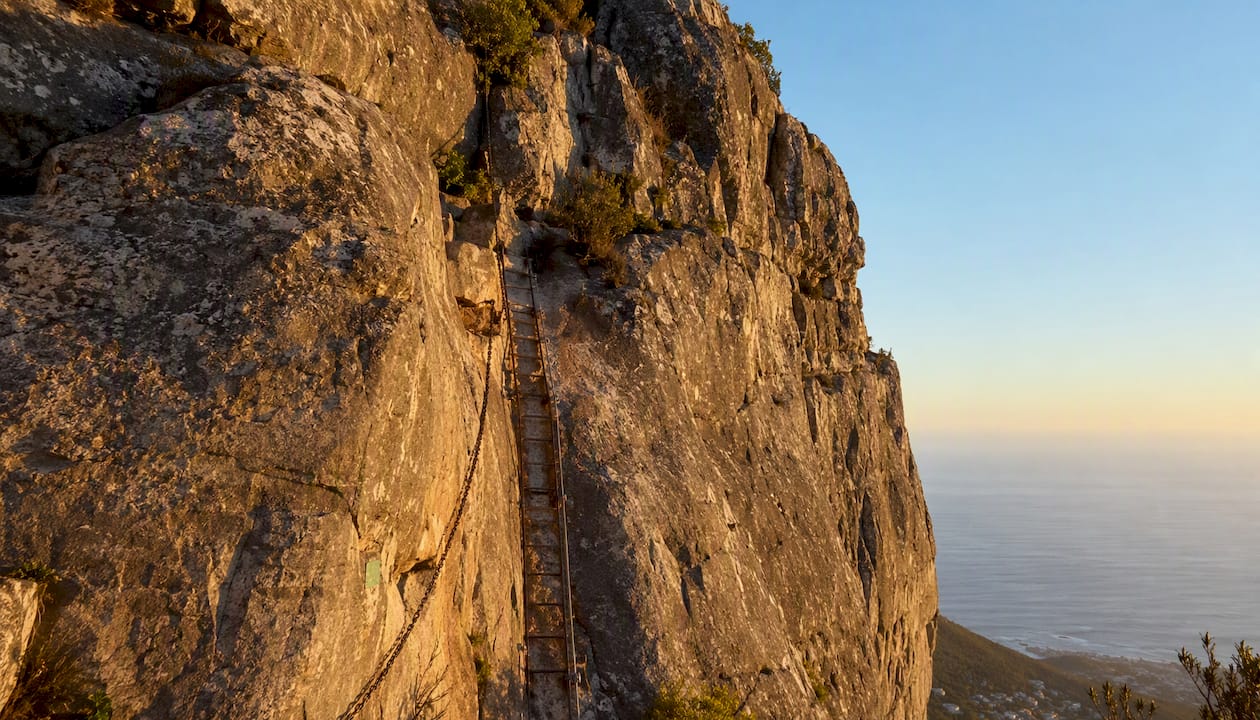
- Staples/chains section: Fixed iron rungs and chains assist on a near-vertical rock face. Takes 10–15 minutes of focused effort. Two Wandering Soles describes this section as the trail's defining moment — exhilarating when dry, genuinely risky when wet or windy.
- Alternative route: A longer path that bypasses the technical section via a series of steep but walkable switchbacks. Adds roughly 20 minutes but requires no upper-body effort.
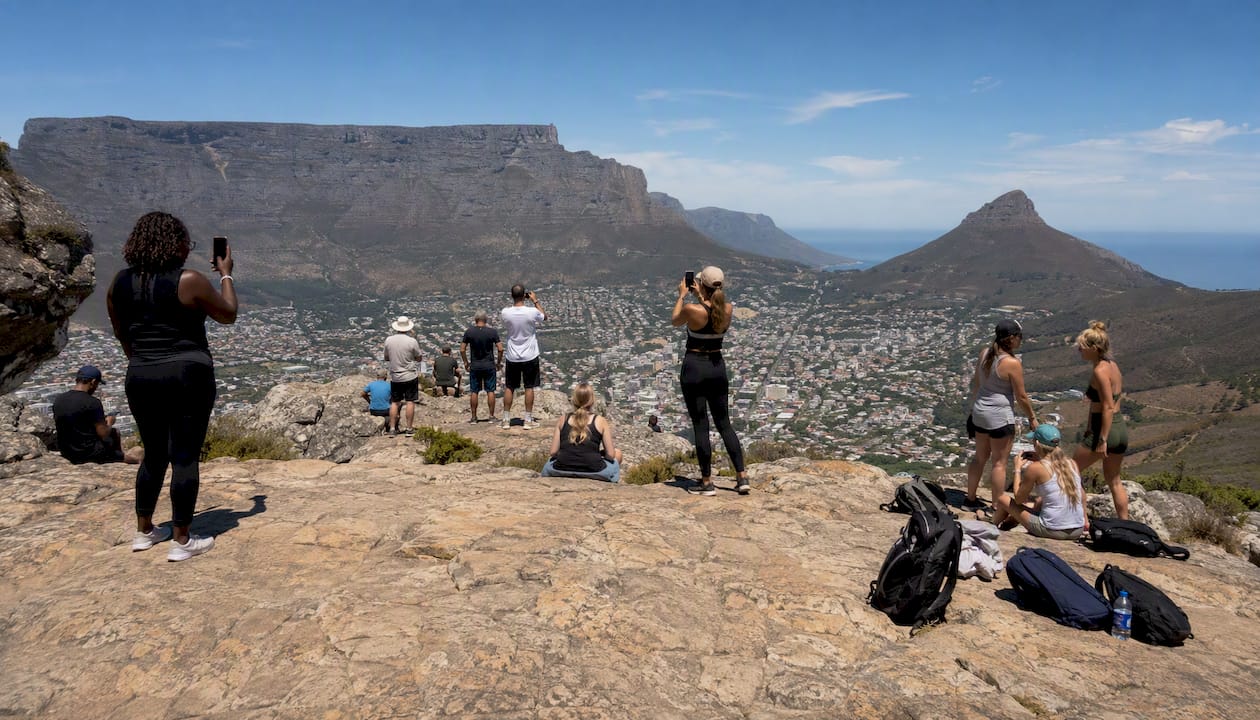
- Summit (669 m): Both routes converge at the top. The 360-degree panorama here — Table Mountain to the south, Robben Island to the northwest, the Atlantic Seaboard below — is the payoff.
Return options:
- Same way back: Fastest, familiar terrain.
- Circular loop: Continue around the peak and descend via the opposite route (Staples down if you took Alternative up, or vice versa). Experienced guides recommend taking the Staples up and the Alternative down to avoid ladder bottlenecks during busy periods.
- Signal Hill extension: A longer descent via Signal Hill adds the Kramat shrine as a photo stop and reduces re-congestion at the ladders.
Getting to the trailhead: parking, rideshares, and transport
The main parking area sits on Signal Hill Road, accessed via Kloof Nek Road from the City Bowl or De Waal Drive from the Southern Suburbs.
- Driving: Follow Kloof Nek Road uphill from the city center, then turn onto Signal Hill Road. The parking lot is clearly signed. Scratch Your Mapa confirms that sunrise hikers should arrive by 5:30 AM in summer — the lot fills fast.
- Parking overflow: When the main lot is full, limited street parking exists on Signal Hill Road itself. Never leave valuables visible in your car; car-guard services operate at the main lot and a small tip (R5–R10) is standard local practice.
- Rideshare: Uber and Bolt both service the trailhead. Drop-off and pickup work well at the main parking area. For sunrise hikes, book your return ride before you start — demand spikes at 7–8 AM when groups finish.
- Public transport: MyCiTi bus routes serve Kloof Nek, about a 15-minute walk from the trailhead. It's a viable option for budget travelers, though the uphill walk adds time and effort before the hike even starts.
Pro Tip: For sunset hikes, rideshare is the smarter call. Parking is chaotic at peak sunset time, and you'll want both hands free for the descent rather than hunting for a parking spot in fading light.
When to hike Lion's Head: sunrise, sunset, and seasonal timing
The Lion's Head sunrise hike and the sunset version are both iconic for good reason, but they suit different travelers.
- Sunrise: Calmer winds, cooler air, and dramatically clear light over the city. Crowds are lighter than sunset. You'll need a headlamp for the approach in the dark, and the reward is watching Cape Town wake up from 669 meters.
- Sunset: The Atlantic catches the last light in a way that's genuinely hard to photograph badly. Crowds are heavier, and you'll need a headlamp for the descent. Plan to be off the technical sections before dark.
Seasonal notes:
- Summer (November–March): Start before 7 AM to beat the heat. Midday UV on the exposed ridge is intense, and the rock surface gets hot enough to affect grip.
- Winter (June–August): Shorter days and stronger winds. The trail stays open but SANParks may close it during storms or sustained high winds. Check official notices before you go.
- Spring and autumn: The sweet spot. Moderate temperatures, longer golden hours, and the fynbos in bloom.
SANParks can and does close Lion's Head during high-wind events. Check the official SANParks notices or the Table Mountain National Park social channels before any dawn or dusk hike.
Full-moon hikes have become a Cape Town tradition — the trail stays busy on full-moon nights, and the light is enough to navigate without a headlamp on the main path, though one is still recommended for the technical sections.
Safety on Lion's Head: what to bring and how to behave
The two real risks on this trail are a fall on the technical sections and a personal-security incident during off-peak hours. Both are manageable with the right preparation.
Kit checklist:
- At least 1.5 liters of water per person (the summit has no shade and UV exposure is high even on overcast days)
- Closed-toe shoes with grip; trail runners or hiking boots are ideal, sneakers are borderline, sandals are a bad idea
- Headlamp with fresh batteries for any dawn or dusk hike
- Sun protection: SPF 50+ sunscreen, sunglasses, and a hat
- Light snack and a basic first-aid kit (plasters, antiseptic)
- Fully charged phone with the trail downloaded offline
Behavior checklist:
- Hike in groups of at least two, especially for early-morning or evening hikes. Cape Town Magazine's local safety guidance specifically advises against solo night hikes.
- On the Staples section, wait for two-way traffic to clear before committing to a ladder. There's no room to pass on the rungs.
- Skip the Staples entirely on windy days. The exposure is real, and a gust at the wrong moment on wet rock is not a recoverable situation.
- Leave jewelry and large amounts of cash in your accommodation. Carry only what you need.
UV at altitude in Cape Town is stronger than most visitors expect. The summit has zero shade, and the combination of reflected light off the rock face and direct sun can burn exposed skin within 30 minutes.
Emergency contacts: Before you hike, save the Cape Town Emergency Services number (107 from a landline, 021 480 7700 from a mobile) and the nearest hospital, Groote Schuur Hospital (021 404 9111), in your phone. Mountain Rescue operates under the Western Cape Government's emergency services framework.
Maps, GPX files, and navigation apps for Lion's Head
The trail is well-signed and hard to lose in daylight, but a downloaded map is worth having for the route split and for sharing your location with someone not on the hike.
Recommended sources:
- AllTrails: The most user-reviewed source for Lion's Head. Download the trail for offline use before you leave your accommodation's Wi-Fi.
- Trailforks: Hosts the Lion's Head and Signal Hill trail network with GPS-capable maps and more granular local variants than most platforms. Useful if you're planning the circular Signal Hill extension.
- Official park maps: Available at the Table Mountain National Park visitor information points and via SANParks.
How to load a GPX for offline use:
- Open AllTrails or Trailforks on your phone.
- Search "Lion's Head Summit" and open the trail page.
- Tap "Download" (AllTrails Pro) or export GPX (Trailforks) and save to your device.
- Share your live location with a contact not on the hike via WhatsApp or Google Maps before you start.
Where signage exists (the route split, the trailhead, the summit), it's clear. Between those points, the worn path is obvious in good visibility. In mist or after dark, the downloaded GPX earns its keep.
When a guided hike makes sense and how to book one
A guide adds real value in specific situations: you're hiking before dawn, you're unfamiliar with Cape Town's trail culture, you have a large group, or you want someone who knows exactly when to turn back if the weather shifts.
Situations that justify booking a guide:
- First-time visitors doing the lion's head sunrise hike in the dark
- Groups of 6 or more (logistics on the Staples section get complicated fast)
- Travelers with limited scrambling experience who want real-time coaching at the technical sections
- Anyone who wants local knowledge — the best photo spots, the quieter approach windows, the history of the peak
What a typical guided Lion's Head hike includes:
- A qualified local guide with knowledge of the route and conditions
- Headlamp provision for dawn/dusk hikes
- Water and basic snacks
- Safety briefing at the route split
- Flexible pacing and photo stops at the best Lion's Head viewpoints
Booking checklist before you confirm:
- Confirm the guide holds valid public liability insurance
- Check group size limits (smaller is better on the Staples)
- Clarify the meeting point and cancellation policy in writing
- Ask whether the guide monitors SANParks wind/closure alerts
Im-at's guided hiking on Table Mountain listings connect you with vetted local guides for exactly this kind of experience. Browse available dates, compare what's included, and book in a few minutes rather than chasing guides across multiple platforms.
What the hike actually feels like: a realistic picture
The first kilometer lulls you. The path is wide, the fynbos smells good, and the city views arrive early enough to feel like a reward before you've done any real work. Then the gradient shifts.
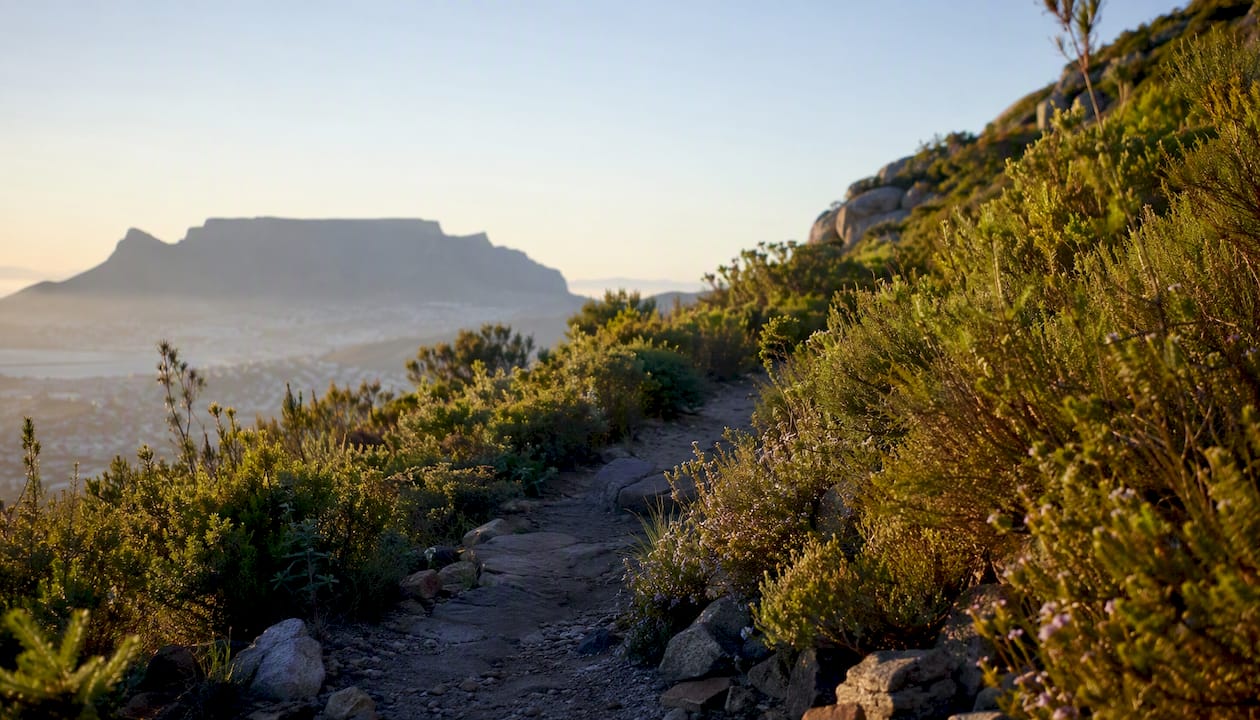
By the time you reach the route split, your legs know they've been working. The Staples section looks more intimidating from below than it feels once you're on the rungs — most hikers who hesitate at the bottom are surprised by how manageable it is with dry conditions and a calm day. The summit itself is compact and often crowded at peak times, but the view is genuinely one of the best urban panoramas on the continent.
For lower-fitness hikers or anyone with mobility limitations, the Alternative route is a legitimate and rewarding choice, not a consolation prize. The circular loop via Signal Hill suits anyone who wants more time on the mountain without repeating the same path.
The honest caveat: at sunrise on a weekend in summer, you will share the summit with a lot of people. That doesn't diminish the view, but it does mean the "solitary mountain moment" is not what this hike delivers. What it does deliver, reliably, is one of the most photogenic 90 minutes you'll spend in Cape Town.
Book a guided Lion's Head hike through Im-at
Sorting out a guide, checking conditions, and coordinating a 5:30 AM meeting point across a group is the part of sunrise hiking that nobody enjoys. Im-at cuts that friction entirely.
Browse Im-at's guided Table Mountain hiking experiences, including options that cover Lion's Head with a vetted local guide, headlamp, water, and safety briefing included. The booking takes minutes, the cancellation terms are clear, and you show up knowing exactly where to go and who to meet. For travelers who want to pair the hike with a broader Cape Town day, Im-at's full-day Cape Tour is worth checking alongside. Head to Im-at to browse available dates and confirm your spot.
Sources
Before your hike, check these directly for live updates, official fees, and downloadable maps:
- Lion's Head Summit, Western Cape, South Africa - 3,620 Reviews, Map | AllTrails
- Lion’s Head Hike: Guide to Cape Town’s Best Trail | Two Wandering Soles
- A Complete Guide to the Lion's Head Hike in Cape Town: Tips & Views - Scratch your mapa
For accommodation and logistics around active days in Cape Town, the 2026 guide to combining lodging and gastronomy covers how to plan your stay around early-morning starts.