
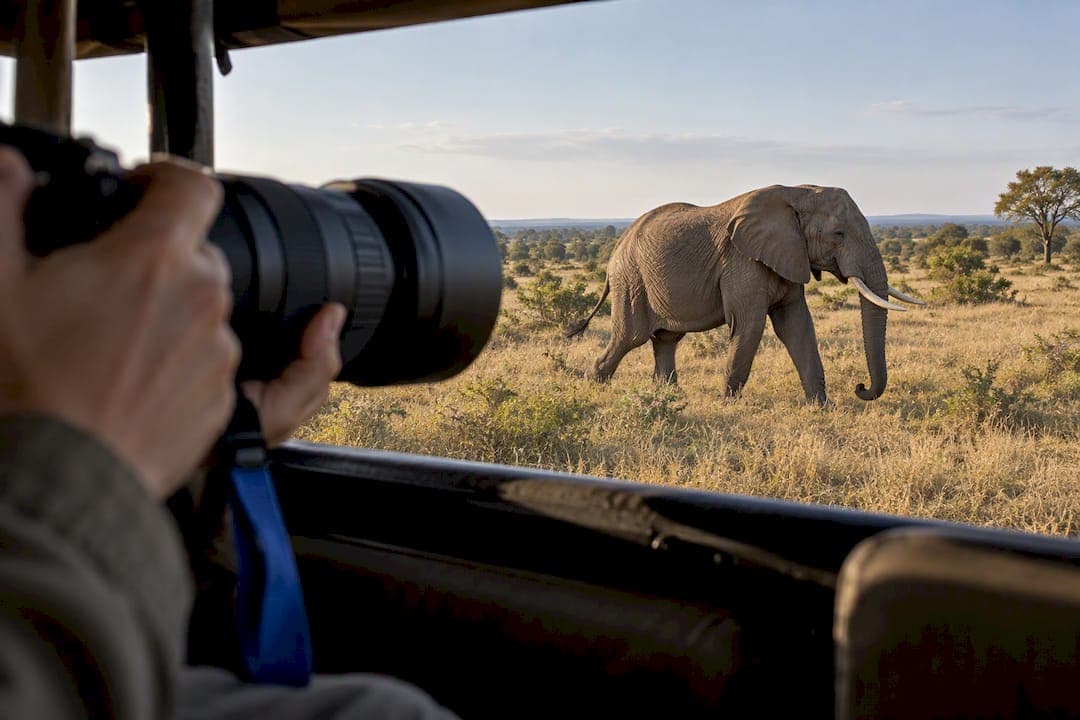
Obey your guide and the park's own rules, never feed or bait wildlife, leave the drone at home in protected areas, ask before photographing people, and check whether your shoot needs a permit if it is commercial or paid. These are the non-negotiables on any guided tour or safari, and park websites and your operator are the final word on local exceptions and paperwork.
TL;DR:
- Feeding or baiting wildlife is strictly prohibited and can lead to fines, equipment confiscation, or park removal due to safety and conservation concerns.
- Commercial filming requires obtaining permits well in advance, with documentation kept on hand, especially for paid or professional shoots, to avoid penalties.
- Drones are banned in most parks, so long lenses and patience are necessary to capture wildlife from a safe distance without disturbance.
- Respect local customs and ask permission before photographing people or cultural sites, and always follow guide instructions regarding restricted or sensitive areas.
- Practicing restraint by staying on designated roads, reducing noise, and avoiding crowding minimizes habitat damage and ethical issues associated with wildlife photography.
Table of Contents
- Top rules to follow on tours and safaris
- Legal rules, permits, and park-specific restrictions
- Wildlife conduct and field craft that protects animals
- Photographing people, cultural sites, and private property
- Equipment rules: drones, tripods, flash, and rigs
- Camera settings and composition that work on a moving tour
- Choosing a photography-aware tour before you book
- Understanding local privacy laws around photography
- Handling sensitive or protected locations
- The environmental and ethical weight of a photograph
- Photographing indigenous communities with respect
- Ethics, conservation, and the photographer's responsibility
- Sources
- FAQ
Top rules to follow on tours and safaris
Most photography problems on tours come from a handful of avoidable mistakes. Keep this list in mind before you raise the camera.
- Follow every instruction from your guide, even when it costs you a shot.
- Stay inside the vehicle wherever the park requires it.
- Keep a real distance from animals rather than closing in for a tighter frame.
- Never feed, bait, or call in wildlife to get a reaction shot.
- Leave drones behind unless you have specific, confirmed permission.
- Ask before photographing a person, and accept it when they say no.
- Skip the flash on nocturnal animals, since sudden light disorients them.
- Don't block the road or crowd another vehicle's view.
The consequences for ignoring these range from minor to severe. An animal that gets used to being fed can become aggressive toward the next vehicle that arrives, and guides have had to have habituated animals removed for the safety of future visitors. Rangers can confiscate footage, issue fines, or revoke a visitor's access to the park entirely.
Feeding or intentionally disturbing wildlife for photography is prohibited and can lead to prosecution or penalties under park rules, according to SANParks. That is not a suggestion aimed at careless tourists: it is an enforceable rule with real teeth, and it exists because a habituated animal is a dangerous animal.
Legal rules, permits, and park-specific restrictions
Park regulations are not etiquette guidelines, they are binding rules enforced under national environmental and protected-area law. SANParks requires visitors to stay on designated roads and remain in their vehicles except in marked areas, and it prohibits feeding wildlife outright. Violating either can bring fines, prosecution, or confiscation of equipment and footage.
Commercial content sits in its own category. A vacation snapshot posted to a personal account is treated differently than footage shot for a brand, a paid promotion, or a professional production. Content creators generally need a permit when the work is commercial, involves professional rigs, or is intended for paid use, and unauthorized commercial filming can trigger the same penalties as any other rule violation, sometimes with added fees or legal exposure.
Before you shoot anything beyond casual, personal photos, run through this:
- Check the park's own rules and regulations page for current restrictions.
- Confirm directly with your guide or tour operator whether your planned shoot counts as commercial.
- Apply for a permit well ahead of your trip, since approval can take time.
- Keep documentation of any permit on hand during the visit.
Casual travelers rarely need paperwork. Anyone shooting for a client, a brand, or a paid gig should assume they do, and should confirm it before departure rather than at the gate.
Wildlife conduct and field craft that protects animals
Feeding, baiting, or playing recorded calls to lure animals into frame is both dangerous and prohibited, and it is one of the fastest ways to turn a wild animal into a liability. Drones are strictly prohibited inside and over South African national parks, according to SANParks, which means the aerial shot has to come from your imagination rather than your gear bag. Distance is your friend here: a longer lens gets you the tight portrait without forcing an animal to change its behavior around your vehicle.
Vehicle conduct matters as much as camera technique. Give way to other vehicles, avoid crowding a sighting that already has several cars parked at it, and follow your guide's positioning rather than asking the driver to nose in closer for your angle.
- Move slowly and avoid sudden gestures that can startle an animal.
- Keep noise down, including phone notifications and camera beeps.
- Focus on the eyes first: a sharp eye carries a portrait even when the rest of the frame is soft.
- Wait. The best behavior often shows up after the vehicle has been still for a few minutes.
Professional and travel photographers consistently favor patience over pursuit, working a single scene rather than rushing from sighting to sighting, a habit that reduces disturbance and tends to produce stronger images, per National Geographic.
Pro Tip: A medium telephoto zoom lets you fill the frame with a face or a gesture from a safe distance, so you never have to ask your driver to close the gap.
Photographing people, cultural sites, and private property
Ask before you shoot a person, full stop. A raised camera and a questioning look, paired with a smile, communicates the request in almost any language, and it is far more reliable than assuming consent because someone is in a public market. National Geographic points to exactly this habit, asking permission and taking the time to understand local customs, as a core part of getting meaningful travel images rather than intrusive ones.
Religious sites and government buildings often carry their own restrictions, and a good guide will flag them before you arrive rather than after you have already raised the camera.
- Ask permission before any portrait, even a quick one.
- Expect some religious sites to prohibit photography entirely, especially during services.
- Follow your guide's lead at government buildings and formal ceremonies.
- If someone objects after the fact, delete the image, apologize, and offer to show them it's gone.
None of this is complicated. It just requires treating the person in front of your lens as someone with a say in the matter.
Equipment rules: drones, tripods, flash, and rigs
Drones are banned in most national parks, largely because they disturb wildlife and can interfere with low-flying aircraft used for park operations. The workaround is not a loophole, it's a longer lens and a bit more patience from the ground.
Tripods and monopods are restricted or banned in many vehicle-based safari settings simply because there is no room and no need. A beanbag on the window frame does the same stabilizing job without the argument.
- Drones: prohibited in most parks, longer lenses are the practical substitute.
- Tripods and monopods: often unnecessary or banned in vehicles, a beanbag works better anyway.
- Flash and continuous lighting: avoid entirely on nocturnal wildlife unless your guide explicitly allows it.
- Professional rigs and multi-camera setups: treat as commercial work and check permit requirements early.
High-security sites raise the bar further. Airports and similarly sensitive locations often require written approval, a storyboard, and an equipment list before any filming can happen, a process that can take real lead time to clear.
Camera settings and composition that work on a moving tour
Wildlife moves, light changes fast at dawn and dusk, and you rarely get a second take. A few settings choices make the difference between a sharp keeper and a blurry miss.
- Set shutter speed high enough to freeze movement, generally 1/1000 of a second or faster for anything active.
- Use continuous autofocus so the camera keeps tracking a subject that shifts position.
- Shoot in short bursts rather than a single frame, since animal behavior changes in fractions of a second.
- Raise ISO as light drops at dawn and dusk rather than dropping shutter speed and risking blur.
- Shoot at the subject's eye level when possible, even if that means bracing lower in the vehicle.
- Fill the frame with your subject, then back off enough to include context that tells a story.
Composition matters as much as settings. A lion filling the frame is a decent photo, a lion filling the frame with a storm building in the background is a memorable one. Set a loose visual goal before the tour starts, then stay flexible enough to abandon it the moment something better happens, as advised in our Best Travel Blog for stronger images and better photography outcomes. Photographers who plan a rough shot list while staying open to what the scene actually offers tend to come home with stronger images than those chasing a fixed checklist.
Pro Tip: When a sighting is quiet, resist the urge to move on immediately. Give it two or three minutes: that is often when the real behavior starts.
Choosing a photography-aware tour before you book
The easiest way to avoid rule conflicts is to sort them out before departure. Ask any operator listed on Im-at a few direct questions: does the tour hold current permits for filming, what is the group and vehicle size, does the guide brief guests on photography etiquette, and are private or photography-focused departures available for anyone who wants more room to work.

Browsing listings on travel booking sites also lets you compare group sizes and provider notes side by side before booking, which is useful when photography access is the deciding factor rather than price. A smaller vehicle with a guide who understands photographers' needs is worth more than a cheaper seat on a crowded truck. For travelers planning a trip built around a camera, checking guided tours and safaris for photography-friendly departures beforehand saves a lot of frustration once you're in the field.
Understanding local privacy laws around photography
Privacy rules around photographing people vary by country and are usually stricter for identifiable photos used commercially than for casual travel shots. As a general practice, treat any photo that clearly identifies a person, especially a minor, as something that needs consent before you publish or sell it, regardless of where it was taken.
This matters most once you get home and start editing. A candid street portrait shared to a personal account carries different exposure than the same image licensed to a stock site or used in an advertisement. When in doubt, ask the subject directly, and when a subject is unavailable to ask, lean toward not publishing rather than assuming it's fine.
Guides and tour operators are a useful resource here too, since they usually know the local norms and can tell you when a market, village, or gathering has specific expectations around cameras. None of this requires legal training. It requires treating consent as part of the shot, not an afterthought once you're back in the editing room.
Handling sensitive or protected locations
Military installations, government buildings, and border areas are treated differently from a national park or a market street, and the rules there are rarely flexible. Photography near these sites can be restricted or banned outright, and a phone or camera pointed at the wrong building can draw the attention of security staff fast.
Your guide is the best source of guidance in the moment: if they say put the camera away, that instruction is not up for negotiation. High-security locations such as airports often require formal written approval, a storyboard, and an equipment list before any filming, professional or otherwise, can proceed, a process that takes real lead time to clear. Treat any site with visible security presence, checkpoints, or uniformed personnel as a default no-photography zone until someone in authority tells you otherwise.
The environmental and ethical weight of a photograph
Every vehicle that drives off-road for a better angle leaves a mark that can take seasons to recover, and every photographer who crowds a sighting adds stress to an animal that did not consent to the audience. The image you bring home is not free: it has a cost paid by the habitat and the wildlife in it.
Ethical wildlife photography treats restraint as part of the craft rather than an obstacle to it. Staying on marked roads, keeping engines and voices low, and accepting that some moments are not meant to be photographed all protect the same resource that makes the photo worth taking in the first place. A single trampled patch of ground looks minor next to one image, but multiplied across thousands of visitors a year, it adds up to habitat damage that outlasts any gallery.
Photographing indigenous communities with respect
Traditional communities are not scenery, and a photograph of a person's daily life, ceremony, or home carries weight that a landscape shot does not. Ask before photographing any ceremony, home, or individual, and accept that some customs restrict photography entirely, particularly around sacred rituals or specific community members.

A good guide will often broker that permission for you, translating both the request and the response, and following their lead is usually the safest and most respectful approach. When permission is granted, offering to send a copy of the photo back to the person or community is a small gesture that goes a long way, and it costs you nothing but a follow-up email.
Ethics, conservation, and the photographer's responsibility
The rules exist because access is a privilege, not a right. Every photographer who feeds an animal for a better shot or flies a drone where it's banned makes the next traveler's experience worse and pushes operators toward tighter restrictions. Following the rules is not a limitation on good photography, it's what keeps the places worth photographing intact for the next trip.
— Mikahil
Sources
FAQ
What are the five basic rules of photography?
Most photographers point to composition, light, exposure, focus, and timing as the core building blocks of a strong image. On tours, timing and composition matter most, since you often get one pass at a fast-moving scene rather than a chance to reset and retry.
What does the Popi Act say about photos?
The Popi Act, South Africa's data protection law, generally requires consent when personal information, which can include identifiable photos, is collected or used for purposes like commercial publication. Definitions and exceptions vary, so treat clear consent from anyone identifiable in a photo as the safer default rather than relying on a narrow legal reading.
What is the "20/60/20 rule" in photography?
Definitions of this rule vary depending on the source, and it isn't a standard covered by the sources behind this article. If you come across it in a specific photography guide, treat that guide's own definition as the one to follow rather than assuming a universal standard.
Are you allowed to take pictures at concerts?
Rules at concerts and events are set by the venue and often the performer, and they range from no restrictions to a full ban on cameras or phones. Always check the ticket terms or ask venue staff, since the same artist can allow photography at one show and prohibit it at another.
Do I need a permit to film wildlife for personal use?
Casual, personal photography and video generally does not require a permit in most parks, but commercial filming, paid promotion, or the use of professional rigs typically does. Confirm with the park or your tour operator before you travel if there's any chance your footage will be used commercially.