
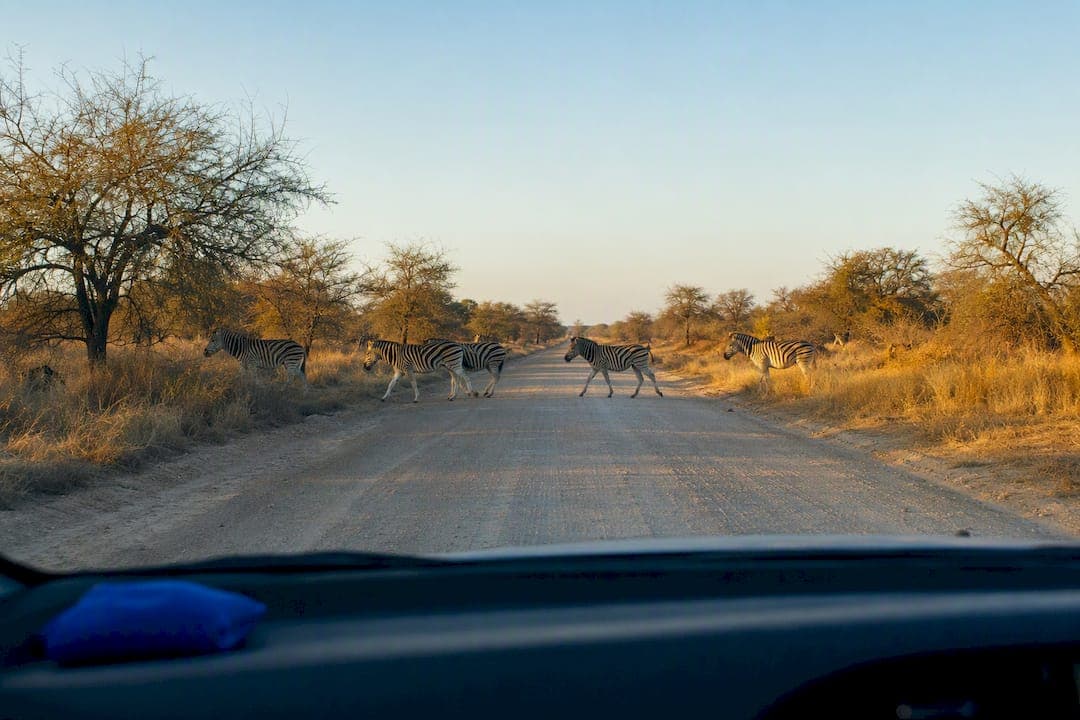
Yes, you can safely and affordably self-drive Kruger National Park if you book SANParks accommodation ahead of time, follow the posted speed and gate rules, and build a route that doesn't overreach. Prioritize three things first: reserve your rest camps before season fills up, confirm gate opening times for your entry point, and plan a route that keeps daily driving under two or three hours so you actually see wildlife instead of just passing through.
TL;DR:
- Stick to speed limits and arrive early at gates to avoid fines and missed sightings, especially on gravel roads where reaction time is critical.
- Prioritize visiting southern or central Kruger for higher wildlife density or predator sightings, and choose camp locations based on your interest and accessibility from your airport.
- Balance trip length to avoid driving fatigue, with two to four days ideal for wildlife watching and minimizing unnecessary travel.
- Use full coverage insurance, pack binoculars, a physical map, and plan fuel stops at camps to ensure safety and convenience onboard.
- Reserve camps ahead of time, purchase day permits at gates if needed, and beware of patchy phone coverage—keep emergency contacts and park rules handy.
Table of Contents
- What Are the Kruger Self-Drive Rules You Can't Ignore?
- Which Gate and Region Should You Choose?
- How Long Should Your Kruger Self-Drive Trip Be?
- What Vehicle, Insurance, and Gear Do You Actually Need?
- How Much Does a Kruger Self-Drive Actually Cost?
- How Do You Book SANParks Accommodation and Day Permits?
- What Does a Good Day of Self-Driving Actually Look Like?
- What Should You Do in a Medical or Vehicle Emergency?
- What Are Kruger's Road Conditions Really Like?
- Will Your Phone Work Inside the Park?
- How Should You Handle Waste and Conservation While Driving?
- Do You Need a Special Permit to Self-Drive Instead of Taking a Guided Tour?
- What's the Honest Case for Adding One Guided Drive?
- Where Can You Verify Kruger Rules and Fees Before You Go?
- Sources
What Are the Kruger Self-Drive Rules You Can't Ignore?
SANParks enforces speed limits on tarred and gravel roads throughout the park, and both limits exist for a reason that has nothing to do with bureaucracy. A kudu or leopard crossing a gravel loop gives you seconds to react, and at 40 km/h you have a fighting chance of stopping in time. At 60, you don't.
Pro Tip: Drop well below the legal limit anyway. Most experienced self-drivers cruise at a slow pace on game-viewing roads, which happens to be the pace at which you actually spot animals rather than just registering a blur of bush.
Gates and camps run on a strict clock tied to sunrise and sunset, and the times shift monthly. Arrive at the gate before it opens and you wait in the car; arrive at camp after it closes and you risk a fine, and in some cases a night spent explaining yourself to a ranger. If you're genuinely delayed by a breakdown or a sighting that ran long, call the camp reception immediately rather than trying to make up time on the road. Speeding to beat a gate closure is how people hit animals.
Beyond speed and timing, the core rules are straightforward:
- Stay inside your vehicle at all times, except at designated picnic sites, camps, and marked viewpoints.
- No off-road driving, ever, even to get a better photo angle on a sighting.
- Display your day permit or entry receipt on the dashboard where a ranger can see it.
- Keep noise down at sightings. Slamming doors and raised voices scatter animals that took you twenty minutes to find.
- No feeding wildlife, no littering, no drones without prior written permission.
Fines for speeding and off-road violations are enforced, and serious or repeat offenses may result in expulsion from the park. None of this is theoretical. SANParks publishes the current rules, gate times, and emergency numbers on its Kruger vital information page, and it's worth bookmarking that page rather than relying on a printout from a previous trip, since gate times change with the seasons.
Which Gate and Region Should You Choose?
Kruger is roughly the size of Israel, and trying to "see the whole park" in one trip is the single biggest mistake self-drivers make. Pick one region, drive it slowly, and you'll see more than someone who covers three times the distance in the same number of days.
Southern Kruger (entered via Malelane, Crocodile Bridge, or Numbi gates, with Skukuza and Lower Sabie as base camps) has the highest wildlife density in the park thanks to the Sabie and Crocodile rivers running through it. This is the right call for first-timers, because the odds of seeing the "Big Five" in a short window are best here. It's also the busiest region, with more vehicles at popular sightings during peak season.
Central Kruger, anchored by Satara camp, opens into wide grassland plains that favor lion and cheetah sightings. Fewer trees mean better sightlines, and the open terrain is why this region has a reputation as predator country. Orpen gate on the western side feeds into this region and tends to be quieter than the southern entries.
Northern Kruger, reached through Phalaborwa or the more remote Punda Maria and Pafuri gates, rewards patience. Fewer vehicles, more solitude, and some of the best elephant viewing in the park along the Letaba and Luvuvhu rivers. If crowded sightings at a southern waterhole sound like the opposite of what you came for, this is your region.
For crowd avoidance specifically, gate and route research consistently points to Phalaborwa and Orpen as the two entries that see meaningfully less traffic than Malelane or Numbi.
Airport logistics matter more than most first-time planners realize. If you're flying into Kruger Mpumalanga International Airport near Nelspruit, you're closest to the southern gates and camps like Skukuza and Lower Sabie, often under an hour's drive. Fly into Eastgate Airport at Hoedspruit instead, and you land right at the doorstep of central Kruger, with Orpen gate a short hop away. Matching your airport to your target region saves you a half-day of driving before your safari has even started.
A few practical anchor points for choosing where to base yourself:
- First safari, limited time, want guaranteed sightings: south, via Malelane or Numbi gate.
- Want predators and open-plains game viewing: central, via Orpen, based at Satara.
- Want fewer vehicles and strong elephant activity: north, via Phalaborwa, based at Letaba or Olifants.
- Flying into Hoedspruit: default to central or north unless you have a strong reason to drive south.
How Long Should Your Kruger Self-Drive Trip Be?
The right itinerary length depends on how much driving you're willing to tolerate versus how many regions you want to sample. Here's what actually works at three common trip lengths.
Two-day weekend trip. Enter through Malelane or Numbi gate and base yourself at Skukuza or Lower Sabie for both nights. Skip the temptation to drive between camps entirely, since with only two days, every hour on the H-road is an hour not spent on a productive loop. Spend both mornings and afternoons on the S-roads around the Sabie River, particularly S28 and S30, which regularly outperform the main tar roads for sightings.
Four-day loop. This is the sweet spot for balancing variety against fatigue.
- Day one: enter south, settle into Lower Sabie, afternoon drive along the river loop.
- Day two: full day exploring southern S-roads, midday rest back at camp between 10am and 3pm when animal activity drops off.
- Day three: drive north to Satara (roughly two to three hours with stops), afternoon on the central plains.
- Day four: morning game drive near Satara before exiting via Orpen or heading back south depending on your flight.
Seven-day trip. Spread across three camps to avoid marathon driving days: two nights in the south (Lower Sabie or Skukuza), two nights central (Satara or Olifants), and three nights north (Letaba and Punda Maria) if you have a genuine interest in elephants and remote terrain. Build in one contingency day with no fixed plan, since a flat tire, a washed-out section of gravel road, or simply a sighting you don't want to leave will eat into your schedule at some point.
Whatever the length, the daily rhythm stays consistent: be at the gate when it opens, drive until the midday heat kills activity, rest at camp through early afternoon, and go out again from roughly 3pm until camp closing. Trip reports consistently back this pattern, with early departures and S-road priority cited repeatedly as the difference between an average day and a genuinely good one.
What Vehicle, Insurance, and Gear Do You Actually Need?
A standard sedan handles Kruger's main routes without complaint. Roughly 1,900 kilometers of road run through the park, and a large share of that network is paved. A 4×4 is not necessary for the tourist roads, and renting one for a standard self-drive trip is usually money spent on capability you'll never use.
That said, an SUV or crossover with a bit more ride height is genuinely worth the upgrade if it's within budget, not for traction but for sightlines. Sitting higher above the grass makes a real difference when you're trying to spot a lion lying flat in tawny scrub fifty meters off the road.
On insurance, get full coverage with the lowest excess you can reasonably afford, and photograph the vehicle thoroughly at pickup. Rental companies in South Africa can be particular about gravel-road damage claims, so confirm before you sign whether your policy covers gravel driving at all. This matters more here than in most rental scenarios, since a large share of Kruger's game-viewing roads are unpaved.
Fuel is available at most major rest camps, so plan to top up at camp rather than running the tank down between fuel stops on remote northern routes.
Before you leave home, pack:
- Binoculars, one pair per person if you can manage it.
- A wide-brimmed hat and reusable water bottles for each traveler.
- A power bank and car charger, since camp plug points can be scarce at peak times.
- A physical park map as backup, along with printed copies of your accommodation reservations and day permits.
- A basic first aid kit and any personal medication clearly labeled.
Pro Tip: Bring a second phone charger you don't mind leaving plugged in the car permanently. Losing charge mid-drive when a sighting develops is the kind of small frustration that ruins an otherwise perfect afternoon.
How Much Does a Kruger Self-Drive Actually Cost?
Daily conservation fees form the backbone of your budget, and they apply per person per day regardless of how long you're inside the gates on any given day. Over a week-long trip split across multiple camps, those fees add up faster than most first-time visitors expect, since you pay for every day you're inside the park, not just travel days.
This is exactly where the SANParks Wild Card earns its keep. Buy the card and you get access to Kruger and a long list of other South African national parks for a full year, and the math tips in your favor once you're spending more than roughly a week total inside SANParks parks in a twelve-month period. A family doing one Kruger trip plus a follow-up visit to another SANParks reserve the same year will often come out ahead with the Wild Card rather than paying daily conservation fees each time.
National Geographic's budgeting breakdown for a self-drive Kruger trip makes the broader point clearly: driving yourself instead of booking a guided safari cuts your overall cost substantially, largely because you're not paying for a private guide, a specialized safari vehicle, and the markup that comes with a fully managed itinerary.
Accommodation inside rest camps runs in clear bands. Camping sites are the cheapest option by a wide margin, basic bungalows with shared facilities sit in the middle, and thatched-roof safari huts or family cottages with private bathrooms and kitchenettes sit at the top. Fuel costs scale with your route length, and a four-day loop covering south to central Kruger typically burns noticeably less fuel than a full north-to-south crossing.
Budget for a few common extras beyond the basics:
- One guided sunrise or sunset drive per camp stay, which SANParks camps sell directly at reception.
- Optional activities like bush walks or night drives, priced separately from accommodation.
- Late return fines if you misjudge gate closing time, which are avoidable with basic planning.
How Do You Book SANParks Accommodation and Day Permits?
Book through the SANParks reservations system directly, and do it early. Popular camps like Skukuza and Lower Sabie fill up months ahead of South African school holidays and the June to September dry season, when animal viewing peaks.
- Decide your region and rough dates, then check availability for two or three camp options rather than fixating on one, since flexibility on camp choice dramatically increases your odds of getting the dates you want.
- Book overnight rest camp accommodation through the official reservation portal, paying the conservation fee as part of the booking rather than at the gate.
- If you're only entering for a single day without an overnight stay, buy a day-visitor permit at the gate itself, which covers conservation fees for that day only and doesn't require advance booking the way overnight camp stays do.
- Stagger your nights across camps rather than booking one camp for your whole trip if you're covering more than one region, so you're never driving more than two to three hours between overnight stops.
- Consider a private lodge just outside the park boundary for one or two nights if SANParks camps are full on your dates. Many border the park directly and let you integrate a lodge stay into an otherwise self-driven itinerary without breaking your route.
Cancellation policies and lead times shift seasonally, so confirm current terms directly on the SANParks site before you commit dates.
What Does a Good Day of Self-Driving Actually Look Like?
Be at the gate the moment it opens. The first ninety minutes after sunrise are consistently the most productive window of the day, since predators are still active and herbivores are moving to feed before the heat sets in.
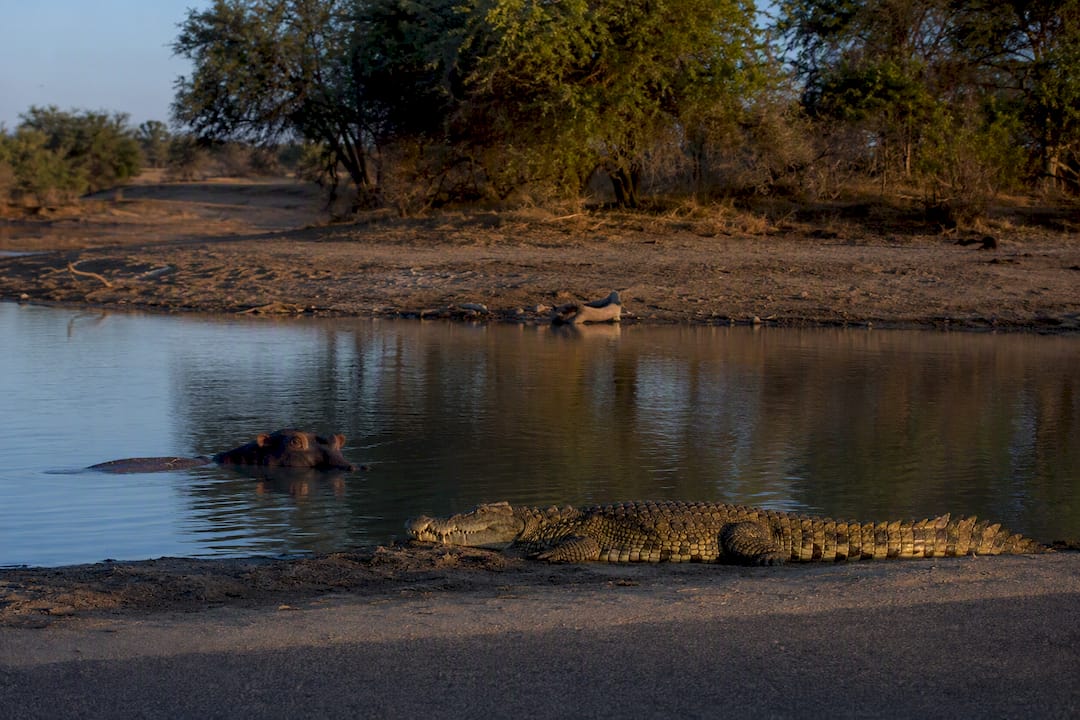
Scan waterholes methodically rather than driving past them at speed, since a still surface can hide a submerged hippo or a crocodile that's easy to miss at a glance. Fresh tracks and dung on gravel roads are a genuine signal, not a curiosity, since they tell you an animal passed recently and may still be close.
Midday, roughly 10am to 3pm, is when most animals rest in shade and activity drops sharply. Use that window to rest at camp rather than burning fuel and patience on quiet roads. Head back out from mid-afternoon until close to gate time, when temperatures drop and animals move again.
At any sighting, hang back rather than crowding the vehicle ahead of you, keep your voice down, and never block the road for other vehicles trying to pass or view. If you're running late and won't make it back to camp before closing, call reception right away and follow whatever guidance the ranger on duty gives you rather than guessing.
What Should You Do in a Medical or Vehicle Emergency?
Every SANParks rest camp has a reception desk staffed around the clock, and that's your first call for almost any problem, from a flat tire to a medical concern. Camp staff carry direct radio contact with rangers and can dispatch help faster than you'd manage trying to navigate to a hospital yourself.
For genuine medical emergencies, Kruger has clinics at several of the larger camps, including Skukuza, which has the most complete medical facility in the park and can stabilize serious cases before onward transfer. Skukuza also has its own small airport, which matters for emergency evacuations in remote sections of the park where road transfer would take hours.
Keep your camp's reception number saved in your phone before you leave the gate each morning, along with the general SANParks emergency contact listed on the park's vital information page. If you break down on a remote road with no cell signal, stay with your vehicle rather than walking. Another vehicle will pass eventually on any maintained tourist road, and a car is a far safer place to wait than open ground.
Report any wildlife-related incident, however minor, to the nearest gate or camp immediately. Rangers need to know about aggressive animal behavior on a specific road segment so they can flag it for other drivers that same day.
What Are Kruger's Road Conditions Really Like?
Kruger's main H-roads are tarred and well maintained, and you can drive them comfortably in any standard sedan. The gravel S-roads are a different story. Surface quality varies a lot depending on recent rain and how recently a grader passed through, and washboard corrugation on some stretches can be uncomfortable at anything above a crawl.
After heavy rain, low-lying sections of certain S-roads can flood or turn genuinely slick, and SANParks occasionally closes specific roads until conditions improve. Camp reception and gate staff know current closures, so ask before committing to a particular loop, especially in the wet season between November and March.
Higher ground clearance helps more than four-wheel drive on these roads, since the concern is usually a scrape on a rutted section rather than getting properly stuck. Drive slower on gravel than you think you need to, both for the 40 km/h limit and because a loose stone kicked up at speed can crack a windshield.
Watch for sudden dips, blind rises, and animals resting directly on warm tarmac in the early morning, particularly in winter when the road surface holds heat longer than the surrounding bush.
Will Your Phone Work Inside the Park?
Cell coverage inside Kruger is patchy and inconsistent, and that's worth planning around rather than treating as a minor inconvenience. Major rest camps like Skukuza, Satara, and Lower Sabie generally have decent signal, often enough for calls and basic data. Between camps, especially on remote roads in the north, expect long stretches with no signal at all.
Don't rely on your phone's GPS or mapping app as your only navigation tool. Buy or borrow a physical Kruger road map, available at every gate and camp shop, and keep it in the car as backup. It has saved more than a few self-drivers who assumed their phone would guide them and found themselves with a dead data connection at a road junction with no signage.
If you're traveling with someone outside the park who expects check-ins, tell them in advance that gaps in contact are normal and not a sign anything's wrong. This also matters for the emergency contact numbers mentioned earlier, since dialing out may simply fail depending on where you are when something goes wrong.
How Should You Handle Waste and Conservation While Driving?
Everything you bring into Kruger, you bring back out or dispose of at a designated bin, full stop. There is no roadside disposal anywhere in the park, and littering carries a real fine, not just a disapproving look from a ranger.
Keep a dedicated bag in the car for trash, and empty it only at bins provided at camps and picnic sites. Food scraps count as litter too, even the seemingly harmless kind like fruit peels, since they can attract animals to roadsides and alter natural feeding behavior in ways that create problems down the line.
Never feed animals, even ones that approach the vehicle looking for it. Habituating wildlife to human food is one of the fastest ways to turn a memorable encounter into a genuine danger for the next visitor who rolls down a window near that same animal.
Stick to marked roads at all times. Off-road driving damages vegetation that takes years to recover and disturbs ground-nesting birds and small mammals in ways that aren't obvious from the driver's seat. The rule exists as much for conservation as for your own safety around unpredictable terrain.
Do You Need a Special Permit to Self-Drive Instead of Taking a Guided Tour?
Self-drive visitors need only the standard day-visitor permit or overnight conservation fee that every guest pays, whether self-driving or on a guided tour. There's no separate or additional permit required specifically for driving yourself, which surprises some first-time visitors expecting extra paperwork.
Day permits are purchased at whichever gate you enter through, on the day itself, and cover conservation fees for that single day of park access. Overnight guests pay their conservation fee as part of the SANParks accommodation booking rather than separately at the gate, which is one reason booking ahead online is worth the extra step over just showing up.
Guided tours booked through a tour operator or your rest camp's own activity desk are priced and permitted separately from general park entry, since you're paying for the guide, the specialized vehicle, and often access to areas closed to self-drive tourist roads. You don't need any special self-drive credential or license beyond a valid driver's license recognized in South Africa, and a permit displayed on your dashboard as instructed at the gate.
What's the Honest Case for Adding One Guided Drive?
Self-driving Kruger gets you most of the way there, but rangers on guided drives have radio networks and trained eyes that consistently spot predators self-drivers miss entirely. Booking one sunrise or sunset drive through a platform like Im-at fills that specific gap without sacrificing the freedom of driving yourself the rest of the trip. Im-at also lists multi-night Kruger packages, including a 6-night, 5-day safari, for readers who want a fuller supported experience alongside their own driving days.
— Mikahil
Where Can You Verify Kruger Rules and Fees Before You Go?
Check SANParks vital information for current gate times and speed limits, SANParks reservations for camp bookings and Wild Card details, and consult park maps at any gate for camp-specific facilities.
If you decide a self-drive trip works better with one bespoke supplement rather than a full guided package, Im-at's tailor-made 4x4 tour listing lets you add a specialized vehicle and guide for a single day without restructuring the rest of your itinerary. For general self-drive logistics beyond Kruger, MyVan Rentals' guide to independent touring covers vehicle and scheduling considerations that apply well beyond South Africa's parks.
Sources
- SANParks — Kruger useful information / vital information
- National Geographic — Self-drive budget safari in Kruger (2023)
- KrugerGuide — Self-drive Kruger National Park guide