

You need accredited training, a valid first-aid certificate, and registration with your Provincial Registrar to guide legally for reward in South Africa. The official registration fee is R240, and the certificate stays valid for three years. If you already have training, your next move is booking a first-aid course; if you don't, start by enrolling with a CATHSSETA or SAQA-accredited provider.
TL;DR:
- Registration is valid for three years and costs R240, but applicants must also budget for training, first-aid certification, photos, and document certification costs.
- Guides can only operate within their registered scope, with site guides limited to one location, provincial guides to one province, and national guides allowed across all nine provinces.
- Passing a competency-based assessment, including practical guiding demonstrations, is required, with re-assessment options available if you do not pass initially.
- Practical experience during training, such as leading tours under supervision, is essential before registration and continues to benefit guides' careers afterward.
- Building reputation through online platforms like Im-at helps new guides secure bookings and grow their niche skills for better earning potential.
Table of Contents
- Who Needs a Tour Guide License in South Africa?
- What Training and Qualifications Does the Law Require?
- What Documents and Fees Do You Need to Submit?
- How Do You Register With the Provincial Registrar?
- Site, Provincial, and National Guide: What's the Difference?
- What Does a Career as a Registered Guide Actually Pay?
- What Happens After You're Registered?
- What Does the Accredited Training Syllabus Actually Cover?
- How Does the Exam Work, and What Do You Need to Pass?
- Do You Need Practical Experience Before You Can Register?
- What Can Each License Category Actually Do, and What Can't It Do?
- What Happens If You Break the Rules?
- What Career Opportunities Open Up Once You're Licensed?
- Getting Your First Bookings as a New Guide
- List Your Tours on Im-at Once You're Registered
- Sources
- FAQ
Who Needs a Tour Guide License in South Africa?
Anyone who guides "for reward" or represents themselves as a tourist guide falls under the registration requirement, whether that's a paid weekend job or a full-time career. Reward doesn't just mean a salary. It covers tips, day rates, referral fees, and even in-kind payment like accommodation swaps for showing tourists around.
The Tourism Act No. 3 of 2014 makes this mandatory, not optional, and for good reason. Guiding puts you in charge of visitor safety in unfamiliar terrain, cultural sites, and sometimes wildlife areas, so the law wants a paper trail proving you're competent and accountable.
Basic eligibility rules to check before you spend a rand on training:
- You must be a South African citizen or hold a valid work permit that legally allows you to earn income in the country.
- Certain criminal convictions, particularly those involving violence, dishonesty, or offenses against tourists, can disqualify an applicant under the Act.
- You cannot claim to be a registered guide, or advertise guiding services, without an actual registration number.
- Foreign nationals working without the correct permit risk both the application being rejected and separate immigration penalties.
If you're unsure whether a past conviction affects your eligibility, it's worth contacting your Provincial Registrar directly before committing to a training course.
What Training and Qualifications Does the Law Require?
You need one of two things: a certificate from a CATHSSETA-accredited provider or a qualification recognized by SAQA. CATHSSETA is the sector education and training authority for tourism, hospitality, and sport, and it accredits the assessors and training bodies that issue guide qualifications. SAQA, the South African Qualifications Authority, maintains the national framework those qualifications sit inside.
In practice, the National Qualifications Framework (NQF) level tied to your course tends to map to the category of guiding you can pursue. Lower NQF levels generally align with site-specific guiding, while higher levels support provincial and national registration, though the exact unit standards vary by provider.
Before enrolling, confirm your provider's accreditation number (often called a C-number) and cross-check it against CATHSSETA's public provider list. Don't take a glossy brochure at face value.
Pro Tip: Keep both digital and certified paper copies of your CATHSSETA number and assessor proof. If your certificate is delayed, some registrars will accept a screenshot with the C-number as a temporary stand-in while the physical document catches up.
Two more things to lock down before you apply:
- A valid first-aid certificate, typically a Level 1 or 2 course from an accredited provider, is a non-negotiable part of the application.
- The sector is mid-transition from CATHSSETA to the Quality Council for Trades and Occupations (QCTO), which means learners already in a CATHSSETA pathway should aim to finish before their program is phased out.
What Documents and Fees Do You Need to Submit?
Here's the exact paperwork the Provincial Registrar will ask for:
- Certified copies of your South African ID, passport, or valid work permit.
- Your CATHSSETA certificate, SAQA-recognized qualification proof, or assessor letter of competence.
- A valid first-aid certificate from an accredited provider.
- The completed provincial application form, plus a signed Code of Conduct.
- Four recent passport-style photographs.
- Proof of payment for the R240 registration fee.
The R240 fee is only the visible cost. Course fees, a first-aid certificate, travel to the registrar's office, photographs, and certified copies all add up before you've earned a cent. Independent guides also need to budget for public liability insurance and, once income starts flowing, tax registration with SARS.
Registration is valid for three years, and renewal requires the same fee plus proof you still meet the conditions, current first-aid certification included.
How Do You Register With the Provincial Registrar?
Registration happens at provincial level, not nationally, so you apply through the registrar in the province where you intend to work.
- Finish accredited training first. You need your CATHSSETA certificate or SAQA qualification proof in hand, or a formal letter of competence from your assessor, before the registrar will process anything else.
- Assemble your certified documents. Certify copies of your ID or work permit at a police station or commissioner of oaths, gather your four photos, and sign the Code of Conduct that comes with the application form.
- Submit the application and pay. Some provinces, Western Cape included, offer online eServices for this step; others require an in-person or postal submission. Pay the R240 fee and keep your proof of payment.
Once submitted, the registrar reviews the file, issues a registration certificate, a badge you must display while guiding, and a unique tourist guide number. Processing times vary by province and season, and incomplete files get bounced back with a request for whatever's missing, which is the most common reason applications stall.
Pro Tip: Apply in the off-season if you can. Registrars process higher volumes just before peak tourist months, and a file submitted in October often clears faster than one submitted in November.
Site, Provincial, and National Guide: What's the Difference?
Your registration category determines where you're legally allowed to work, and it's not a technicality; guiding outside your registered scope is a compliance breach.
- Site guides are registered to work at a single specific location, like a museum, garden, or historic building, and can't legally guide tourists elsewhere.
- Provincial guides can operate anywhere within their registered province, covering multiple towns, reserves, and attractions.
- National guides can work across all nine provinces, typically after additional assessment and broader geographic knowledge requirements.
Guides often add specializations, nature, culture, or adventure activities like hiking and diving, each tied to its own unit standards. Upgrading from site to provincial, or adding a new province to an existing registration, usually means passing an additional assessment rather than restarting the whole process.
What Does a Career as a Registered Guide Actually Pay?
There's no single number to give you here. Earnings vary enormously by employment model, experience, and season, and pretending otherwise does new guides a disservice.
- Employed guides working for a tour operator typically earn a base salary plus tips, with more predictable income but less schedule control.
- Contractor and freelance guides charge day rates and rely more heavily on gratuities, which means income swings hard between peak season (roughly November through February in most regions) and the quieter winter months.
- Overheads eat into margins fast: marketing, transport, equipment, public liability insurance, and tax compliance are all costs a salaried guide rarely thinks about but a freelancer must.
- Specialization pays. Guides who add niche skills, birding, geology, battlefield history, adventure certifications, tend to command higher day rates than generalists.
- Listing on multiple channels, including marketplaces like Im-at, helps freelance guides smooth out seasonal gaps by reaching travelers who wouldn't otherwise find them.
If you've watched what a Cape Point guide actually handles on a single tour, from route planning to safety briefings, it's clear the day rate reflects real responsibility, not just a walk in the park.
What Happens After You're Registered?
Your badge and registration card need to be visible whenever you're working. That's not a suggestion; provincial officials and tourism inspectors do check.
Renewal comes around every three years, with the same fee and updated first-aid proof required. Complaints against guides get lodged directly with the Provincial Registrar, and outcomes range from a formal warning to suspension or revocation of your registration, depending on severity. You're also required to notify the registrar if your circumstances change, a new specialization, a change in work-permit status, or a change of province.
What Does the Accredited Training Syllabus Actually Cover?
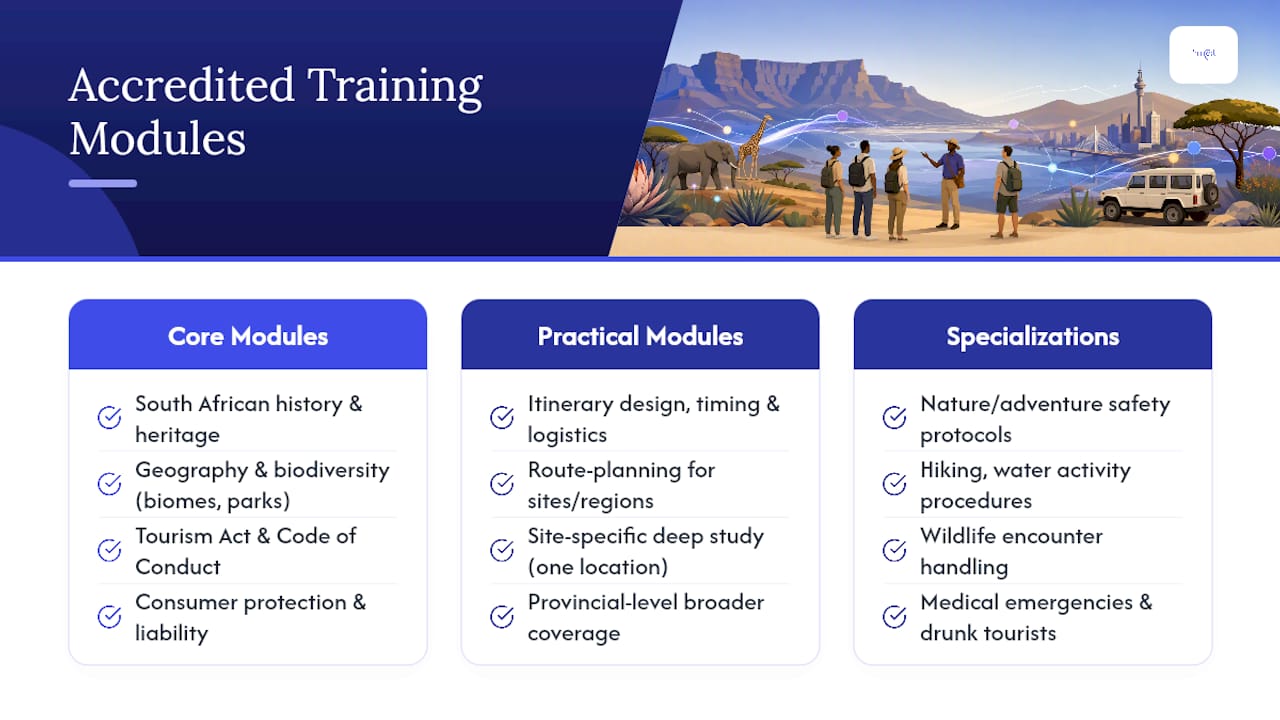
CATHSSETA-aligned courses build around unit standards, not a single fixed textbook, so content varies somewhat by provider and category. That said, most programs share a common backbone.
Expect modules on South African history and heritage sites, covering everything from precolonial history through apartheid-era landmarks to post-1994 developments, since guides are frequently asked pointed questions on this ground. Geography and biodiversity training covers biomes, national parks, and the country's status as a megadiverse nation, particularly relevant for nature and adventure specializations.
Legal and regulatory modules walk through the Tourism Act itself, the Code of Conduct, consumer protection basics, and liability considerations, so you understand your obligations before you're standing in front of a bus load of tourists. Communication and interpretation training focuses on storytelling technique, group management, and handling difficult situations, drunk tourists, medical emergencies, hostile wildlife encounters, calmly and correctly.
Practical route-planning modules teach itinerary design, timing, and logistics for the specific sites or regions you're training toward. Courses aimed at site-specific registration go deep on one location's history and layout; provincial-level courses cover a much wider geographic and cultural spread.
First aid is typically bundled or run alongside the main course rather than folded into it, since it needs its own separate certificate from an accredited first-aid provider. Programs preparing candidates for adventure specializations may add safety protocols specific to hiking, water activities, or wildlife areas.
How Does the Exam Work, and What Do You Need to Pass?
Assessment for guide qualifications runs on a competency-based model rather than a single high-stakes written exam. That means you're evaluated against specific unit standards through a mix of methods rather than one pass-or-fail test.
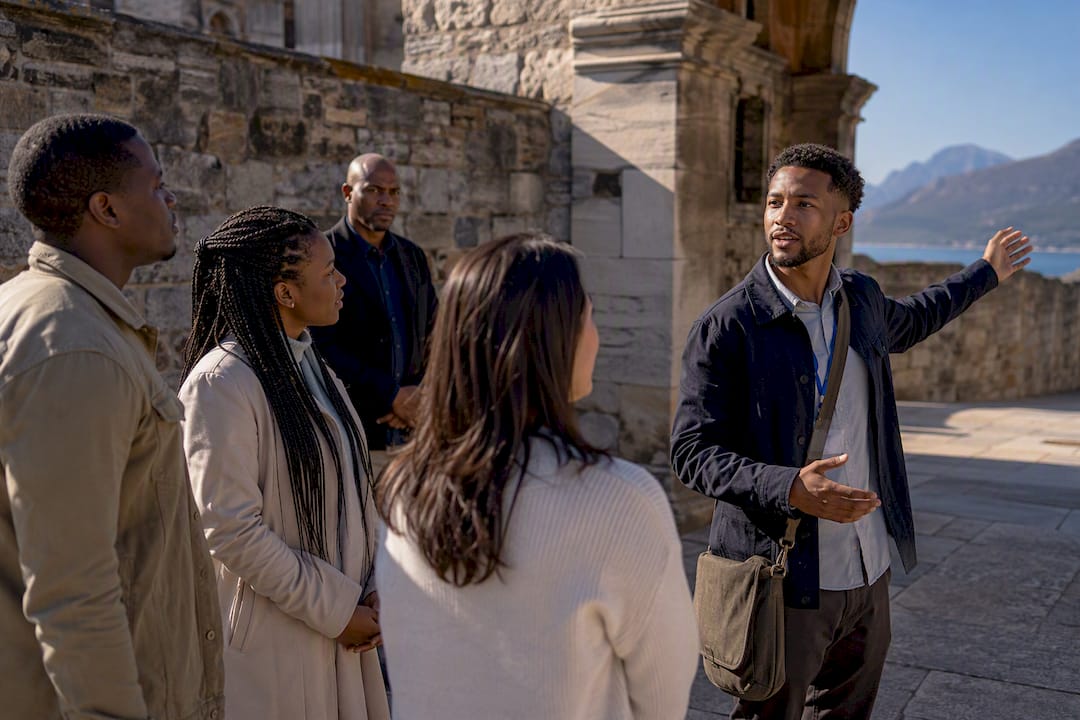
Written assessments typically test knowledge of history, geography, legislation, and site-specific facts relevant to your category. Practical assessments are where most candidates feel the real pressure: you're often required to deliver an actual guided presentation, at a real or simulated site, in front of an assessor who scores your content accuracy, group handling, timing, and professionalism.
Portfolio-based evidence sometimes supplements or replaces additional written testing, particularly for experienced candidates applying through a recognition-of-prior-learning route. Passing criteria are set against the specific unit standards CATHSSETA or your qualification's SAQA framework define, rather than a universal percentage cutoff, so ask your training provider directly what their pass benchmark looks like.
If you don't pass on the first attempt, most accredited providers allow a resubmission or reassessment, sometimes at an additional cost. It's worth confirming a provider's reassessment policy before you enroll, not after you've failed a module.
Do You Need Practical Experience Before You Can Register?
Formal internship requirements aren't universally mandated the way, say, articles are for accountants, but practical exposure is baked into most accredited programs rather than left optional. Assessors generally require you to demonstrate real guiding competence, not just theoretical knowledge, before signing off on your certificate.
That usually shows up as supervised guiding practice during training, where you lead a mock or real tour group under an assessor's observation. Some providers structure this as a mentorship period with an already-registered guide, giving new candidates a chance to shadow real tours before being assessed solo.
For site-specific guiding, practical experience often means logging actual time at the location, learning its layout, its collection or history, and the questions visitors typically ask. For provincial and national categories, the practical component tends to widen to cover multiple sites and longer, more complex itineraries.
Even once you're registered, treating your first year as an extended learning period pays off. Guides who actively seek feedback, track which parts of their commentary land well and which fall flat, and deliberately widen their site knowledge tend to build stronger reputations and repeat bookings faster than those who coast on the bare minimum certificate.
What Can Each License Category Actually Do, and What Can't It Do?
Your registration category isn't just a label; it's a hard legal boundary on where and how you can work.
A site guide's authorization stops at the property line of their registered location. Guiding tourists at a neighboring attraction, even one just down the road, falls outside that registration and can trigger the same penalties as guiding with no registration at all.
Provincial guides can move freely across every town, reserve, and site inside their registered province but can't legally guide across a provincial border without either a national registration or an additional provincial add-on. National guides have the broadest scope, covering all nine provinces, but that breadth doesn't automatically include specialized activities; a national guide without adventure-specific training still can't legally lead a certified hiking or diving excursion.
Specializations layer on top of geographic scope, not instead of it. A nature guide certification doesn't authorize cultural site interpretation at a heritage building, and vice versa, unless the specific unit standards for that specialization were part of your training. This is where a lot of new guides get caught out: they assume a broad registration covers everything, when in practice the Code of Conduct and the Act tie your legal scope tightly to what your certificate actually says.
What Happens If You Break the Rules?
Breaches of the Code of Conduct or the Tourism Act's provisions get reported directly to the Provincial Registrar, and the disciplinary process that follows is proportionate to the severity of the complaint.
Minor infractions, an expired badge display, a paperwork lapse, might result in a formal warning and a deadline to correct the issue. More serious breaches, guiding outside your registered scope, fraud, misrepresenting your qualifications, or conduct that endangers tourists, can lead to suspension or full revocation of your registration.
Guiding for reward without any registration at all is its own separate offense under the Act, distinct from a registered guide who breaches conduct rules. Both outcomes carry real consequences: loss of your legal right to earn as a guide, and in serious cases, the matter can escalate beyond an administrative penalty.
The practical lesson here is simple. Renew on time, keep your first-aid certificate current, stay inside your registered category's scope, and treat the badge requirement as non-negotiable. Most disciplinary cases trace back to guides who let a small administrative detail slide until it became a bigger problem.
What Career Opportunities Open Up Once You're Licensed?
A registration certificate is the entry ticket, but what you build on top of it determines whether guiding becomes a sustainable career or a side hustle.
Employed positions with established tour operators, lodges, and heritage sites offer steady income and built-in bookings, particularly attractive for guides just starting out who want experience before going independent. Freelance and contractor work offers more control over rates and schedule but demands the marketing and admin muscle to keep a booking pipeline full year-round.
Specialization is where the real income ceiling lifts. Guides who layer in birding expertise, battlefield history, wine-region knowledge, or adventure certifications tend to command premium day rates that generalist guiding simply doesn't reach, and continuous professional development is what separates guides who plateau from guides who keep climbing.
National registration opens the door to working with international tour operators who need guides comfortable moving across multiple provinces on a single multi-week itinerary, often the most lucrative segment of the industry. Beyond direct guiding, registered guides sometimes move into training, assessing, or tourism-board roles once they've built enough field experience and reputation. The certificate gets you in the door; reputation, niche skills, and how visible you make yourself to travelers determine how far the career actually goes.
Getting Your First Bookings as a New Guide
Before you chase your first client, get five things sorted: your registration certificate and badge, your first-aid card, four clean photos, a one-paragraph description of what you offer, and a sample itinerary. A listing on a platform like Im-at can help a newly registered guide land early bookings and start building the reviews that make the next booking easier.
— Mikahil
List Your Tours on Im-at Once You're Registered
Getting registered solves the legal side. Getting booked is a different problem, and it's the one most new guides underestimate. Online marketplaces are the practical next step after registration: places where travelers searching for guided tours, cultural walks, and outdoor experiences can find your listing without you having to build a website or chase social media algorithms first.

Setting up a listing takes a fraction of the time a full booking site would. You'll want your registration number, a clear description of the experience, honest pricing, and a few solid photos ready to go, the same basics you'd have prepared for your Provincial Registrar application. For a new guide, a strong first listing tends to be something tightly scoped: a half-day themed walk, a single-site deep dive, or a short cultural excursion that's easy for a first-time visitor to say yes to. Categories on the platform range from guided tours and cultural experiences to outdoor adventures and workshops, so there's room to list beyond a single tour type as your registration and specializations grow. Listings are free to create, with optional paid promotion for guides who want more visibility. Head to Im-at to set up your first listing and put your new registration number in front of travelers who are actively booking.
Sources
- Registration Requirements | Tourism Knowledge Portal
- Tourism Act No. 3 of 2014 (government publication)
- Registration as a Tourist Guide (Western Cape)
- Tour guide salaries — Indeed South Africa
- Registration Requirements | Tourism Knowledge Portal (detailed)
FAQ
What Qualifications Do I Need to Be a Tour Guide?
You need a certificate from a CATHSSETA-accredited provider or a SAQA-recognized qualification, plus a valid first-aid certificate. South African citizenship or a valid work permit is also required before you can register with your Provincial Registrar.
How Much Is a Tour Guide Certificate?
The official government registration fee is R240, valid for three years before renewal. That figure doesn't include your training course fees, first-aid certification, photos, or certified document copies, which add real cost on top of the registration fee itself.
How Much Is a Tour Guide Paid in South Africa?
There's no fixed national salary; pay varies by employment model, specialization, and season. Employed guides typically get a base rate plus tips, while freelance guides work off day rates and gratuities that swing significantly between peak and off-peak months.
How Long Does It Take to Become a Tour Guide?
Timeline depends heavily on the course and category you choose, with site-specific training generally faster than provincial or national programs. Add time for first-aid certification and the Provincial Registrar's processing period, which varies by province and season.