

TL;DR:
- Booking portals, or OTAs, dominate travel bookings by aggregating millions of listings and influencing destination popularity. Their commercial algorithms often prioritize higher-commission properties, affecting search results and loyalty rewards, while enabling quick comparison and verification of reviews. Future trends show AI will reinforce OTA centrality, emphasizing the importance of critical research and direct bookings for travelers seeking value.
Booking portals are online platforms that aggregate, compare, and enable the purchase of travel services including flights, hotels, and experiences from a single interface. Known in the industry as online travel agencies (OTAs), platforms like Booking.com, Expedia, and Airbnb have fundamentally changed how travelers plan and book trips. OTAs control over 50% of all online hotel bookings, making them the dominant gateway between travelers and suppliers worldwide. The role of booking portals in travel now extends far beyond simple reservations. They shape destination popularity, influence pricing, and determine which properties get seen at all.
How do booking portals work to simplify travel planning?
Booking portals operate as two-sided marketplaces. On one side, suppliers including airlines, hotels, tour operators, and activity providers list their inventory. On the other, travelers search, compare, and book. The platform sits in the middle, earning a commission on each completed transaction.

The scale of this inventory is staggering. Over 31 million unique accommodation listings are accessible through the largest OTAs, a number no single hotel chain or tour operator could match independently. That breadth is the core value proposition for travelers who want to compare options quickly without visiting dozens of separate websites.
Search results on these platforms are not purely ranked by quality or relevance. OTA search rankings favor hotels paying higher commissions or participating in promotional programs. A boutique lodge with exceptional reviews may appear below a chain hotel that bids more aggressively for placement. Knowing this changes how you should read any results page.
Most major OTAs also act as the merchant of record, meaning they process your payment and own the transaction data. Acting as merchant of record gives OTAs access to consumer browsing and purchase behavior, which they use to refine algorithms, personalize recommendations, and strengthen advertiser relationships. The traveler gets convenience; the platform gets data.
Key features that make booking portals genuinely useful for trip planning include:
- Price comparison tools that surface rates across multiple suppliers in seconds
- Verified guest reviews from past travelers that help calibrate expectations
- Flexible filters for budget, location, amenity, and cancellation policy
- Bundled booking options combining flights, hotels, and car rentals for potential savings
- Instant confirmation with digital itineraries sent directly to your inbox
Pro Tip: Before booking, open the same property on two or three different portals. Rates and cancellation terms can differ significantly for the same room on the same night, and a few minutes of comparison can save real money.
What are the advantages and limitations of booking portals for travelers?
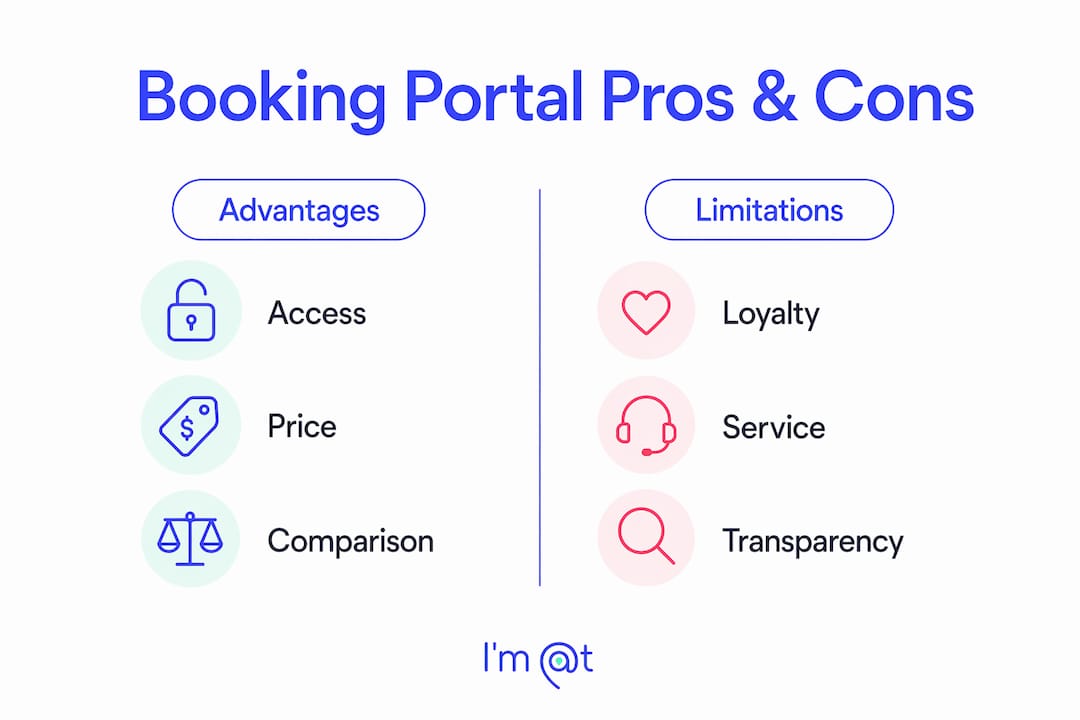
The clearest advantage of using an OTA is access. You can compare hundreds of properties in a single city, read thousands of reviews, and book in minutes without making a single phone call. For travelers planning a complex itinerary across multiple countries, that efficiency is genuinely hard to replicate through direct channels.
Price transparency is another real benefit. Portals surface rates you might never find by visiting individual hotel websites, particularly for independent properties that lack sophisticated direct booking infrastructure. For adventure travelers looking at remote lodges or niche tour operators, OTAs often provide the only practical discovery mechanism.
The limitations are equally real and worth understanding before you commit. OTA bookings generally do not earn hotel loyalty points or elite status credits. If you stay at a Marriott property booked through Expedia, you will not receive Bonvoy points for that stay. For frequent travelers, that gap compounds quickly across a year of trips.
Customer service is another friction point. When something goes wrong, your first call goes to the OTA, not the hotel. The OTA then contacts the property, which adds time and removes the direct relationship that often resolves problems fastest. Hotels also tend to prioritize guests who booked directly when allocating room upgrades or handling complaints.
| Factor | Booking via OTA | Booking direct |
|---|---|---|
| Price comparison | Broad, instant comparison across suppliers | Limited to one property's rates |
| Loyalty rewards | Typically not awarded | Full points and elite credit earned |
| Customer service | Mediated through the platform | Direct access to the property |
| Cancellation flexibility | Varies by platform policy | Often more flexible with direct contact |
| Exclusive perks | Rare | Common (upgrades, breakfast, late checkout) |
Pro Tip: Use an OTA to research and compare, then check the hotel's own website before booking. Many properties offer a best rate guarantee plus perks like free breakfast or room upgrades that the portal simply cannot match.
How do booking portals influence the travel industry worldwide?
The impact of online travel agencies on the broader tourism industry is profound and not always visible to the traveler making a booking. Booking.com alone holds a 65% market share in European hotel bookings, which means a single private company effectively controls the distribution pipeline for a majority of European hotel stays. That concentration gives OTAs enormous leverage over pricing, visibility, and ultimately which properties survive.
For independent hotels and small tour operators, the relationship with OTAs is both necessary and costly. Independent properties rely on OTA marketing infrastructure to reach international travelers they could never access through their own channels. A family-run guesthouse in Oaxaca or a safari camp in Botswana gains global visibility through a portal that would otherwise require years of marketing investment to build. The commission, typically 15 to 25 percent per booking, is the price of that access.
Platform algorithms also shape where travelers go, not just where they stay. OTA algorithms contribute to overcrowding in destinations like Barcelona and Bali by consistently surfacing them in search results, reinforcing their popularity in a self-amplifying loop. Lesser-known destinations with equally compelling offerings receive far less algorithmic attention, which means travelers often cluster in the same places year after year.
| OTA impact area | Effect on industry |
|---|---|
| Commission model | 15 to 25% per booking reduces hotel profitability |
| Algorithm-driven visibility | Amplifies popular destinations, marginalizes emerging ones |
| Data ownership | OTAs retain consumer data, limiting supplier insight |
| Independent property access | Global reach for small operators who lack marketing budgets |
| Direct booking pressure | Hotels increasingly incentivize guests to bypass portals |
Hotels have responded by pushing direct booking incentives aggressively, offering perks, price matching, and loyalty rewards to recapture guests from OTA channels. This hybrid distribution model, where properties maintain OTA presence for discovery while converting loyal guests to direct bookings, is now standard practice across the hospitality industry. Understanding this dynamic helps you as a traveler extract maximum value from both channels.
What future trends are shaping booking portals in travel?
The most significant near-term shift involves artificial intelligence. AI travel planning tools like those integrated into Google, ChatGPT, and emerging travel-specific agents are changing how travelers discover options. The critical finding from Morgan Stanley's 2025 research is that AI tools currently route users back to OTAs to complete transactions rather than processing bookings independently. This means OTAs retain their central role even as the discovery layer changes.
The reason is straightforward. Assuming merchant of record responsibilities requires payment infrastructure, fraud protection, dispute resolution, and regulatory compliance across dozens of markets. AI platforms are not built for that. OTAs remain vital intermediaries because their data advantage and transaction infrastructure are genuinely difficult to replicate, regardless of how sophisticated the AI layer above them becomes.
Other trends reshaping how booking portals change travel include:
- Mobile-first booking now accounts for the majority of OTA transactions, pushing platforms to optimize for one-tap checkout and app-based itinerary management
- Experience-led travel is driving growth in activity and tour bookings, with platforms expanding beyond hotels and flights into guided tours, cultural experiences, and outdoor adventures
- Personalization engines are using past booking data to surface relevant options faster, reducing the time between inspiration and confirmed booking
- Sustainability filters are appearing on major platforms, allowing travelers to sort by eco-certified properties or low-carbon transport options
- Dynamic pricing transparency tools are emerging, helping travelers identify the best time to book based on historical rate data for specific routes and properties
For travelers, the practical implication is clear. Portals will get smarter at predicting what you want, but the commercial incentives shaping their results will not disappear. Learning to read a results page critically, as explored in digital travel guides for 2026, remains a skill worth developing regardless of how AI reshapes the front end.
Key takeaways
Booking portals are the dominant infrastructure of modern travel, and using them well requires understanding both their power and their commercial logic.
| Point | Details |
|---|---|
| OTA market dominance | OTAs control over 50% of online hotel bookings, making them unavoidable for most travelers. |
| Search results are commercial | Rankings favor higher-commission properties, not necessarily the best options for you. |
| Loyalty rewards gap | Booking through an OTA typically means forfeiting hotel loyalty points and elite status. |
| Independent properties depend on OTAs | Small operators gain global reach through portals they could not build independently. |
| AI reinforces OTA dominance | Current AI travel tools route bookings back to OTAs, preserving their central role. |
Why I think most travelers use booking portals wrong
Most people treat OTAs as the final word on price and availability. They search, they sort by "recommended," and they book whatever appears at the top. That approach hands the algorithm exactly what it wants and often leaves real value on the table.
The smarter move is to treat portals as research tools first. Use Booking.com or Expedia to map the competitive set, read reviews across multiple platforms, and identify two or three properties that genuinely fit your needs. Then go directly to those properties. You will often find a better rate, a room upgrade, or at minimum a direct line to someone who can actually help if something goes wrong.
I have also found that the benefits of joining travel platforms extend well beyond hotels. Activity and experience portals, particularly those focused on adventure travel, often surface operators you would never find through a general OTA search. A guided hike, a local food tour, or a 4x4 safari booked through a specialized platform frequently delivers a more authentic experience than anything surfaced by an algorithm optimized for volume.
The travelers who get the most from booking portals are the ones who understand that the platform is not neutral. It has commercial interests, and those interests do not always align with yours. Use the tools, but stay critical.
— Mikahil
Discover your next adventure with Im-at
Im-at connects you directly with the experiences that make travel worth it. Whether you are planning a weekend escape or a full expedition, the platform puts guided tours, cultural excursions, and outdoor adventures within reach in minutes. Browse tailor-made 4x4 tours built for off-road adventure seekers, or explore Table Mountain hiking treks with expert local guides. Im-at functions as both a search engine and booking portal for experiences, so you spend less time planning and more time actually doing. Find your next adventure at im-at.com.
FAQ
What is the role of booking portals in travel?
Booking portals, also called OTAs, aggregate travel inventory from airlines, hotels, and experience providers into a single searchable platform. They simplify trip planning by enabling price comparison, instant booking, and access to verified reviews across millions of listings worldwide.
Do OTAs offer the cheapest prices?
Not always. OTA prices are competitive but not guaranteed to be the lowest. Many hotels offer price matching or exclusive perks for direct bookings, so comparing the portal rate against the property's own website is worth the extra step.
Why don't I earn loyalty points when booking through an OTA?
Hotel chains generally do not award elite night credits or loyalty points for OTA-processed bookings because the OTA, not the guest, is the hotel's direct customer in that transaction.
How do OTA algorithms decide what appears first in search results?
OTA search rankings are influenced by commercial agreements, meaning properties paying higher commissions or participating in promotional programs appear more prominently. Quality and relevance play a role, but they are not the only factors shaping what you see.
Will AI replace booking portals?
Current evidence suggests no. AI travel tools are routing users back to OTAs to complete transactions rather than processing bookings independently, because OTAs hold the payment infrastructure and consumer data that AI platforms currently lack.