
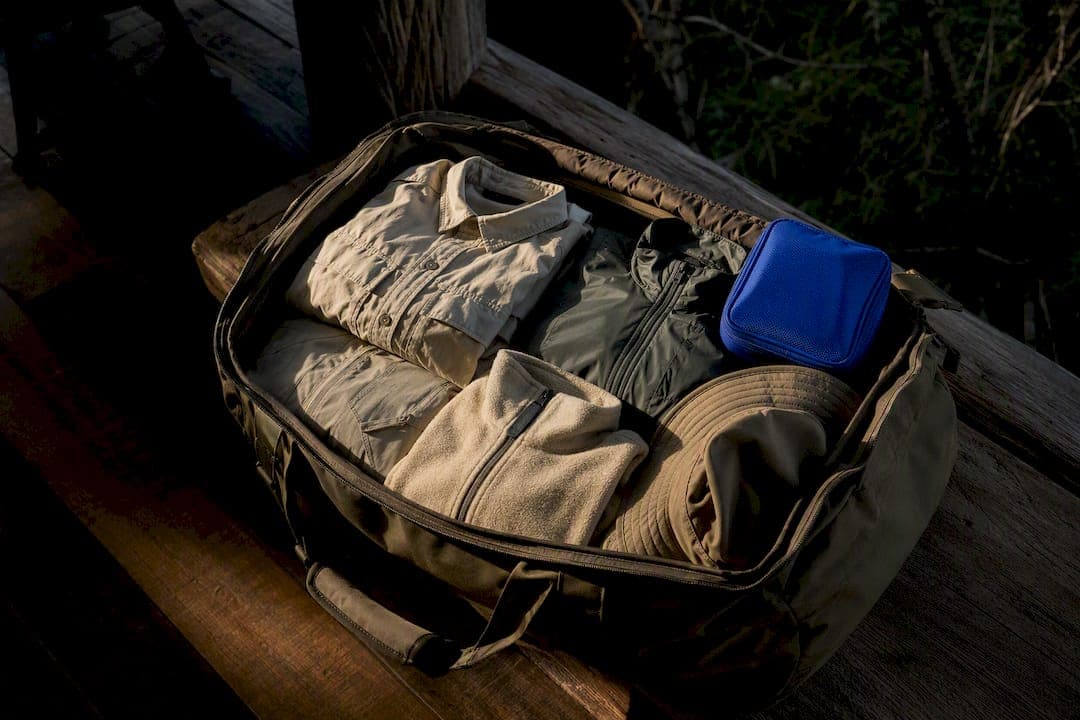
The single decision that shapes your whole safari packing list is soft luggage over hard. Pack a soft-sided duffel, dress in neutral layers, and keep medications, valuables, and one change of clothes in your carry-on. Everything else on your checklist builds outward from those three choices.
TL;DR:
- Use a soft-sided duffel of 50 to 70 liters and confirm luggage weight limits before departure, as they typically range from 15 to 20 kg.
- Pack multiple long-sleeve shirts made of merino or synthetic fabrics and consider extra for a week-long trip to account for laundry cycles.
- Select lightweight, quick-drying clothing and avoid heavy fabrics like denim, especially during rainy or humid seasons when rain shells and moisture-wicking layers are essential.
- Carry essential medicines, high-SPF sunscreen, insect repellent, and a basic first-aid kit, with prescriptions in original packaging and extra doses on your body.
- Prioritize carrying a camera with telephoto lens, binoculars, power bank, and multiple memory cards in your carry-on to withstand dust and ensure quick access during transfers.
Table of Contents
- Your Safari Packing List by Category
- Why Neutral Colors and Layering Actually Matter
- What Are the Luggage Rules for Safari Flights?
- Do You Need Hiking Boots for a Safari?
- What Medications and Toiletries Should You Pack?
- What Camera and Optics Gear Belongs on Safari?
- What Should You Leave at Home?
- Why Trust This Safari Packing Guide?
- What Snacks and Hydration Gear Should You Pack?
- How Should You Pack for Rainy Season vs Dry Season?
- What Travel Documents Should You Carry?
- What Safety Items Should You Pack for a Safari?
- The Real Priority Order for Safari Packing
- Sources
Your Safari Packing List by Category
A safari packing list works best organized by category, not by "shirts, then socks, then everything else." Here's what a typical 7- to 10-day trip actually requires, with quantities that account for daily lodge laundry rather than a fresh outfit every day.
Clothing (7 to 10 day trip):
- 3 to 4 long-sleeve shirts in khaki, olive, or stone
- 2 pairs of quick-dry trousers, one convertible to shorts
- some kind of fleece or lightweight insulated jacket for early game drives
- a packable rain shell
- a warm hat and gloves for winter mornings, if traveling during cooler months
- several pairs of underwear and socks, preferably merino blend
- a swimsuit for lodge pools
- one smart casual outfit for dinner
Footwear:
- one pair of closed-toe trainers or light hiking shoes
- one pair of camp sandals or flip-flops
Health and toiletries:
- Prescription medications in original packaging, plus a few days' backup
- Malaria prophylaxis if prescribed by your travel clinic
- High-SPF sunscreen, lip balm with SPF, and insect repellent
- A compact first-aid kit with plasters, antiseptic, and rehydration salts
Tech:
- Binoculars (8x42 is the standard recommendation)
- Camera body plus one telephoto lens
- Spare batteries, memory cards, and a power bank
- Universal travel adapter
Luggage and documents:
- One soft-sided duffel, 50 to 70 liters
- Packing cubes and a few dust bags for electronics
- Passport, visas, printed booking confirmations, and photocopies of everything
Carry-on essentials (never check these): medications, passport, camera and binoculars, phone charger, and one full change of clothes. If your checked duffel gets delayed on a bush transfer, this bag is what gets you through the first day comfortably.
A tool like Im-at's booking platform can help you confirm exact trip length and activity type before you finalize quantities, since a walking safari and a vehicle-based trip call for slightly different gear.
Why Neutral Colors and Layering Actually Matter
Color choice on safari isn't about looking the part. It's functional. Bright colors and white spook wildlife and show dirt within an hour of your first game drive. Camo is often restricted for civilians in several African countries, and it just isn't necessary in a vehicle. The bigger issue is darker shades: tsetse flies are drawn to dark blue and black fabrics, so avoid navy and black entirely in tsetse zones, which cover parts of East and Southern Africa's bush regions.
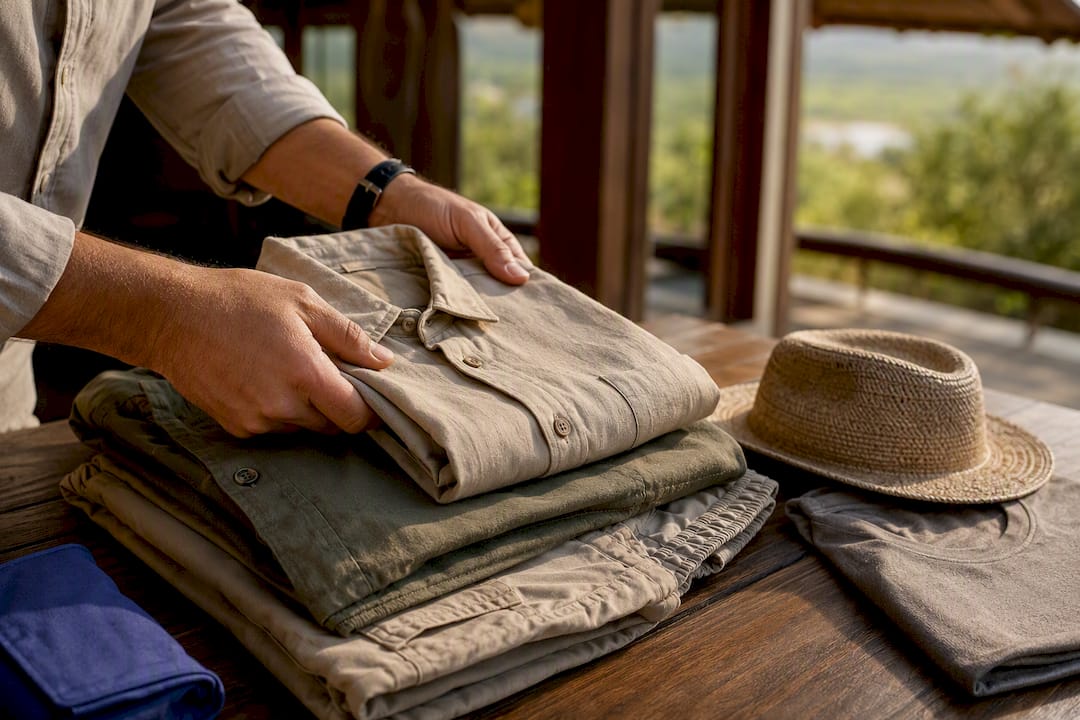
Fabric matters as much as color. Merino wool regulates temperature and resists odor far better than cotton, letting you wear the same base layer for two or three days without it smelling. Quick-dry synthetics work well for shirts and trousers. Skip denim entirely. It's heavy, slow to dry, and miserable once damp from dew or a river crossing.
The three-layer system solves most temperature swings in a single outfit change:
- Base layer: merino or synthetic long-sleeve shirt, worn against the skin
- Mid-layer: fleece or light insulated jacket for the 6 a.m. game drive chill
- Outer layer: packable rain shell, used only when weather turns
For a 7-day trip, three long-sleeve shirts and two trousers cycle comfortably through daily laundry. Stretch to four shirts and a third pair of trousers for 10 days, since some remote camps only offer laundry every other day.
Pro Tip: Pack one merino t-shirt specifically for travel days. It handles airport sweat and 12-hour transit without smelling by the time you land at camp.
What Are the Luggage Rules for Safari Flights?
Most multi-stop safaris include at least one light-aircraft transfer between camps, and that's where hard suitcases become a real problem. Charter operators need bags that compress into small cargo holds, which rules out wheeled hard-shell cases entirely.
- Choose a soft-sided duffel, 50 to 70 liters. It folds flat, molds around other cargo, and survives rough handling on gravel airstrips.
- Expect a strict weight limit. Bush-flight allowances commonly run 15 kg (33 lb) in some regions and 20 kg (44 lb) in others, and this often includes your carry-on weight, too.
- Confirm the exact number with your operator before departure. Limits vary by aircraft type and route, not just by country.
- Keep meds, valuables, camera gear, and a spare outfit in your carry-on. Checked duffels occasionally travel on a later flight than you do.
- Use packing cubes and seal dusty items separately. Bush airstrips are unpaved, and red dust finds its way into everything — see our Family Cabin Trip Essentials: Your Printable Packing Checklist for tips on packing cubes and luggage handling.
Do You Need Hiking Boots for a Safari?
For most vehicle-based safaris, no. A two-shoe system covers nearly every itinerary: closed-toe trainers or light hiking shoes for drives and camp walking, plus sandals or flip-flops for lounging at the lodge. Save actual hiking boots for a dedicated walking safari or a trek that involves uneven terrain for hours at a stretch.
Small accessories punch above their weight here. A wide-brim hat blocks sun better than a cap. A buff or light scarf doubles as dust protection on open vehicles and warmth at dawn. Polarized sunglasses with a retention strap cut glare off water and dust off gravel roads, and the strap matters more than it sounds, since dropping them off a moving vehicle onto the savanna ends the conversation quickly.
What Medications and Toiletries Should You Pack?
Pack prescriptions in their original packaging and carry a few extra days' supply directly on your body, not in checked luggage. Malaria risk varies significantly by region and season, so talk to a travel clinic well before departure about prophylaxis suited to your specific itinerary.
- DEET or picaridin insect repellent (30% or higher concentration)
- High-SPF sunscreen and SPF lip balm
- Basic first-aid kit: plasters, antiseptic wipes, rehydration salts
- Any personal medication, doubled up between checked and carry-on bags
Malaria transmission occurs across large parts of sub-Saharan Africa, and the CDC maintains destination-specific guidance on risk levels and recommended prophylaxis by country and even by region within a country, since risk can shift sharply between coastal and inland areas.
What Camera and Optics Gear Belongs on Safari?
Binoculars matter more than most first-timers expect. 8x42 is the practical sweet spot: bright enough for dawn and dusk drives, and comfortable to hold steady for hours without arm fatigue.
- Binoculars, 8x42 magnification and objective lens size
- Camera body with one telephoto lens (300mm or longer for wildlife)
- Two to three spare batteries and several memory cards
- Power bank rated for multiple phone and camera charges
- Universal adapter, since plug types vary by country
- Dry bags and microfiber cloths, since dust and lens glass don't mix
Keep camera gear in your carry-on on transfer days. Dust is relentless on unpaved airstrips, and a sealed bag protects glass elements far better than a side pocket.
What Should You Leave at Home?
Hard-shell suitcases don't survive charter cargo holds, and airlines will ask you to repack on the spot if you show up with one. Skip drones too. Most parks and reserves ban them outright without a specific permit. Leave excessive jewelry and multiple valuable electronics at home; camps are generally secure, but there's little upside to the risk.
- Hard-shell luggage
- Drones without a confirmed permit
- Bright white or neon clothing
- More than one "special occasion" outfit
- Excessive jewelry or a second expensive camera body
Pro Tip: Email your lodge directly to confirm laundry service and exact luggage allowance before you pack. A two-minute email saves you from either overpacking or showing up over the airstrip's weight limit.
Why Trust This Safari Packing Guide?
Im-at works as a booking platform for safaris and outdoor experiences, which means the operational details here, laundry norms, luggage math, transfer logistics, come from how these trips actually run on the ground, not from a generic travel blog. Cross-check your specific camp's rules with your operator before departure, since luggage allowances and laundry service both vary by property.
What Snacks and Hydration Gear Should You Pack?
Most safari vehicles carry water and a mid-morning snack stop, but relying entirely on the lodge misses two problems: game drives run long, and dietary preferences don't always match what's on offer.
A collapsible water bottle with a filter cap solves the hydration question without adding rigid bulk to your duffel. Aim for at least one liter of capacity, since dry-season dust and heat pull moisture out of you faster than you'd expect on an open vehicle. Electrolyte tablets are worth the few grams they weigh, particularly for early departures before breakfast fully settles.
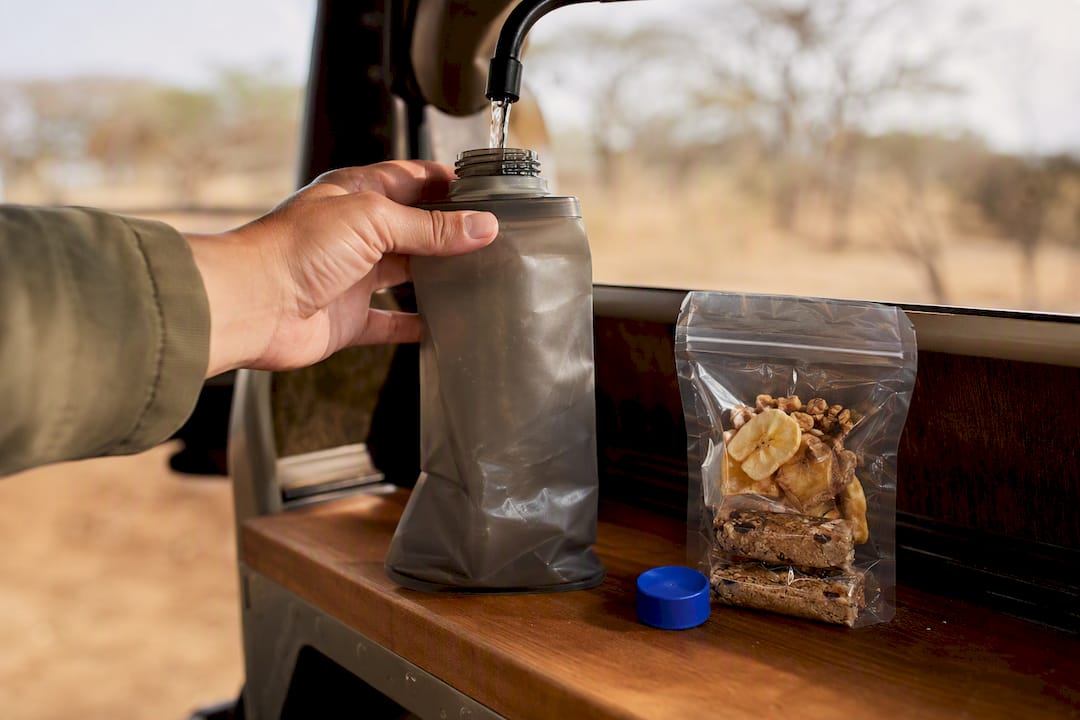
For snacks, pack items that survive heat and pressure changes: nut butter packets, dried fruit, protein bars, and biltong if you're departing from a region where it's sold locally. Skip anything chocolate-based unless it's the freezer-stable kind. It melts into a mess inside a duffel within an hour of midday sun. A small resealable pouch keeps crumbs contained and doubles as an easy grab during a five-hour game drive when the vehicle doesn't stop.
If you have specific dietary restrictions, pack a few days' worth of familiar snacks regardless of camp assurances. Remote lodges do their best, but ingredient availability shifts by season and by how recently the supply truck arrived.
How Should You Pack for Rainy Season vs Dry Season?
Safari packing shifts more with season than most first-timers realize, and getting this wrong means either sweating through cotton at midday or shivering through a 6 a.m. drive with nothing warm to put on.
Dry season (roughly May through October in much of Southern and East Africa) brings cold mornings, often near freezing at higher elevations, followed by hot, dusty afternoons. This is where the three-layer system earns its place: a warm layer for departure, stripped down by mid-morning. Dust is heaviest during this stretch, so packing cubes and sealed electronics bags matter more now than any other time of year.
Green or rainy season (roughly November through April, varying by region) trades dust for humidity and short, heavy downpours. A packable rain shell becomes essential rather than optional. Quick-dry fabrics matter even more, since a soaked cotton shirt won't dry between game drives. Insect activity also rises significantly in green season, which pushes repellent and long sleeves higher on the priority list.
Check your specific region's calendar before finalizing your list, since equatorial East Africa and Southern Africa run on different rainfall patterns entirely. What counts as "dry season" in Kenya can overlap with the wetter months in Botswana.
What Travel Documents Should You Carry?
Losing a passport mid-trip is a solvable problem if you've prepared. Losing it with no backup documentation turns into a multi-day embassy scramble that eats into actual safari time.
Carry your passport, visa approvals or e-visa printouts, yellow fever certificate if required for your route, travel insurance details, and printed booking confirmations for every lodge and flight. Photocopy the passport's photo page and visa pages, then store the copies separately from the originals, one set in your carry-on, one set left with someone at home who can email it to you in an emergency.
A digital backup matters just as much as paper. Photograph every document and save it to a cloud folder accessible without wifi issues, since some camps have limited connectivity. Include your travel insurance policy number and emergency contact line; if you need to file a claim from a remote lodge, you won't have a filing cabinet to dig through.
Keep a small folder of local currency alongside your documents for tips and incidentals, since remote camps rarely have card facilities for cash withdrawals.
What Safety Items Should You Pack for a Safari?
Safaris are safer than most first-timers assume, but a few small items address the specific risks of remote bush travel rather than generic vacation risk.
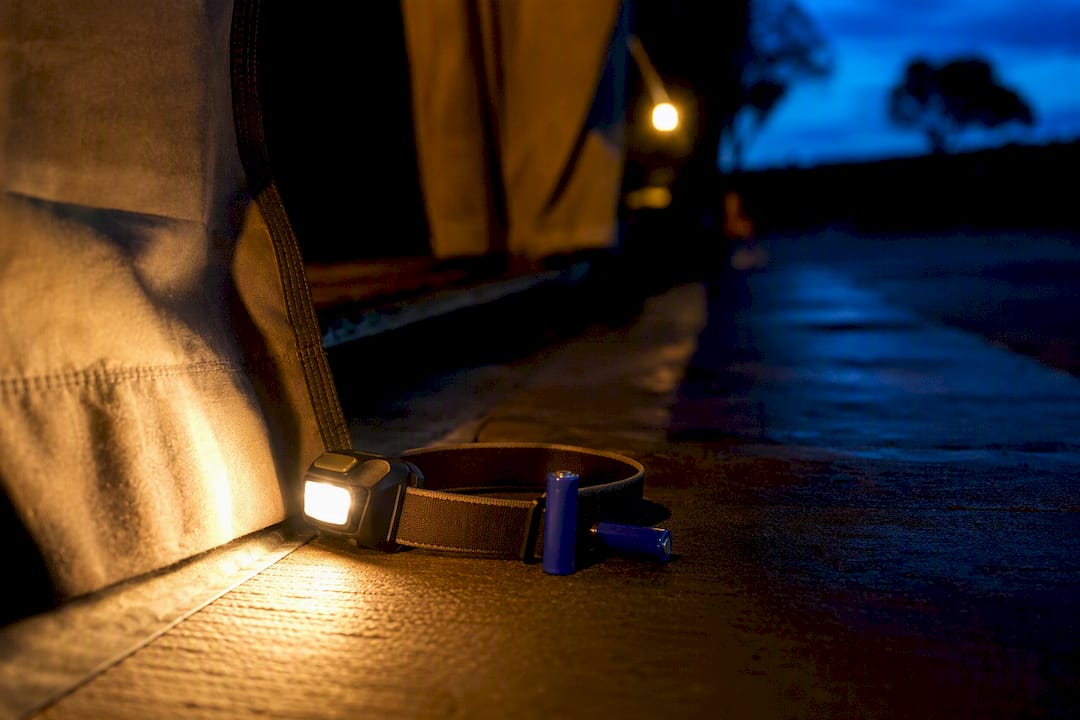
A personal alarm or whistle is standard advice for walking safaris, where guides carry rifles but guests are expected to signal if separated from the group. It weighs nothing and takes up no space, so there's little reason to skip it. A basic headlamp matters more than people expect, since camps often have limited lighting after dark and paths between tents cross open ground where animals move at night. Pack spare batteries for it.
A whistle attached to your daypack works as a backup signal if you're on a guided walk and get briefly out of sight of your group, though guides brief you on this before any walking activity begins. Consider a small door alarm or wedge if you're staying in a tented camp with limited security, though most reputable lodges already have night guards.
Basic situational habits matter as much as gear: never walk between tents alone after dark without a guide escort, and always follow camp briefing instructions about zipping tent flaps fully. None of this is about excessive caution. It's about matching your gear to the actual environment, which is genuinely different from a hotel resort.
Ready to put this checklist to use? Im-at's tailor-made 4x4 safari tours let you book the exact kind of trip this packing list is built for, with operators who can confirm luggage allowances and laundry service before you fly.
The Real Priority Order for Safari Packing
Most packing lists treat every item as equally urgent, and that's where they fail readers. The order of priority actually matters: luggage type first, layering second, everything else a distant third.
Conventional advice spends too much time on clothing quantity and not enough on the two things that actually derail a trip, a rejected hard suitcase at a bush airstrip or a missed malaria prophylaxis window. Neither shows up in most generic packing lists, yet both cause more real problems than forgetting a spare shirt.
If you take one thing from this guide, let it be this: confirm your exact luggage allowance and laundry situation with your specific operator before you pack a single bag. Every camp runs slightly differently, and the three to four day wardrobe cycle that works at one lodge might need adjusting at another with less frequent laundry service. Everything else on this checklist, the merino layers, the dust bags, the 8x42 binoculars, matters. But it matters less than getting the luggage and health basics right first.
— Mikahil
Sources
- The Complete African Safari Packing List (What to Actually Bring) · The Faraway Edit
- Safari Packing Guide 2026: Essential Items List