
Imagine booking a vacation only to find yourself following the same crowded tourist routes as everyone else, missing the authentic local experiences you craved. This common frustration stems from generic travel packages that treat every traveler identically. Travel experience curation solves this problem by designing personalized, immersive journeys tailored to your unique interests and pace. This guide explains what travel experience curation truly means, how it works, and why it transforms ordinary trips into extraordinary adventures through expert knowledge and smart technology.
Table of Contents
-
Core mechanics and technology behind travel experience curation
-
Human vs AI curation: strengths, limitations, and hybrid approaches
-
Practical benefits and real-world applications for travelers
-
Enhance your trip with expertly curated tours and experiences
Key takeaways
| Point | Details |
| Definition | Travel experience curation professionally selects and orchestrates personalized itineraries using expert knowledge and technology for authentic journeys. |
| Core process | Involves traveler profiling, unique experience research, algorithmic optimization, narrative crafting, and seamless booking coordination. |
| Human vs AI | Humans provide cultural insight and flexibility while AI offers speed and scale, with hybrid approaches combining both strengths. |
| Practical benefits | Custom itineraries yield 40% higher satisfaction and 64% of luxury travelers prioritize personalization in their travel planning. |
| Real applications | Includes adventure tours, cultural immersion experiences, and bespoke itineraries that adapt to disruptions and preferences. |
What is travel experience curation: an in-depth explanation
Travel experience curation is the process of professionally selecting, customizing, and orchestrating personalized travel itineraries and activities using expert knowledge, relationships, and technology to create immersive, authentic journeys beyond standard tourism. Unlike booking pre-packaged tours or following generic city guides, curation involves deliberate design that considers your personality, travel style, budget constraints, and deeper motivations for exploring new places.
Professional curators bring three critical elements to the table. First, they possess deep destination knowledge gained through years of personal exploration and industry connections. Second, they maintain relationships with local guides, venue owners, and hidden gem proprietors who rarely appear in mainstream travel apps. Third, they apply sophisticated matching algorithms that balance your stated preferences with logistical realities like weather patterns, seasonal crowd levels, and optimal timing for specific experiences.
The fundamental difference between basic trip planning and true curation lies in the orchestration of details. A standard itinerary might list five attractions to visit in a day. A curated experience considers how those five stops flow together narratively, whether the second location complements the emotional tone of the first, if the lunch venue between stops three and four offers cuisine that deepens your understanding of local culture, and whether the final activity leaves you energized or peacefully reflective for evening plans.
Consider these core characteristics of curated travel:
-
Focus on authenticity over popularity, often steering travelers toward experiences locals actually enjoy
-
Emphasis on immersion rather than surface-level sightseeing, creating opportunities for genuine cultural exchange
-
Adaptive flexibility that allows itineraries to evolve based on your energy levels, weather changes, or spontaneous interests
-
Narrative coherence where each day’s activities build upon previous experiences to create meaningful travel stories
Pro Tip: When evaluating whether a service offers true curation or just booking assistance, ask if they interview you about your travel philosophy and past trip disappointments. Genuine curators dig deep into your motivations, not just your destination preferences.
The technology supporting modern curation has evolved dramatically. Platforms now analyze thousands of types of travel activities for immersive trips simultaneously, identifying non-obvious connections between your interests and available experiences. However, technology serves as an enabler rather than a replacement for human judgment, particularly when navigating cultural nuances or responding to the subtle emotional needs travelers express during their journeys.
Core mechanics and technology behind travel experience curation
Core mechanics include detailed traveler profiling, research and mapping of unique experiences, algorithmic optimization for logistics, crafting narrative-driven itineraries, and seamless booking and coordination. Understanding these steps reveals how curators transform vague vacation ideas into precisely orchestrated adventures.
The process unfolds through five interconnected stages:
-
Traveler profiling begins with structured conversations that go far beyond asking about favorite destinations. Curators explore your ideal travel pace, comfort with spontaneity, dietary restrictions, physical activity preferences, cultural curiosity levels, and even how you prefer to process new information. Some travelers want detailed historical context at every site while others prefer minimal narration and maximum sensory immersion.
-
Experience research involves mapping both popular attractions and lesser-known venues that align with your profile. Professional curators maintain databases of experiences categorized by emotional tone, physical intensity, cultural depth, and seasonal availability. They identify opportunities most travelers miss, like attending a local cooking class in someone’s home rather than a commercial culinary school, or timing your museum visit to coincide with a curator-led tour not advertised publicly.
-
Algorithmic optimization tackles the complex logistics that can make or break a trip. Software analyzes travel times between locations, optimal visit windows to avoid crowds, weather probability patterns, and budget allocation across experiences. The system might recommend visiting an outdoor market early morning on day three instead of afternoon on day two because historical data shows better vendor selection and cooler temperatures.
-
Narrative crafting transforms a list of activities into a cohesive story. Each day receives thematic coherence, perhaps starting with morning meditation at a temple, progressing to afternoon exploration of spiritual art, and concluding with dinner at a restaurant whose chef incorporates ceremonial cooking techniques. The sequence creates emotional resonance rather than random activity sampling.
-
Seamless booking coordination handles all reservations, confirmations, payment processing, and contingency planning. Curators establish backup options for weather-dependent activities and maintain relationships with vendors who accommodate last-minute adjustments without penalties.
| Curation Stage | Primary Tools | Key Output |
| Traveler Profiling | Structured interviews, preference surveys | Detailed personality and interest profile |
| Experience Research | Local databases, insider networks | Curated venue and activity shortlist |
| Algorithmic Optimization | Route planning software, weather APIs | Logistics-optimized daily schedules |
| Narrative Crafting | Thematic frameworks, emotional mapping | Cohesive story-driven itinerary |
| Booking Coordination | Reservation systems, vendor relationships | Confirmed experiences with contingencies |
Pro Tip: Request a sample day from your curator before committing to a full itinerary. A well-designed sample reveals their attention to pacing, transitions between activities, and whether they build in adequate rest time between intense experiences.
Modern curation platforms integrate with real-time data sources, automatically adjusting recommendations when unexpected events occur. If a museum closes for emergency maintenance, the system immediately suggests alternative cultural experiences matching the original activity’s thematic purpose and time slot. This dynamic responsiveness distinguishes professional curation from static itinerary planning, ensuring your guide to exploring new destinations remains relevant regardless of disruptions.
Human vs AI curation: strengths, limitations, and hybrid approaches
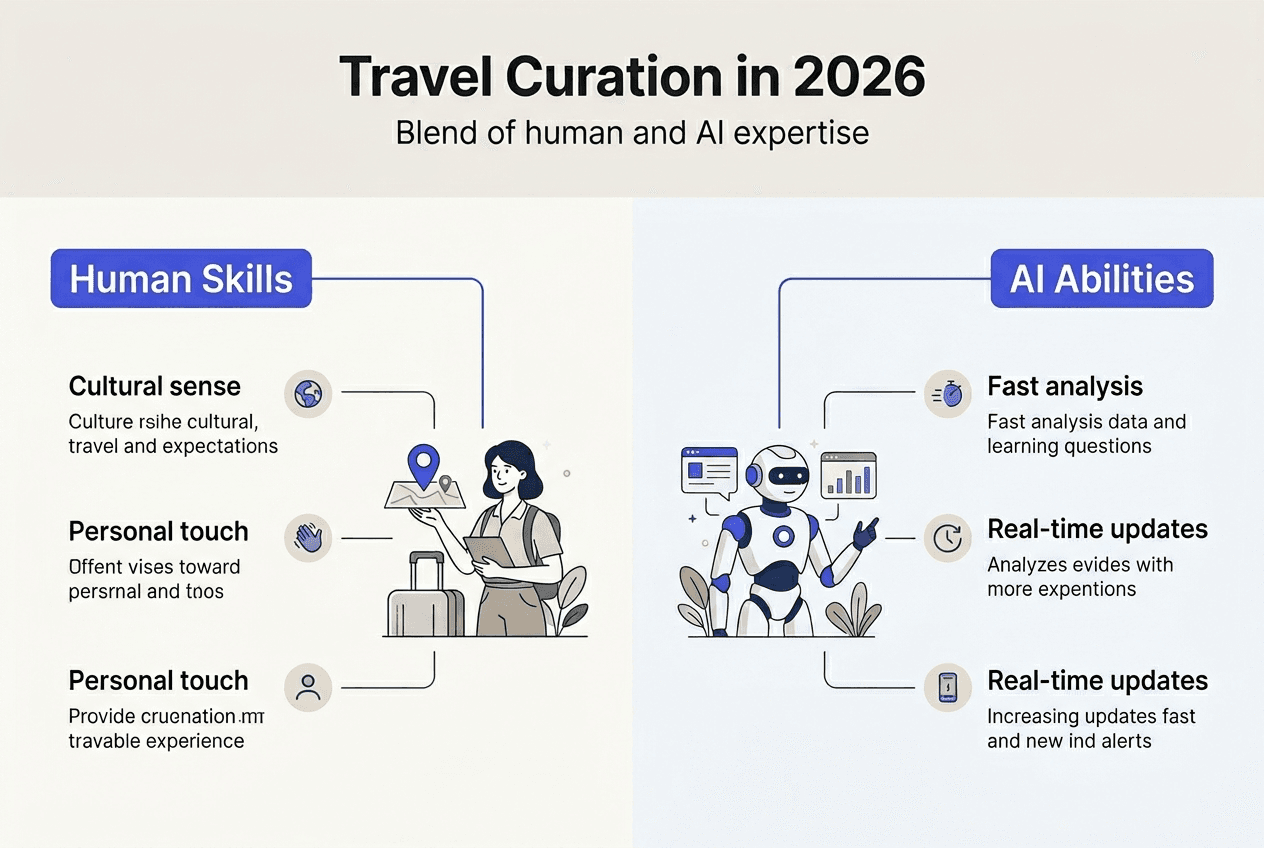
Human curation excels in cultural judgment, handling disruptions and soft preferences while AI offers speed and scale but often lacks nuance. Understanding these complementary capabilities helps travelers choose the right curation approach for their needs and budget.
Human curators bring irreplaceable advantages to complex travel planning. They exercise cultural judgment when navigating sensitive situations, like advising appropriate dress codes for religious sites or interpreting unspoken social customs that prevent awkward interactions. When flights get canceled or weather forces itinerary changes, human curators make real-time decisions that consider your emotional state, remaining budget flexibility, and which backup experiences best preserve your trip’s original intent.

Human expertise particularly shines when handling soft preferences that resist quantification. You might tell a curator you want “authentic local food experiences,” but what does authentic mean to you? A human can probe deeper, discovering whether you’re seeking street food adventures, family-run restaurants serving regional specialties, or opportunities to cook alongside local home chefs. They recognize that identical preference labels mean vastly different things to different travelers.
AI systems excel in processing massive datasets to identify patterns and optimize logistics. Algorithms analyze thousands of traveler reviews, seasonal pricing fluctuations, and historical weather data simultaneously, surfacing insights no human could manually compile. AI handles the computational heavy lifting of route optimization, ensuring you don’t waste hours backtracking across a city or scheduling outdoor activities during historically rainy periods.
However, AI struggles with multiple conflicting constraints and contextual nuance. A system might recommend a highly-rated restaurant that technically matches your cuisine preferences but fails to recognize it’s located in a neighborhood requiring a 90-minute commute that destroys your evening’s pacing. AI also misses subtle emotional cues, like recognizing when a traveler needs downtime after several intense cultural experiences even though their stated preferences emphasize activity-packed days.
| Capability | Human Curators | AI Systems | Hybrid Approach |
| Cultural sensitivity | Excellent, nuanced judgment | Limited, rule-based only | AI suggests, human validates |
| Disruption handling | Flexible, context-aware | Rigid, predefined responses | AI identifies options, human decides |
| Logistics optimization | Time-intensive, limited scale | Fast, comprehensive analysis | AI optimizes, human refines |
| Soft preference interpretation | Skilled through conversation | Struggles with ambiguity | Human profiles, AI matches |
| Relationship leverage | Strong local connections | None, purely data-driven | Human activates network as needed |
Hybrid models combine AI efficiency with human discernment for optimal results. The AI handles initial research, logistics optimization, and continuous monitoring of booking confirmations and schedule conflicts. Human curators then apply their judgment to the AI-generated shortlist, removing experiences that technically match criteria but feel wrong for a specific traveler’s personality, and adding unexpected options their local knowledge suggests would create magical moments.
Pro Tip: When working with hybrid curation services, ask how many human touch points exist in the process. Quality services include human review at profiling, final itinerary approval, and during-trip support stages, not just automated responses.
The future of travel curation likely involves increasingly sophisticated AI that handles more routine decisions while freeing human experts to focus on complex cultural navigation and emotional intelligence. This evolution benefits travelers by reducing curation costs while maintaining the personalized attention that transforms good trips into unforgettable journeys. Platforms facilitating master immersive cultural experiences increasingly adopt these hybrid models to scale personalized service.
Practical benefits and real-world applications for travelers
Empirical data shows 64% of luxury travelers prioritize personalization, custom itineraries yield 40% higher satisfaction, and AI boosts meal scheduling success. These statistics reflect measurable improvements travelers experience when moving from generic planning to professional curation.
The satisfaction gap between curated and standard travel experiences stems from several factors. Curated trips eliminate the research paralysis many travelers face when confronting thousands of online reviews and conflicting recommendations. Instead of spending vacation time second-guessing choices or discovering booked activities don’t match expectations, curated travelers enjoy confidence that each experience was deliberately selected for their specific interests.
Time efficiency represents another significant benefit. Professional curators compress weeks of research into days, leveraging existing knowledge and industry relationships. They bypass the trial-and-error process of booking experiences that sound appealing online but disappoint in person. This efficiency proves especially valuable for travelers with limited vacation time who cannot afford wasted days on mediocre activities.
Financial optimization often surprises travelers who assume curation services only add costs. Experienced curators identify value opportunities invisible to casual researchers, like knowing which high-end restaurants offer exceptional lunch menus at half the dinner price, or which tour operators provide identical experiences to premium competitors but market less aggressively. The money saved through strategic booking often offsets curation fees.
Real-world applications span diverse travel styles:
-
Adventure seekers benefit from curated multi-day expeditions that balance thrilling activities with adequate recovery time and safety considerations
-
Cultural enthusiasts receive itineraries connecting historical sites with contemporary cultural expressions, creating deeper understanding than isolated museum visits
-
Family travelers get age-appropriate activity sequences that keep children engaged while satisfying adult interests
-
Solo travelers access curated small-group experiences that facilitate social connection without forced interaction
Consider a traveler booking tailor-made 4x4 tours through a curation platform. The curator doesn’t just arrange transportation and routes. They profile the traveler’s comfort with off-road driving, interest in wildlife versus landscapes, preferred photography opportunities, and ideal balance between guided narration and silent appreciation. The resulting tour feels personally designed rather than commercially standardized.
Similarly, a private Bagamoyo day trip with lunch becomes more than a historical site visit when curated thoughtfully. The curator might schedule the trip to coincide with a local artisan market, arrange lunch at a family-owned restaurant serving regional specialties rarely found in tourist areas, and time the return journey to avoid peak traffic while catching optimal sunset lighting for photography.
Pro Tip: Track your satisfaction levels across different trip components after returning home. Curated experiences typically generate stronger positive memories and fewer regrets about missed opportunities compared to self-planned activities.
The measurable improvement in meal scheduling success through AI optimization demonstrates how technology enhances even seemingly simple decisions. Algorithms consider reservation availability, optimal dining times based on your daily activity schedule, cuisine variety across your trip to prevent repetition, and budget allocation to ensure you experience both casual local eateries and special occasion restaurants without overspending early in your journey.
Enhance your trip with expertly curated tours and experiences
Ready to transform your next journey from ordinary to extraordinary? Im-at offers instantly bookable curated experiences designed by local experts who understand what makes travel truly memorable. Whether you’re drawn to mysterious historical narratives like The Unholy Secrets tour, seeking adventure through tailor-made 4x4 tours, or wanting comprehensive city exploration via the Cape Town 3-day attraction tour, our platform connects you with experiences that match your unique travel style. Each offering reflects the curation principles discussed throughout this guide, combining local knowledge with seamless booking convenience. Browse our collection today and discover how professionally curated experiences eliminate travel planning stress while maximizing adventure and authenticity.
Frequently asked questions
What exactly does a travel experience curator do?
A travel experience curator interviews you to understand your interests, researches unique experiences matching your profile, optimizes logistics for seamless execution, and coordinates all bookings while building in flexibility for spontaneous adjustments. They act as both researcher and orchestrator, ensuring each trip component serves your broader travel goals.
How does travel experience curation improve my trip?
Curation delivers greater personalization by matching experiences to your specific interests rather than generic tourist activities. You gain access to authentic local experiences through curator relationships with venue owners and guides. The service provides convenience by handling all research and booking coordination, plus expert support when disruptions occur, allowing quick itinerary adjustments that preserve your trip’s quality and intent.
Can AI replace human travel curators?
AI excels at processing large datasets, optimizing routes, and identifying highly-rated experiences quickly and affordably. However, it struggles with cultural nuance, interpreting ambiguous preferences, and making context-aware decisions during disruptions. Human curators provide irreplaceable cultural judgment, relationship leverage with local providers, and emotional intelligence for reading subtle traveler needs that resist algorithmic analysis.
How much does professional travel curation typically cost?
Curation fees vary widely based on trip complexity, destination, and service level. Some platforms charge flat fees ranging from $200 to $500 per trip, while luxury curators command percentages of total trip costs or daily rates exceeding $300. Many services offer tiered options, with basic AI-assisted curation at lower price points and full-service human curation for premium rates. The investment often pays for itself through optimized bookings and eliminated planning time.
How can I get started with travel experience curation?
Start by clearly defining your travel interests, constraints, budget range, and what disappointed you about past trips. Research curated travel platforms or professional curators specializing in your target destination. Schedule initial consultations to assess whether their approach matches your communication style and travel philosophy. Be open to co-creation, sharing honest feedback during the planning process, and remaining flexible as curators suggest unexpected experiences that align with your deeper motivations even if they weren’t on your original wish list.