

TL;DR:
- Most travelers skip the activity discovery process, relying on superficial lists that lead to generic trips. A structured, diverge-converge workflow helps travelers identify meaningful activities aligned with their personal goals and constraints. Using early planning, documentation, and AI support improves trip satisfaction and encourages deliberate, memorable experiences.
The activity discovery process is the systematic approach travelers use to identify, evaluate, and select activities that enrich their trip itineraries. Most travelers skip this process entirely, defaulting to top-ten lists or hotel concierge suggestions. That shortcut produces generic trips. A structured approach, by contrast, produces itineraries built around what you actually want from a destination. Industry frameworks recommend a 4–6 week research phase before departure, paired with ongoing flexibility to adapt plans once you arrive. The trigger-to-outcome evaluation method and the diverge-converge workflow are the two core techniques that separate intentional travelers from tourists who come home feeling vaguely underwhelmed.
What does the activity discovery process actually involve?
The activity discovery process is not a single search session. It is a repeatable cycle of observation, questioning, and investigation that shifts your planning from collecting activities to designing an itinerary aligned with your values. Discovery cycles that follow this pattern consistently produce higher traveler satisfaction than ad hoc research. The reason is simple: structured investigation surfaces activities you would never have found through a standard search.

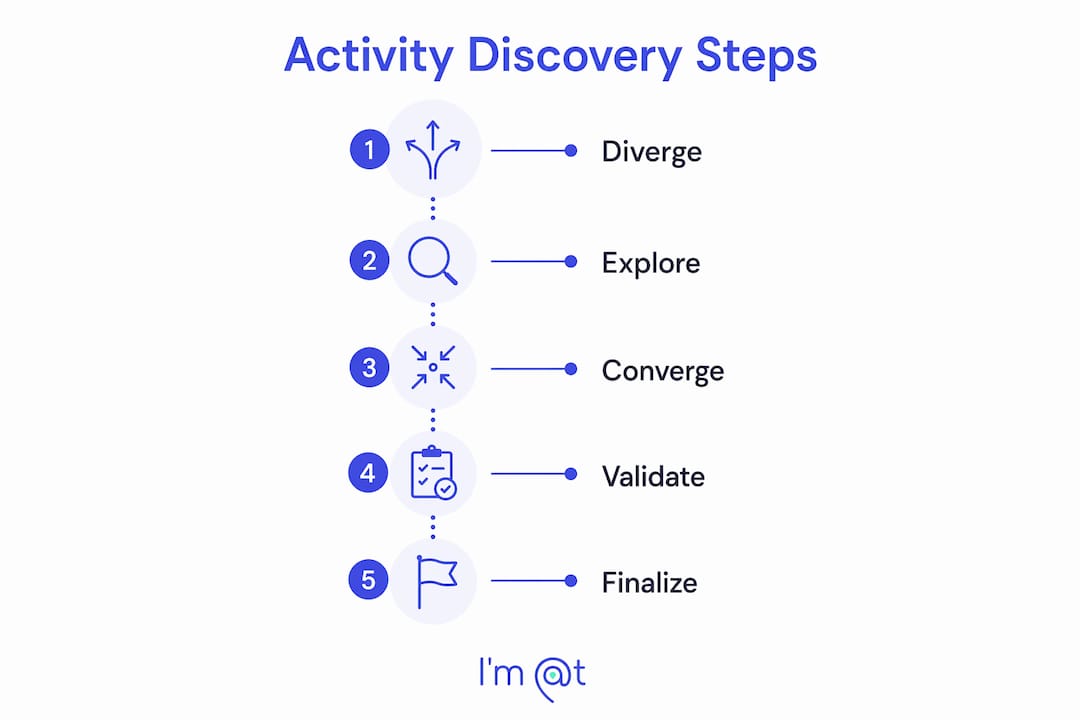
The process has two phases. The first is divergence, where you generate the broadest possible list of options without filtering. The second is convergence, where you narrow that list using real constraints like budget, physical stamina, and available time. Skipping the convergence step is the single most common cause of overpacked, exhausting itineraries.
What do you need before starting activity exploration?
Setting clear trip goals before you research a single activity is non-negotiable. Goals answer the question: what do you want to feel or know at the end of this trip? Without that anchor, every activity looks equally appealing, and you end up booking too many.
Three categories of constraints define your realistic options:
- Budget: total spend available for activities, including entrance fees, equipment rental, and guide tips
- Physical capacity: your honest fitness level and any mobility considerations
- Time: daily hours available after accounting for travel between locations, meals, and rest
The right tools make the research phase faster and more focused. A Discovery Log is the most underrated tool in travel planning. Maintaining a log with columns for Activity Name, Trigger (how you found it), and Expected Value (what you hope to gain) prevents you from booking activities based on appealing photos rather than genuine interest.
| Tool | Role in discovery |
|---|---|
| Discovery Log | Tracks activity name, source, and expected personal value |
| AI brainstorming aid | Converts vague interests into specific, searchable activity ideas |
| Itinerary planner | Maps activities against daily time blocks and travel distances |
| Constraint checklist | Validates budget, stamina, and logistics before confirming bookings |
Pro Tip: Build your constraint checklist before you open any travel site. Knowing your hard limits turns a two-hour browsing session into a focused 30-minute research sprint.
How to execute the activity discovery process step by step
A disciplined execution separates travelers who return energized from those who return exhausted. Follow this sequence to get the most from your research phase.
- Set your trip intention. Write one sentence describing the feeling or outcome you want from the trip. "I want to understand local food culture" is more useful than "I want to have fun."
- Run a broad search. Use maps, travel blogs, Im-at, and AI tools to generate at least 20 candidate activities without filtering. This is the diverge phase.
- Apply the trigger-to-outcome pattern. For each activity, ask: what triggered my interest, and what specific outcome do I expect? This evaluation pattern reduces scheduling based on marketing appeal and surfaces activities with genuine personal relevance.
- Validate feasibility. Check location, travel time between activities, physical requirements, and booking lead times. Most disappointments in travel come from untested assumptions about how easy it is to get somewhere or how demanding an activity is.
- Converge to a shortlist. Cut your list to the activities that pass both the trigger-to-outcome test and the feasibility check. Aim for no more than two structured activities per day.
- Document your "why." For each confirmed activity, write one sentence explaining why it made the cut. Documenting personal motivation improves satisfaction because it keeps your choices connected to your original trip intention.
- Leave space. Reserve 30–40% of your itinerary for activities you discover on the ground. Some of the best experiences are invisible during the planning phase.
Pro Tip: When your shortlist exceeds two activities per day, do not cut randomly. Rank each activity by how directly it serves your trip intention, then remove from the bottom up.
The 4–6 week research window matters because it gives you time to validate logistics without the pressure of an imminent departure. Rushing this phase compresses your ability to check opening hours, book guides in advance, or identify seasonal closures. Smart activity planning consistently shows that travelers who start research early make fewer last-minute substitutions and report higher overall trip satisfaction.
Treat your Discovery Log as a living document. Add activities as you encounter them, remove those that fail the feasibility check, and revisit your trip intention every time the list grows beyond 20 options. This discipline prevents the log from becoming a wishlist that paralyzes rather than guides.
What are the most common challenges in activity identification?
Over-scheduling is the most predictable failure in activity planning. Travelers consistently underestimate travel time between locations and overestimate their daily energy levels. A day with four activities that each take 90 minutes looks manageable on paper. Add 45 minutes of transit between each, and you have a 9-hour day with no buffer for delays, meals, or the unexpected.
The core challenges to watch for:
- Untested feasibility assumptions: booking a hike without checking the trail's difficulty rating or required fitness level
- Ignoring logistics windows: assuming a popular site is walk-in accessible when it requires advance booking
- Itinerary bloat: adding activities because they look interesting rather than because they serve your trip intention
- Single-source research: relying on one platform or one review source, which produces a narrow and often biased activity list
Structured discovery conversations with clear start and end times for each activity day reduce fatigue and keep the itinerary realistic. Setting a hard stop time for each day, say 6:00 PM, forces you to prioritize rather than accumulate.
Leaving 30–40% of your itinerary open is not laziness. It is a deliberate strategy that accounts for local opportunities, weather changes, and the spontaneous discoveries that produce the most authentic travel memories. The guest experience journey in hospitality research consistently shows that unplanned moments rank among travelers' most valued memories.
Pro Tip: Treat the first 24 hours of any trip as a pure observation phase. Walk the neighborhood, talk to locals, and note what draws your attention before confirming any remaining flexible slots in your itinerary.
How do AI tools fit into the activity discovery process?
AI tools in 2026 are most useful at the diverge phase, where the task is generating options rather than evaluating them. AI-supported discovery converts vague interests like "I like history" into specific, searchable ideas like "Ottoman-era walking tour" or "colonial architecture photography route." That specificity makes your subsequent research faster and more targeted.
The practical workflow looks like this:
- Feed your trip intention and destination into an AI brainstorming tool
- Ask it to generate 15–20 activity ideas across different categories (cultural, physical, culinary, social)
- Map each suggestion against your constraint checklist before adding it to your Discovery Log
- Use AI again at the convergence phase to compare two or three shortlisted options against your stated priorities
The critical boundary is this: AI accelerates ideation and comparison, but it does not know your physical limits, your travel companions' preferences, or the specific conditions on the ground. Balancing AI support with human judgment produces the best outcomes. Use AI to expand your thinking, then apply your own knowledge to filter.
| Approach | Strengths | Limitations |
|---|---|---|
| Discovery without AI | Fully personal, reflects lived experience | Slower, prone to narrow search patterns |
| Discovery with AI | Fast ideation, broad category coverage | Requires human validation of feasibility and fit |
The travelers who get the most from AI tools are those who use them as a starting point, not a final answer. AI suggestions still need the trigger-to-outcome test and the feasibility check before they earn a place in your itinerary.
Key Takeaways
A structured activity discovery process, built on the diverge-converge workflow, trigger-to-outcome evaluation, and deliberate itinerary flexibility, produces more satisfying trips than any amount of spontaneous browsing.
| Point | Details |
|---|---|
| Start with a trip intention | Write one sentence defining your desired outcome before researching any activity. |
| Use the diverge-converge workflow | Generate 20+ options first, then narrow by feasibility and personal relevance. |
| Apply trigger-to-outcome evaluation | Assess each activity by how you found it and what specific value it delivers. |
| Leave 30–40% of the itinerary open | Reserve flexible slots for on-the-ground discoveries that planning cannot anticipate. |
| Document your "why" | Record the personal motivation behind each confirmed activity to maintain alignment with your trip intention. |
Why most travelers skip the most important step
Most travelers I observe treat activity research as a single session the week before departure. They open a few travel sites, screenshot what looks appealing, and call it planning. The result is an itinerary built on visual appeal rather than personal fit.
The step they skip is the convergence phase. Generating a long list of activities feels productive. Cutting that list feels like loss. But an unfiltered list is not a plan. It is a source of anxiety. Every activity you add without a clear "why" is a decision you defer to a moment when you are tired, hungry, and standing on a street corner in an unfamiliar city.
I have also seen travelers over-rely on AI suggestions without running a single feasibility check. AI will confidently recommend a sunrise hike that requires a 3:00 AM departure from a hotel 90 minutes away. The suggestion is not wrong. It just does not know your situation. Human judgment is not optional in this process. It is the whole point.
The travelers who come home with the best stories are not the ones who did the most. They are the ones who chose deliberately, left room for surprise, and organized their itineraries around what they actually cared about. That is the activity discovery process working as intended.
— Mikahil
Plan your next adventure with Im-at
Im-at connects travelers with curated, bookable experiences across destinations worldwide, from cultural day tours to outdoor adventures. The platform handles the logistics so your discovery process ends in a confirmed booking rather than an open browser tab.
If you are planning an outdoor adventure, the Table Mountain hiking experience on Im-at is a fully organized trek with guide support, making it a strong fit for travelers who want physical challenge without logistical uncertainty. For a multi-layered cultural itinerary, the Cape Town 3-day attraction combines township tours, Cape Peninsula exploration, and wine tasting into one structured package. Both experiences reflect exactly what a well-executed activity discovery process is designed to find: activities with clear value, confirmed logistics, and genuine alignment with traveler interests.
FAQ
What is the activity discovery process in travel planning?
The activity discovery process is a structured method for identifying, evaluating, and selecting activities that align with your trip goals and personal constraints. It uses techniques like the diverge-converge workflow and trigger-to-outcome evaluation to produce intentional itineraries.
How long should the activity discovery phase take?
A 4–6 week research window before departure gives you enough time to validate logistics, check booking requirements, and refine your shortlist without last-minute pressure.
How much of my itinerary should stay flexible?
Leaving 30–40% of your itinerary open for spontaneous, on-the-ground discoveries is a recognized best practice. Local opportunities and real-time finds often produce the most memorable travel experiences.
What is the trigger-to-outcome evaluation method?
The trigger-to-outcome method asks two questions for each activity: what prompted your interest, and what specific outcome do you expect? This framework filters out activities chosen for marketing appeal rather than genuine personal value.
How do I use AI tools without over-relying on them?
Use AI at the diverge phase to generate a broad list of ideas, then apply your own constraint checklist and the trigger-to-outcome test before confirming any activity. AI accelerates brainstorming but requires human validation of feasibility and personal fit.