

TL;DR:
- Choosing excursions that align with your interests, activity level, and schedule ensures a memorable trip.
- Booking through vetted providers and understanding full costs help prevent surprises and disappointment during travel.
Most travelers land at a new destination with good intentions and a brain full of options. A cooking class here, a boat tour there, a half-day safari in between. Knowing how to choose excursions that match your actual energy, budget, and interests is what separates a memorable trip from a frustrating one. The difference between an excursion you'll talk about for years and one you regret booking often comes down to a few deliberate decisions made before you ever leave home. This guide gives you a practical framework to get those decisions right.
Table of Contents
- Key takeaways
- How to choose excursions: start with yourself
- Matching your excursion to the destination type
- Booking strategies: organized vs. independent tours
- Understanding the real cost of excursions
- Common mistakes that ruin excursions
- My take on excursion planning after years of travel
- Ready to find your next excursion?
- FAQ
Key takeaways
| Point | Details |
|---|---|
| Know yourself first | Identify your interests, activity level, and schedule before comparing any excursion options. |
| Match the destination type | Historic cities call for cultural tours; adventure ports call for outdoor and wildlife experiences. |
| Budget for the full cost | Factor in tips, gear rentals, and transportation on top of the listed excursion price. |
| Vet independent operators carefully | Read reviews, check responsiveness, and verify guide credentials before booking outside official providers. |
| Avoid common timing mistakes | Always build in buffer time between your excursion return and any ship or scheduled departure. |
How to choose excursions: start with yourself
Before you compare a single tour or price point, you need a clear picture of who you are as a traveler on this specific trip. Your preferences on a beach vacation are not the same as on a city break, and neither is your energy level.
Start with your interests. Are you drawn to history and architecture, or do you want adrenaline and movement? Food lovers will get more out of a local market tour than a zipline, while nature enthusiasts will feel cheated spending three hours in a museum. Travel preferences influence tour satisfaction far more than a destination's reputation, which is why self-assessment is the most underrated step in excursion planning.
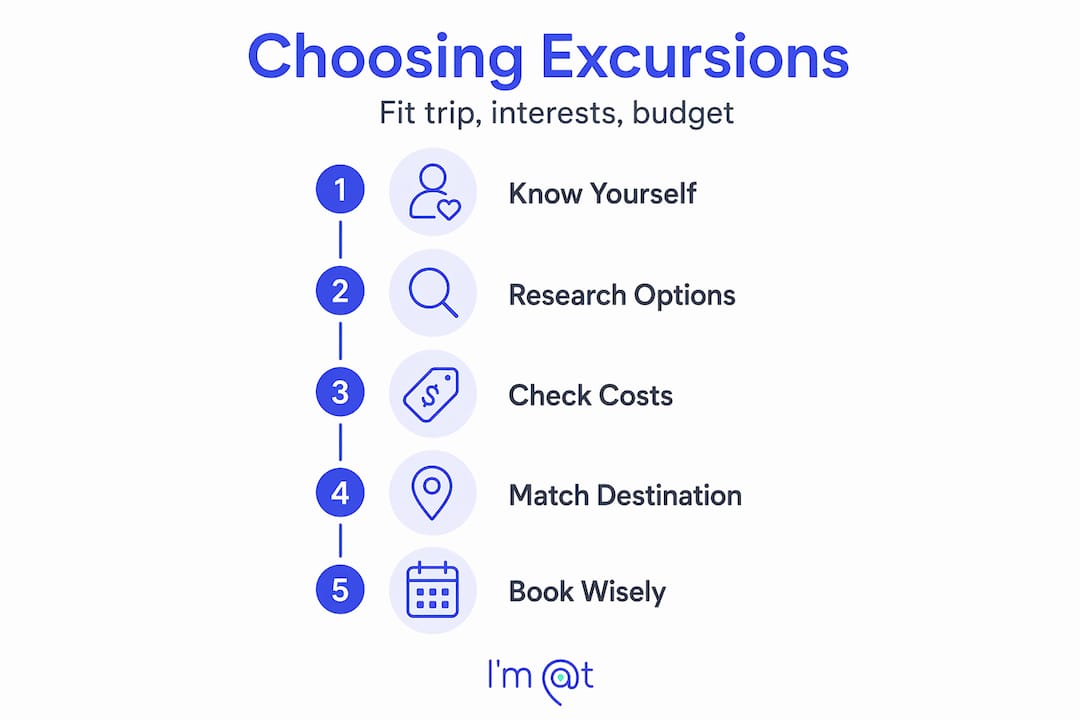
Next, think honestly about your physical condition and comfort level. A "moderate hiking tour" in Costa Rica can mean three hours on uneven terrain in 90-degree heat. If that's not your idea of fun, the beautiful photos online will not make up for the reality.
Here is what to pin down before you book anything:
- Your interest category: culture, adventure, relaxation, food, wildlife, or a mix
- Your activity level: sedentary, light walking, moderate hiking, or physically demanding
- Your time budget: how many hours are actually free after transfers, meals, and rest
- Your financial ceiling: the maximum you are willing to pay per excursion per person
Pro Tip: Use a simple spreadsheet or worksheet to organize excursion options by port, duration, activity level, and cost before you start browsing. It sounds tedious but cuts decision fatigue in half.
Matching your excursion to the destination type
Not every destination deserves the same type of tour. One of the most consistent mistakes travelers make is bringing a fixed idea of what they want to do and forcing it onto a place that offers something completely different. Understanding the connection between port type and excursion type will sharpen every choice you make.
Here is a quick breakdown of destination types and their best excursion matches:
| Destination type | Best excursion options | What to skip |
|---|---|---|
| Historic city (Rome, Cartagena, Athens) | Walking tours, food experiences, museum visits, cultural immersions | Outdoor adventure tours disconnected from local character |
| Adventure-heavy port (Queenstown, Interlaken, Monteverde) | Wildlife encounters, ziplining, kayaking, off-path hikes | Passive sightseeing buses that waste active terrain |
| Easy-access beach or town | Short local food tours, snorkeling, self-guided walks | Full-day bus excursions that pull you away from what the place does best |
The third row in that table is worth pausing on. Easy-access destinations are places where the best experience might be no guided tour at all. If you can walk from the port or hotel into a vibrant neighborhood, a self-guided local exploration often beats any organized group tour. Knowing when to skip the excursion entirely is part of being a smart planner.
Pro Tip: Look up your port or destination on a travel forum before booking. Locals and seasoned travelers will often tell you which tours are unnecessary because the attraction is ten minutes away on foot.
Booking strategies: organized vs. independent tours
This is where travelers face one of their biggest decisions: book through an official provider like a cruise line, or go independent with a local operator.

Cruise line tours offer real advantages. They are logistically protected, meaning if a traffic jam or boat delay makes you late back, the ship waits. They handle everything, and the customer service infrastructure is there if something goes wrong. The tradeoff is price. Independent tours can run 20 to 30 percent cheaper than cruise line versions of similar experiences, and they often feel less scripted.
The risks of going independent are real but manageable. A local operator might have a smaller boat, less predictable timing, or a guide with inconsistent English skills. What separates a great independent operator from a bad one almost never shows up in their star rating. Responsiveness before booking is the single strongest predictor of service quality. If an operator takes three days to answer a basic question, that behavior does not improve once you have paid.
Here is how to vet an independent operator before committing:
- Check reviews on multiple platforms: Look for recent reviews across Google, TripAdvisor, and travel forums, not just the operator's own website.
- Message them with a specific question: Their response speed and clarity tell you everything about how they manage real-time logistics.
- Verify guide credentials: Some destinations require licensed guides for specific sites. A quick search confirms who is qualified.
- Confirm the logistics clearly: Get the pickup location, timing, and cancellation policy in writing before you pay.
Pro Tip: When booking independent shore excursions, always know your hard deadline. If you are on a cruise, that is 30 to 45 minutes before departure. Build that buffer in from the start.
Understanding the real cost of excursions
The listed price is almost never the actual price. This is the part of excursion planning that most guides gloss over, and it is where travelers consistently get surprised.
A typical breakdown of excursion costs looks like this:
| Cost category | Typical range | Notes |
|---|---|---|
| Base excursion price | $20 to $300+ per person | Varies widely by destination and activity type |
| Guide tip | $5 to $20 per person | Expected in most countries; skip it and your reputation precedes you |
| Equipment rental | $15 to $60 per person | Snorkel gear, bikes, wetsuits, helmets |
| Food and drinks | $10 to $40 per person | Often not included unless explicitly stated |
| Transportation to site | $0 to $30 per person | Sometimes not included in "all-inclusive" tour price |
Excursion prices can range dramatically, and the extras add up fast. A $75 snorkeling tour can easily become a $130 afternoon once you factor in gear, a tip, and a beach lunch.
The smartest strategy is to read the tour description carefully and ask the operator one direct question: "What is not included in this price?" Their answer tells you what your actual spend will be.
Know when to spend more, too. If something is on your travel bucket list, and you are only in that location once, this is not the place to find the discount version. Spend appropriately on what matters. Save the budget on shorter, simpler excursions where the experience is largely the same across price points.
Pro Tip: Always carry local currency for tips and small purchases during excursions. Many guides and vendors cannot process cards at outdoor sites.
Common mistakes that ruin excursions
Even well-prepared travelers fall into predictable traps. Knowing these pitfalls in advance puts you ahead of most people on the tour bus.
- Booking based on photos alone. A stunning drone shot of a waterfall does not tell you it is a four-hour round trip hike. Read the full tour description before making any decision.
- Underestimating travel time. The excursion site might be 90 minutes from your port or hotel. That is three hours of transit on top of the tour itself. Many travelers only discover this after they book.
- Over-scheduling your day. Booking a morning tour and an afternoon tour with 45 minutes between them sounds efficient until the first one runs long. Give yourself breathing room.
- Ignoring physical requirements. Some tours list health conditions or mobility requirements in fine print. Missing this creates problems for you and everyone else on the tour.
- Cutting it too close to departure. Whether it is a cruise ship or a flight, failing to plan a generous return buffer has ruined countless vacations. Thirty minutes is never enough. Give yourself at least an hour.
Pro Tip: Before finalizing any excursion booking, pull up a map and time the route from the excursion end point back to your port or hotel. Do it with realistic traffic, not optimistic estimates.
My take on excursion planning after years of travel
I have made every one of those mistakes at some point. Booked too much, rushed back to the ship sweating through a linen shirt, and sat through a walking tour clearly designed for a very different type of traveler than me.
What I have learned is that excursion variety matters to nearly every traveler, but having options only helps if you filter them honestly. A one-size-fits-all group excursion rarely satisfies anyone deeply because it is built to offend no one, which usually means it delights no one either.
The trips I remember most are not the ones with the busiest itineraries. They are the ones where I made one or two deliberate excursion choices and spent the rest of the time getting genuinely curious about a place on my own terms. The best excursion you ever take might be a three-hour food tour with six strangers. Or it might be skipping the tour entirely and following your nose down an alley that is not on any map.
Plan thoughtfully. Then stay loose enough to follow the city when it shows you something better than what you booked.
— Mikahil
Ready to find your next excursion?
Knowing what to look for is only the first step. Finding experiences that match your interests, fit your schedule, and come from vetted providers is where Im-at does the heavy lifting.
Im-at connects travelers with curated experiences across the world, from the Cape Town township and Peninsula tour that covers cultural depth and natural beauty across three days, to the Douro Valley wine and river cruise for travelers who want relaxed, small-group immersion. If you are looking for something more unexpected, The Unholy Secrets delivers a themed experience unlike anything on a standard tour catalog. Browse the full activity library at Im-at and find what fits your next trip.
FAQ
What factors matter most when choosing excursions?
Your personal interests, physical activity level, available time, and budget are the four most important filters. Apply all four before comparing any specific tours.
Is it better to book cruise line excursions or independent tours?
Cruise line tours offer logistical protection and guaranteed return, while independent tours can cost 20 to 30 percent less and often feel more personal. The right choice depends on your risk tolerance and how tight your schedule is.
How do I know if an excursion is worth the price?
Read the full tour description, calculate all-in costs including tips and gear, and check recent reviews on at least two platforms. If the experience aligns with your top travel priorities, the price is usually justified.
How do I avoid picking the wrong excursion?
Read detailed tour descriptions carefully rather than relying on photos or titles, and check whether the activity level and health requirements match your situation before booking.
How much buffer time should I leave before a ship departure?
Give yourself at least one hour between the excursion end point and your departure time. Thirty minutes is not enough once you account for traffic, transfers, and the unexpected.