

TL;DR:
- Reviews shape travel expectations by providing experiential details that scores alone cannot capture.
- Evaluating recent, specific reviews across multiple platforms reveals genuine service quality and reduces booking risks.
Most travelers treat star ratings as the final word on where to go or what to book. That instinct makes sense on the surface, but it misses the bigger picture entirely. The role of reviews in travel runs far deeper than a 4.2 versus a 4.7. Reviews activate something closer to a mental preview of your actual trip, shaping expectations, surfacing risks, and building or destroying trust before you spend a single dollar. Understanding how reviews actually work gives you a genuine edge when planning your next adventure.
Table of Contents
- Key takeaways
- The role of reviews in travel decisions
- How to evaluate reviews beyond star ratings
- Comparing review platforms for travel booking
- Practical strategies for using reviews when planning trips
- My take on what reviews actually teach you
- Plan your next adventure with confidence on Im-at
- FAQ
Key takeaways
| Point | Details |
|---|---|
| Star ratings alone aren't enough | Detailed experiential narratives in reviews predict trip satisfaction more accurately than scores. |
| Recency matters more than volume | 74% of consumers only trust reviews written in the last three months. |
| Management responses reveal service culture | How a business replies to complaints tells you more about quality than the complaint itself. |
| Cross-platform checking reduces risk | Using multiple review sources helps you catch fake impressions and outdated feedback. |
| AI summaries are useful but imperfect | 42% of travelers trust AI-generated review summaries equally to traditional reviews, but human judgment still matters. |
The role of reviews in travel decisions
Travel products are fundamentally intangible. You cannot test a guided safari before you book it, sample a day trip before you pay, or walk through a lodge room before you arrive. That uncertainty creates anxiety, and reviews exist to reduce it. User-generated content consistently outperforms promotional materials in credibility precisely because it comes from people who had nothing to sell.
What separates a genuinely useful review from noise is experiential specificity. Research published in Scientific Reports in 2025 found that sensory, behavioral, affective, and intellectual dimensions of travel experiences described in reviews jointly influence travel intentions in ways that aggregate scores simply cannot replicate. When a reviewer describes the smell of the ocean at dawn during a boat tour, the physical strain of a mountain hike, or the unexpected warmth of a local guide, those details activate something psychologists call a "pre-experience." You mentally simulate the trip before you book it.
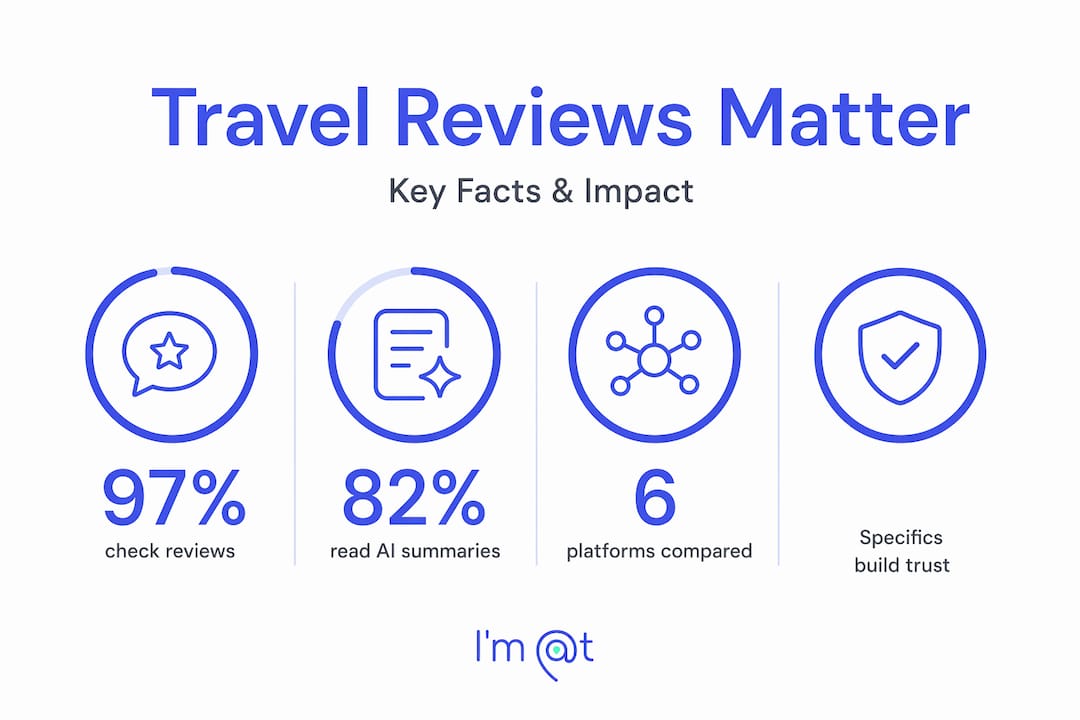
This is why the role of user reviews in tourism has grown so dramatically over the past decade. 97% of consumers now read reviews before choosing a local business, and the travel industry feels that pressure especially hard. The stakes of a bad booking are higher than a disappointing restaurant meal. You've spent money, taken time off work, and traveled potentially thousands of miles.
The practical takeaway here is straightforward. When you read reviews, look for language that describes how something felt, not just whether it was good or bad. A review that says "the guide knew every bird by call and stopped the jeep three times for elephant sightings we would have driven past" tells you something real. "Great experience, five stars" tells you almost nothing.
Pro Tip: When evaluating reviews, filter specifically for the type of traveler closest to you in age, travel style, or group size. A solo backpacker and a family of four experience the same tour very differently.
How to evaluate reviews beyond star ratings
Most travelers skim for the average score and a few top comments. That approach leaves real information on the table. Here is a more structured way to read reviews that actually improves your decisions.
- Read the narratives, not just the scores. Look for reviews that describe specific moments, interactions, or challenges. These detailed accounts give you the most accurate preview of what to expect from a tour, accommodation, or destination.
- Check management responses carefully. Research from the Journal of Multidisciplinary Academic Tourism confirms that accommodative responses from businesses increase trust and reduce perceived risk, while defensive or dismissive responses do the opposite. A business that says "You're right, and here's what we changed" signals operational accountability. One that deflects blame signals the opposite.
- Prioritize recency. According to BrightLocal's 2026 survey, 74% of consumers only care about reviews written in the last three months. An activity that had terrible reviews two years ago but strong recent feedback likely improved. The reverse is also worth noting.
- Look at volume alongside score. A 4.9 average based on 11 reviews is statistically fragile. A 4.5 based on 400 reviews is far more reliable. Volume indicates a pattern rather than a lucky streak.
- Assess photo and Q&A content. Platforms like TripAdvisor allow travelers to upload photos and ask questions. A robust photo library from multiple unrelated travelers is a strong authenticity signal. Q&A threads show whether the operator engages proactively with prospective guests.
The risk of fake or vindictive reviews is real and worth accounting for. Vindictive reviews, those written specifically to damage a business rather than report an authentic experience, increase perceived risk even when the business responds well. The "scar effect" means that some negative impressions stick in your memory regardless of what the operator says afterward. Your best defense is cross-referencing. One alarming review across three platforms is likely an outlier. The same complaint pattern appearing across multiple sources deserves attention.
| Signal | What it suggests |
|---|---|
| Accommodative response to negative review | Operator takes accountability and likely improved |
| Defensive or dismissive response | Risk of recurring service issues |
| Recent photo uploads from multiple travelers | Authentic, active operation |
| Sudden spike in five-star reviews | Possible manipulation worth investigating |
| Consistent complaint theme across platforms | Genuine operational problem |
Pro Tip: If you see a negative review that describes a specific problem like broken equipment or a canceled route, search for more recent reviews that mention the same issue. Positive operator responses without follow-up evidence from newer guests are less reassuring than they appear.
Comparing review platforms for travel booking
Not all review platforms are created equal, and the differences matter when you are making real booking decisions. The role of reviews in activity booking depends heavily on how platforms verify and moderate their content.
TripAdvisor operates on a user-generated model where any traveler can post a review regardless of whether they booked through the platform. It compensates with automated and human moderation to detect and remove fraudulent submissions, plus extensive photo and Q&A features that create richer context around raw scores. Booking.com takes a different approach. Its reviews are tied to completed bookings, meaning only guests who actually stayed or participated can leave feedback. That verified structure makes scores harder to game and generally more reliable for accommodation decisions.
The practical reality is that smart travelers use both, and then some. Consumers consult an average of six review platforms before making a decision. That number seems excessive until you realize how much each platform reveals about a different slice of the experience.
Here is how to use platforms strategically:
- Use verified platforms like Booking.com for accommodation reliability scores
- Use TripAdvisor for activity depth, photos, and Q&A engagement
- Check Google Reviews for raw volume and recency on local operators
- Scan travel forums and community groups for unfiltered candid opinions
- Look at specialized adventure booking platforms for curated, experience-specific feedback
One emerging factor worth watching: AI-generated review summaries. 82% of consumers now read AI summaries of reviews, and 42% trust them as much as individual reviews. These tools are genuinely useful for spotting patterns across hundreds of reviews at a glance. The limitation is that AI summaries can smooth over important outlier experiences, the ones that might be most relevant to your specific situation. Treat them as a starting point, not a final answer.
Practical strategies for using reviews when planning trips
Knowing that reviews matter is not the same as knowing how to use them effectively. Here is how to apply review insights at every stage of your travel planning process.
Start with recent reviews across multiple platforms. Set a mental cutoff of three months for anything related to service quality, guides, or logistics. Physical infrastructure like a hiking trail or a city's layout changes more slowly, so older reviews on those factors carry more weight. For tour planning decisions, recency and cross-platform consistency together form your strongest signal.
Use review content to match experiences to your preferences. The impact of travel reviews is not just about quality. It is about fit. If every review of a day trip to Bagamoyo mentions long stretches of walking and significant heat, that detail is neutral for an experienced hiker and a dealbreaker for someone with mobility concerns. Reviews tell you what an experience actually involves, not just whether it was enjoyed.
Evaluate operator responsiveness as a proxy for service culture. The importance of travel feedback shows up most clearly in how businesses use it. An operator who responds to 80% of reviews, addresses specific complaints, and thanks guests by name runs a fundamentally different operation than one that ignores feedback entirely. That behavior predicts your actual experience.

Recognize that even good responses carry residual risk. A single empathetic reply from management to a concerning review does not fully erase the underlying concern. Look for newer reviews that either confirm the problem persisted or demonstrate it was resolved. That pattern of evidence is what builds genuine booking confidence.
Pro Tip: Before booking any guided experience, search for the specific guide's name in reviews if the platform allows it. Individual guides often make or break an activity regardless of how the company scores overall.
My take on what reviews actually teach you
I've spent years reading travel reviews as both a traveler and an observer of how the industry uses them. My honest assessment is that most people are reading them wrong.
The biggest mistake I see is treating a high star average as a green light without reading the narrative content. I've seen 4.8-rated tours that, based on the actual review text, would be a poor fit for anyone who values flexibility or spontaneity. The reviews were glowing, but every single one described a rigid, group-heavy format. The score told you nothing. The stories told you everything.
The "scar effect" is also something I think travelers underestimate. When a business responds beautifully to a serious complaint, we tend to mark it resolved in our minds. But the research is clear: residual risk perception lingers even after empathetic responses. My advice is to look for newer reviews that confirm the problem was genuinely fixed. Words from a business are less convincing than experiences from subsequent guests.
Where I've seen review culture genuinely improve travel is in the way it forces local operators to stay accountable. The benefit of reviews in tourism is not just for travelers. It creates a feedback loop that raises standards across entire regions. That's a win worth supporting by leaving honest, detailed reviews yourself after every trip.
— Mikahil
Plan your next adventure with confidence on Im-at
Knowing how to read reviews is only useful if you're booking experiences worth reading about. Im-at connects you with hundreds of guided tours, safaris, cultural day trips, and outdoor adventures, each with real guest feedback built into the platform so you can make confident, informed decisions before you book.
Explore tailor-made 4x4 tours with verified guest reviews that give you the kind of experiential detail this article described. You can also check out the private Bagamoyo day trip and read firsthand accounts from travelers who have already made the journey. For mountain enthusiasts, Im-at's Table Mountain hiking experiences come with extensive feedback on guide quality, trail conditions, and physical demands.
The platform's review system reflects exactly what this guide outlines. Recent, specific, and cross-verified feedback from real guests. Browse, compare, and book your next experience at im-at.com.
FAQ
How do reviews influence travel decisions?
Reviews reduce the uncertainty that comes with booking intangible travel experiences by providing peer-sourced accounts of what to actually expect. Experiential content in reviews influences travel intentions more strongly than promotional descriptions or star averages alone.
What makes a travel review trustworthy?
Reviews tied to verified bookings, supported by photos, and written with specific experiential detail are the most reliable. Platforms like Booking.com link reviews to completed stays, which significantly reduces the risk of fabricated feedback.
Should I trust how businesses respond to negative reviews?
Yes, with one caveat. Accommodative responses from operators do increase trust and reduce perceived risk, but risk perception can linger even after a good reply. Look for newer guest reviews that confirm the issue was actually resolved.
How many review platforms should I check before booking?
Consumers consult an average of six platforms before making a decision, and for travel in particular, cross-referencing two to three platforms is enough to identify consistent patterns and filter out outliers.
Are AI-generated review summaries reliable for travel planning?
They are useful for spotting broad trends across large numbers of reviews, but 42% trust them fully compared to individual reviews. Use AI summaries as a starting point, then read individual reviews for the specific details that match your travel style.