

A day trip lowers stress within 24 hours, costs a fraction of an overnight vacation, and needs no PTO request. That's the entire case in one sentence, and it holds up under research from environmental health journals to occupational psychology labs. A day trip is a single-day outing where you leave and come home the same day, no lodging involved, which is exactly why it clears so many of the barriers that keep people from traveling at all.
The advantages break down into a few clear categories:
- Mental restoration — a change of scenery interrupts autopilot thinking and measurably improves mood
- Low cost — no hotel, no extra vacation days, no flight
- Minimal time commitment — fits into a Saturday or a long weekend afternoon
- Social connection — an easy, low-stakes way to spend real time with people
- Physical activity — walking, hiking, or cycling built into the day itself
- Cognitive boosts — novelty and movement both sharpen problem-solving
Leisure trips as short as two to three days already produce measurable drops in stress and improved mood within the first 24 hours, according to research published in the International Journal of Environmental Research and Public Health. If a multi-day trip works that fast, a well-planned day trip captures a meaningful slice of that same effect, at almost no cost. Im-at exists largely to make that slice easy to find and book.
Key Takeaways
Day trips deliver measurable stress and mood benefits within 24 hours, at a fraction of the cost and time commitment of overnight travel.
| Point | Details |
|---|---|
| Benefits start fast | Mood and stress improvements appear within the first 24 hours of a short leisure trip. |
| Frequency beats length | Regular short trips produce steadier happiness than one long annual vacation. |
| Keep transit under two hours | Longer commutes eat into the restorative value of the day. |
| One anchor activity wins | Overpacked itineraries reduce recovery; pick one anchor and stay flexible. |
| Book through Im-at | Search and book local tours, workshops, and outdoor activities in one place to remove planning friction. |
Table of Contents
- What Are the Advantages of Day Trips?
- What Does the Research Say About Day Trips?
- How Often Should You Take a Day Trip?
- How Do You Plan a Day Trip That Actually Restores You?
- When Are Day Trips Not Enough?
- Day-Trip Ideas You Can Adapt Anywhere
- Why I Track My Day Trips Like Data
- Let Im-at Handle the Planning Part
- Frequently Asked Questions
- Sources
What Are the Advantages of Day Trips?
Each advantage works through a different mechanism, and knowing which lever you're pulling helps you plan a better day.
Stress reduction happens fast. Novelty breaks the loop of routine thinking that keeps cortisol elevated. A two-hour walk through a botanical garden you've never visited does more for your nervous system than an extra hour of sleep, because it forces your brain out of autopilot. One insight on psychological restoration points out that new environments sharpen attention precisely because they're unfamiliar, not because they're far away.
Practical savings are immediate. No hotel booking, no packing for multiple days, no requesting time off work. You leave in the morning and you're home for dinner. That single fact removes the biggest obstacle most people cite for not traveling more, according to travel-cost commentary on short excursions.

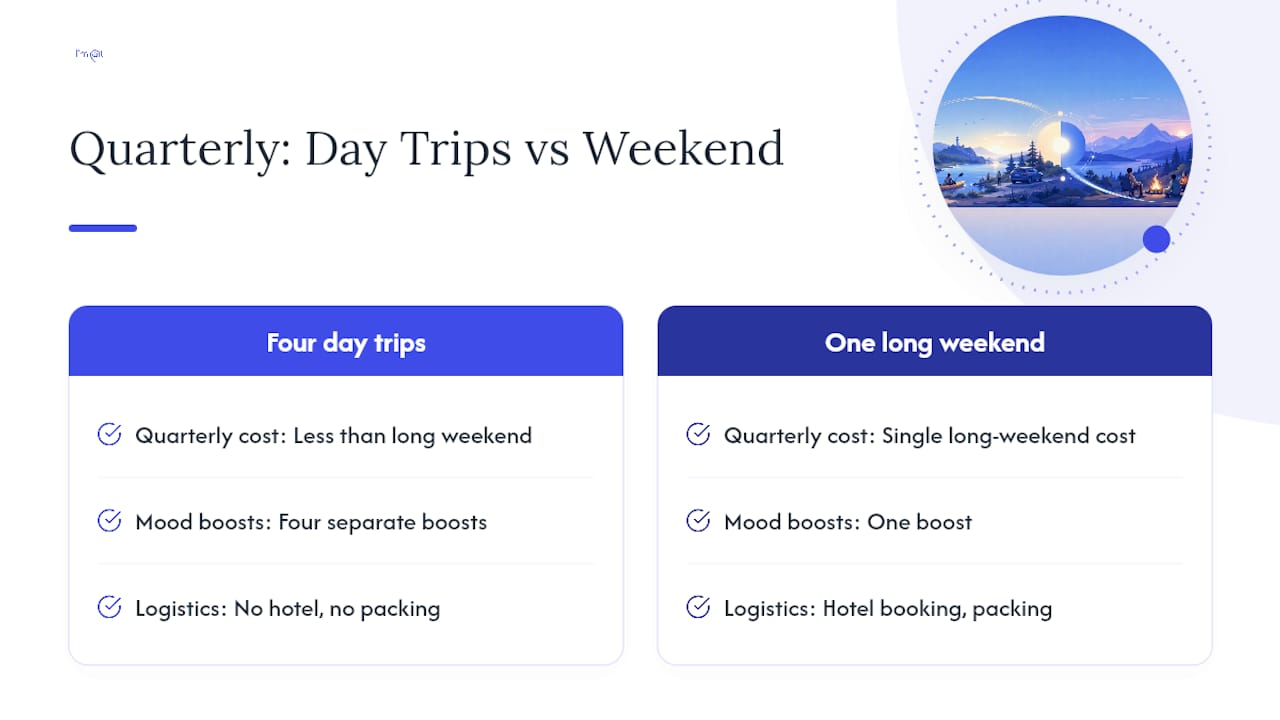
Financial savings compound over a year. Four day trips a quarter, each costing less than an overnight stay, can add up to less than a single long weekend away. And you get four separate mood boosts instead of one.
Social connection gets easier. A day trip is a low-pressure way to spend real hours with a friend, partner, or family member, without the logistics of coordinating overnight plans. Something as simple as exploring nearby local excursions together builds connection without the planning overhead of a bigger trip.
Physical activity gets built in automatically. A hike, a bike tour, a walking food crawl. Stanford research on walking versus sitting found that walking in natural or novel settings improves creativity and problem-solving compared with staying seated indoors. That's not a coincidence; movement paired with new scenery does double duty.

Cognitive and creative boosts follow the same pattern. Stepping outside a familiar routine, even for six hours, gives your brain the kind of unstructured input that sparks ideas you wouldn't get staring at the same four walls.
Pro Tip: When you're deciding between two day-trip options, pick the one that feels newer to you over the one that's simply farther away. Novelty drives restoration more than mileage does.
What Does the Research Say About Day Trips?
The most useful finding for anyone skeptical of "just a day trip" is timing: benefits show up fast. Mental-health improvements from short leisure trips begin within the first 24 hours of travel, based on findings in the International Journal of Environmental Research and Public Health. You don't need a week to see a measurable shift in mood and stress markers.
Frequency turns out to matter more than length. Psychology research on short trip frequency found that people who take short trips every few months report more happiness and resilience than people who save everything for one long annual vacation. A parallel finding on anticipation shows why: planning a trip generates a mood boost before it happens, so four day trips a year hand you four anticipation windows instead of one.
Repeated short breaks spread anticipation and recovery across the calendar year, producing a steadier mood curve than a single long vacation that spikes once and fades for months afterward.
University research on distance adds a wrinkle worth knowing: traveling farther from home correlates with better health outcomes and more social participation in some populations, which suggests day trips shouldn't always stay hyper-local if the goal is maximum benefit.
How Often Should You Take a Day Trip?
Monthly is a reasonable target for most people; quarterly is a practical minimum to maintain the anticipation-and-recovery cycle. Keep the travel-to-experience ratio in check by staying under roughly a two-hour transit window each way, a rule of thumb backed by research on travel's impact on stress and satisfaction at university students. Beyond that window, the drive itself starts eating into the restorative payoff.
A day that actually works usually follows this rhythm:
- Departure by mid-morning so you're not rushing the first activity.
- One anchor activity that gives the day its shape and purpose.
- A buffer hour before heading home, so you're not sprinting straight from activity to car.
- A short decompression window once you're back, even fifteen minutes of quiet before diving into email or chores.
The planning itself is part of the benefit. Booking the anchor activity a week or two ahead extends the anticipation window and gives you a small mood lift every time you glance at the calendar.
How Do You Plan a Day Trip That Actually Restores You?
The biggest planning mistake is cramming too much into six hours. One anchor activity beats three rushed ones, every time.
- Pick a single anchor first: a hike, a museum, a market, a specific tour.
- Sort transport before anything else, since a bad commute erases the benefit before the day even starts.
- Book timed entry if the anchor activity has one, so you're not standing in a line burning your morning.
- Plan food loosely, one solid meal reservation or a known food stop, not a scheduled itinerary.
- Build in a return ritual, a coffee, a playlist, ten quiet minutes, anything that signals the day is closing out.
Cost-saving moves that don't cost you the experience:
- Travel off-peak to dodge crowds and higher pricing.
- Use public transit where it's practical instead of driving and parking.
- Pack a lunch for at least one meal instead of eating out three times.
- Book the anchor activity in advance to lock in lower prices before demand pushes them up.
Pro Tip: Plan with "loose intention": lock in one anchor activity and leave the rest of the day unscheduled. Decision fatigue from an over-planned itinerary undoes a lot of the calm you were trying to create. Tools like smart activity planning guides can help you nail the logistics without over-engineering the whole day.
When Are Day Trips Not Enough?
Day trips are not a substitute for everything. They won't replace a longer retreat if you're recovering from burnout that's been building for months, working through a major life transition, or need real distance from a demanding environment to reset properly.
Watch for these red flags that a day trip is doing more harm than good:
- An itinerary packed with four or five activities back to back
- Transit time that eats more than a third of the day
- Skipping sleep the night before to squeeze in an early departure
Research on travel recovery and reflective practice backs this up directly: overstuffed itineraries blunt the restorative payoff, while a deliberate decompression period afterward improves it. If you're consistently exhausted after "restorative" day trips, that's a sign you need a longer getaway, not a better day plan.
Day-Trip Ideas You Can Adapt Anywhere
A short list of formats that work in almost any region, adjusted to whatever is nearby:
- Nature walk or trail — a state park, coastal path, or urban greenway, low-cost and highly restorative
- Museum plus café — one exhibit, one long coffee afterward to talk it over
- Culinary crawl — three or four small stops instead of one long sit-down meal, an approach explored in local cuisine and tourism coverage
- Creative workshop — pottery, painting, or a cooking class booked for the afternoon
- Active day — a bike route or moderate hike with a scenic payoff at the end
- Social day with friends — a group activity like shark cage diving built specifically around shared experience
- Reflective solo trip — one quiet, unstructured day exploring somewhere you've never been
Why I Track My Day Trips Like Data
I started jotting down a one-line mood note before and after every day trip, nothing formal, just a phone note. The pattern showed up fast: the trips with one clear anchor activity beat the ones where I tried to cram in three stops, every single time. It's a small habit, but it turned "I should get out more" into an actual, trackable practice. Planning tools that surface nearby activities worth exploring make that first step, picking the anchor, take minutes instead of an evening of tab-hopping.
Let Im-at Handle the Planning Part
Im-at is the fastest way to turn "I should take a day trip" into a booked plan, because it works as a search engine and booking portal for local tours, workshops, and outdoor experiences in one place, instead of five open browser tabs. You pick the anchor activity, book it in minutes, and skip the research spiral that usually kills the whole idea before it starts.

If you're weighing options for your next Saturday out, browse something like The Unholy Secrets and see how quickly a real plan comes together once the anchor activity is locked in. That single booking is often the difference between a day trip that actually happens and one that stays a someday idea.
Frequently Asked Questions
What counts as a day trip? A day trip is any outing where you leave and return home the same day, with no overnight stay involved. That distinguishes it from a weekend getaway or vacation, and it's exactly why day trips carry a lower cost and time barrier.
How often should you take a day trip for real mental-health benefits? Monthly is a strong target, with quarterly as a realistic floor. Research on short trip frequency found people who travel every few months report more happiness and resilience than those saving up for one big annual trip.
Are day trips actually better than a long vacation? Not better, but different, and often more sustainable. A long vacation gives you one large mood spike; frequent day trips spread smaller boosts and anticipation windows across the whole year, which several studies link to more consistent resilience.
What's the biggest mistake people make planning a day trip? Overpacking the schedule. One anchor activity with breathing room around it produces a better outcome than three rushed stops, according to research on travel recovery and reflective practice.
Can a day trip replace therapy or a longer retreat? No. Day trips are a solid tool for everyday stress and routine burnout, but they aren't a substitute for addressing deeper mental-health needs, major life transitions, or medical recovery, which call for professional support or a longer break.
Sources
- International Journal of Environmental Research and Public Health
- UCL — Travelling farther away from home linked to better health