

TL;DR:
- Day trips offer mental health benefits similar to long vacations through novelty and routine disruption.
- They are cost-effective, flexible, environmentally friendly, and enhance local community engagement.
- Proper planning and moderation are key to maximizing the rewards and avoiding travel burnout.
Day trips can deliver mood-boosting, stress-reducing benefits equal to weeklong vacations, and most travelers never realize it. Research backs this up: mental health benefits comparable to longer vacations are achievable through a single well-planned day out. No packing, no airports, no blown budget. Just a fresh experience that resets your mind, exposes you to new cultures, and leaves you more energized than before. This guide breaks down the science behind why day trips work so powerfully, how they compare to traditional vacations, and what practical steps you can take to get the most out of every local adventure.
Table of Contents
- The science behind day trips: Wellbeing and mental health
- Day trips vs. longer vacations: Comparing access, cost, and impact
- Culture, community, and sustainability: Local connections through day trips
- Risks, limitations, and how to plan day trips for maximum benefit
- The overlooked power of day trips: Rethinking modern travel
- Ready to plan your unforgettable day trip?
- Frequently asked questions
Key Takeaways
| Point | Details |
|---|---|
| Mental health boost | Day trips trigger novelty, dopamine, and stress reduction, rivaling longer vacations. |
| Accessible and flexible | Day trips are easier to plan, budget-friendly, and offer lower ecological impact. |
| Cultural connection | Short trips foster community support, authentic experiences, and local economic growth. |
| Sustainable adventure | Frequent, moderate day trips prevent burnout and support eco-friendly travel practices. |
| Smart planning matters | Avoid extreme itineraries and balance your day trips for maximum enjoyment and wellbeing. |
The science behind day trips: Wellbeing and mental health
Let's dig into how day trips really affect your mind and body. The short answer is that your brain is wired to reward novelty. When you step into an unfamiliar environment, even one just 30 miles from home, your brain releases dopamine, the same chemical tied to motivation, pleasure, and learning. That fresh context is enough to snap your nervous system out of its routine-dulled state.
Routine is the enemy of vitality. Repetitive daily patterns can cause cortisol, the body's main stress hormone, to stay chronically elevated. Short, frequent trips help regulate cortisol by giving your system a genuine break without the logistical demands of longer travel. You get the chemical reset without the burnout of a long haul.
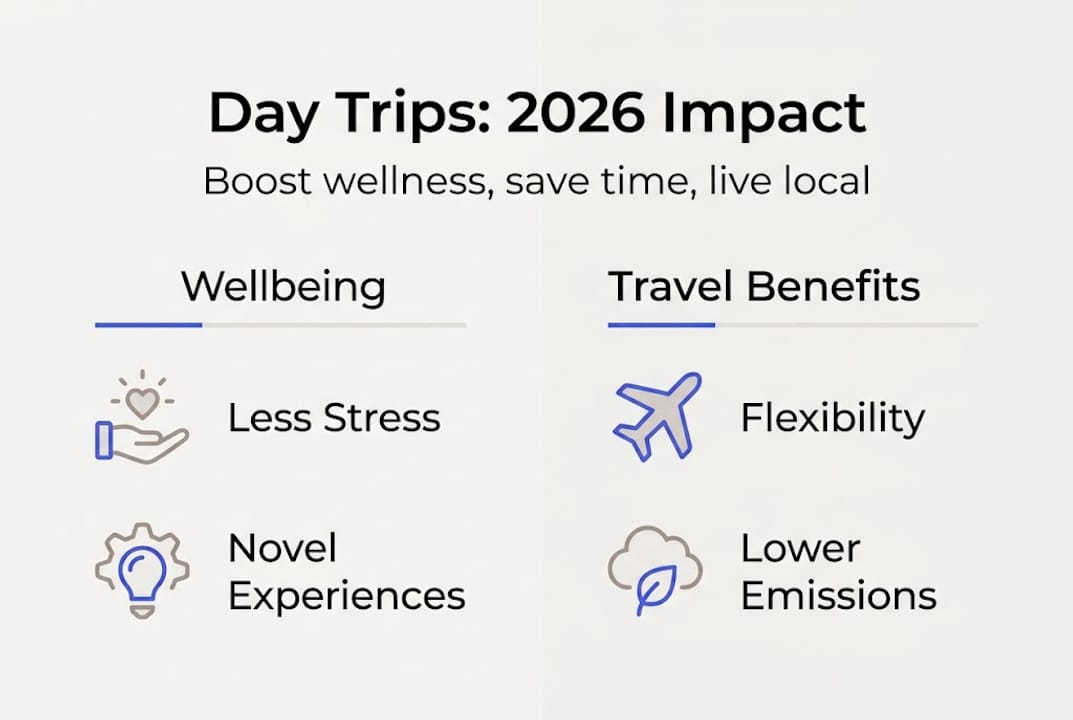
Nature-based day trips take these benefits even further. Forest therapy and nature excursions have been shown to reduce anxiety, anger, depression, fatigue, and confusion while actively enhancing vitality. So a day hike through a forest preserve or a coastal trail walk is doing serious neurological and emotional work, even if it feels casual.
Dynamic day trips, ones where you move, explore, and engage, consistently outperform passive outings for mental benefit. Sitting on a beach is restful; guiding yourself through a new neighborhood, joining a food tour, or kayaking an unfamiliar river is restorative. That difference matters.
Here is a quick look at how different day trip types stack up for wellbeing outcomes:
| Day trip type | Mood boost | Stress relief | Vitality gain |
|---|---|---|---|
| Forest or nature hike | High | High | High |
| City cultural tour | Moderate | Moderate | Moderate |
| Passive beach visit | Low | High | Low |
| Active outdoor adventure | High | High | High |
Key wellbeing benefits of a well-planned day trip:
- Dopamine release from novel environments
- Cortisol reduction through routine interruption
- Mood elevation from physical activity
- Increased sense of purpose and connection
- Reduced mental fatigue and cognitive overload
Exploring cultural experience benefits alongside the physical side of travel creates a compounding effect on wellbeing. Culture stimulates different cognitive pathways than nature, and combining both in a single day is entirely achievable. Research on staycation mental health confirms that proximity to an experience has almost no bearing on its psychological value.
Pro Tip: Adopt a "tourist gaze" in your own city. Visit a neighborhood you have never walked through, eat somewhere unfamiliar, and narrate the experience to yourself as if you are seeing it for the first time. Your brain will register the novelty and reward you for it.
Day trips vs. longer vacations: Comparing access, cost, and impact
Beyond mental health, day trips also reshape how you travel logistically. The first thing most travelers notice is the cost. Day trips are budget-friendly because they cut out overnight accommodation, which is often the single largest travel expense. No hotel booking, no early check-in fees, no last-minute cancellation penalties.
Interestingly, short trips cost more per day at around $220 to $280 compared to $150 to $200 for longer trips. But day trips sidestep this entirely. You keep the novelty of a short trip and eliminate the accommodation premium. That is a meaningful financial advantage, especially if you travel frequently.
Here is how the three formats compare side by side:
| Factor | Day trip | Weekend trip | Long vacation |
|---|---|---|---|
| Average cost | $30 to $100 | $400 to $800 | $1,500+ |
| Planning time | Under 1 hour | 2 to 5 hours | Days to weeks |
| Carbon footprint | Low | Moderate | High |
| Flexibility | Very high | Moderate | Low |
| Local economic impact | High | Moderate | Variable |
Looking at travel activities comparison across trip types makes it clear that day trips score consistently high on accessibility and sustainability. They are genuinely available to more people, more often.
Steps to maximize value from a day trip:
- Choose a destination with at least two distinct activity types, such as nature and culture combined.
- Leave earlier than you think you need to. Morning arrivals at popular spots avoid crowds and peak pricing.
- Eat where locals eat. One authentic meal can define the entire experience.
- Book at least one guided or structured activity to deepen the experience.
- Leave time unplanned. Spontaneous discoveries often outperform the itinerary.
- Document one specific thing you learned or felt, not just photos.
The flexibility of day trips also means you can respond to weather, energy levels, and your mood in real time. A long vacation locks you into bookings. A day trip lets you pivot without penalty.

Culture, community, and sustainability: Local connections through day trips
Mental health and cost savings are only part of the picture. Let's explore culture and sustainability next. Day trips are uniquely positioned to build genuine connections with local communities in a way that resort-based or hotel-anchored travel rarely achieves. When you spend the full day in a local area, spending at local vendors, joining community-led tours, and engaging with residents directly, that money circulates locally rather than going to international chains.
Day trips actively support local economies and provide more accessible entry points to authentic culture. You do not need a week off work or a premium travel budget. You need a free Saturday and a willingness to show up somewhere new.
"The most powerful cultural travel is often the most ordinary, a neighborhood market, a local festival, a guided walk through streets most tourists never see."
Sustainability is also dramatically more achievable with day trips. No flights means a fraction of the carbon footprint. Staying within a region means you support the same local suppliers repeatedly, building relationships and reinforcing economic resilience. Learning about authentic local travel shows just how much guides and community members shape the quality of a travel experience.
Practical ways to build cultural immersion into a day trip:
- Join a locally led walking tour instead of a large group bus tour
- Visit a community market or farmers market rather than tourist-facing shops
- Eat at family-run restaurants and ask what is seasonal
- Attend a local event, festival, or open-air performance
- Learn three words in the local language before you go
- Buy a small handmade item directly from the creator
For those curious about maximizing each outing, reading up on local excursion insights reveals how thoughtful curation of a day trip can yield genuinely rich travel experiences without leaving your own region. Even seasoned international travelers are often surprised by what is on their doorstep.
Pro Tip: Ask a local business owner or guide for one recommendation they would give a friend, not a tourist. The answers are almost always better than anything on a review site. These conversations are where authentic travel rewards actually live. Exploring types of local activities can help you identify which formats suit your interests most.
Risks, limitations, and how to plan day trips for maximum benefit
While day trips offer substantial rewards, there are important limitations to consider. The biggest mistake travelers make is trying to pack too much into a single day. The extreme day trip trap involves waking up before dawn, driving hours each way, rushing through multiple attractions, and arriving home exhausted rather than refreshed. That is not a day trip; that is a sprint.
Frequent short breaks prevent burnout more effectively than infrequent long holidays, but only when those breaks are genuinely restful or stimulating, not logistically punishing. The format matters as much as the frequency.
The micro-cation trend emerging globally reflects this growing awareness. Travelers are learning that the best adventures are lean, flexible, and intentional rather than exhausting and overloaded.
Steps to design a flexible, rewarding day trip itinerary:
- Set a clear theme or intention, such as food, history, or outdoor movement.
- Limit yourself to two or three anchor activities.
- Choose a location no more than two hours away to preserve energy.
- Build 60 to 90 minutes of unstructured time into the middle of the day.
- Plan your return time so you arrive home before you are exhausted.
Common day trip pitfalls to avoid:
- Overbooking timed entry slots back to back
- Underestimating travel time and arriving stressed
- Choosing destinations purely based on popularity rather than personal interest
- Ignoring weather forecasts for outdoor-heavy plans
- Forgetting to eat before physical activities
For those who want to build discovery into the habit, exploring unique travel discovery can spark ideas for destinations that suit your specific travel style.
Pro Tip: Prioritize moderation. A day trip that ends with you saying "I could have stayed longer" is a perfect day trip. That feeling is exactly what you want to carry into the next one.
The overlooked power of day trips: Rethinking modern travel
Now, let's look at why day trips are poised to reshape travel culture itself. For decades, the cultural script around travel has been built on scarcity: save for a big trip, take two weeks off, go far away. That model works for some people sometimes. But it quietly sidelines the majority who do not have the budget, the paid leave, or the flexibility for annual mega-vacations.
Day trips challenge that script in a useful way. They suggest that meaningful travel is not about distance or duration. It is about attention. The traveler who spends a full Saturday exploring local excursion perspective in their own region often returns more satisfied than someone who spent 10 days on a pre-packaged resort holiday.
The travel industry should take note. Businesses that help local guests discover nearby experiences, rather than only marketing long-haul packages, tap into a market that is growing, price-conscious, and highly motivated. The micro-cation is not a consolation prize. For many travelers, it is becoming the preferred format.
Ready to plan your unforgettable day trip?
The best way to embrace these insights? Start planning your next locally inspired adventure. Whether you are drawn to rolling wine country, rugged volcanic trails, or curated cultural walks, there is a perfectly crafted day experience waiting for you.
On Im-at, you can browse and book experiences like a tailor-made adventure tour designed around your interests, a scenic Douro Valley day trip complete with wine tasting and a river cruise, or an outdoor adventure on Terceira Island featuring hiking and caving. Each experience is bookable in minutes. No long itineraries, no complex logistics. Just a great day, ready when you are.
Frequently asked questions
Are day trips as beneficial as longer vacations for mental health?
Yes, day trips deliver comparable benefits to longer vacations by triggering novelty responses and reducing stress hormones, without requiring time off work or a big budget.
What are the best types of day trips for boosting mood and wellbeing?
Nature-focused and active day trips consistently produce the strongest results. Forest therapy excursions reduce anxiety, depression, and fatigue while significantly enhancing vitality compared to passive rest.
Do day trips help prevent travel burnout?
Frequent short breaks outperform infrequent long holidays at preventing burnout, because they deliver regular novelty and cortisol regulation without the recovery time a big trip demands.
Are day trips environmentally friendly?
Day trips produce far less carbon than flights or overnight travel, and local day trip spending feeds directly into community economies, making them one of the most sustainable travel formats available.
How can I avoid burnout or exhaustion during intense day trips?
Keep your itinerary lean, limit anchor activities to two or three, and build in unstructured time. Poorly planned extreme trips risk physical fatigue and financial overrun, so flexibility is the most important planning tool you have.