

TL;DR:
- Balancing well-planned activities with unscheduled time enhances leisure travel energy and satisfaction. Travelers should limit daily activities to avoid exhaustion, using tiers, clusters, and open buffers for flexibility. Smart planning, early bookings, and leaving gaps for spontaneous moments lead to more enjoyable, relaxed trips.
Maximizing leisure time travel means combining well-planned key activities with intentional unscheduled time, so you stay energized instead of exhausted. Most travelers either overpack their schedules or drift without direction, and both approaches waste the trip. The sweet spot sits between structure and freedom. Experts recommend capping daily sightseeing at 2-3 activities per day, leaving at least 1-2 hours open for wandering, eating, or simply sitting still. When you plan leisure trips with that balance in mind, you get more out of every destination, not less.
How to maximize leisure time travel with a smarter itinerary
The biggest mistake travelers make is treating every hour as a slot to fill. A smarter approach uses what planners call a tiered itinerary: confirmed anchors, preferred activities, and a backup list. Each tier serves a different purpose. Anchors are non-negotiable bookings like museum tickets or guided tours. Preferred activities are things you want to do if time and energy allow. Backups exist for weather changes, closures, or moments when you simply need something lower-key.
Anchor-based planning groups activities by zone and time of day rather than strict timestamps. Instead of scheduling "the cathedral at 10:15 AM," you plan "morning zone: old town area." That flexibility lets you move at your own pace without feeling behind. It also cuts the mental load of tracking exact times for every stop.
Grouping attractions geographically is one of the highest-value tips for maximizing travel time. Planning activities in clusters by neighborhood or zone cuts commute time by 30-50%, which translates directly into more time doing things you enjoy. Crossing the city twice in one day to hit scattered sights is one of the fastest ways to drain your energy.
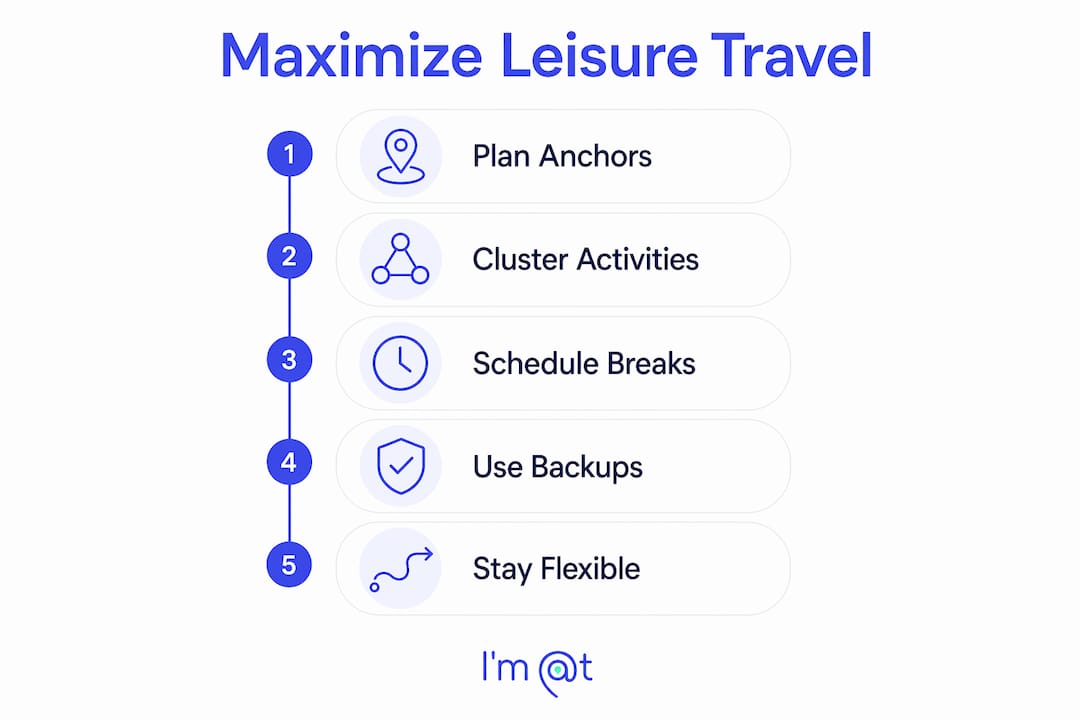
Slow days are not wasted days. One unstructured day every 5-6 travel days is a fixed part of any well-built itinerary. These days reset your energy, give you space to revisit a favorite spot, and often produce the most memorable moments of a trip.
Here is how to structure your daily itinerary for maximum leisure:
- Anchor (1-2 per day): Pre-booked, time-sensitive activities like tours or entry tickets
- Preferred activities (1-2 per day): Flexible additions based on energy and interest
- Open time (1-2 hours daily): Unscheduled buffer for spontaneous detours or rest
- Backup list: 3-5 low-effort alternatives accessible offline for plan changes
- Slow day (every 5-6 days): A full day with no anchors, just wandering and recharging
Pro Tip: Use a simple notes app with three sections, anchors, preferred, and backups, and share it with your travel companions before you leave. Offline access matters when you lose signal.
What travel logistics strategies save the most time?
Smart logistics are the foundation of efficient travel for free time. Every hour saved on transit, airport lines, or packing confusion is an hour you can spend actually enjoying the destination.
-
Book flights mid-week. Travelers can save 20-30% on airfare by choosing Tuesday through Thursday departures and avoiding peak holiday periods. That saving also means fewer crowds at airports, which reduces stress before the trip even starts.
-
Lock flights first, then book accommodations gradually. Booking flights 2-3 months ahead secures the best prices. For accommodations, book your first night before you arrive, then decide on the rest as the trip unfolds. This approach works especially well for multi-city trips where your interests may shift.
-
Choose centrally located accommodations. Staying near the areas you plan to explore reduces transport time and improves your overall travel tempo. A central hotel costs more per night but saves money and energy on taxis and transit.
-
Pack carry-on only for short trips. Carry-on travel reduces physical drag and keeps you mobile. You skip baggage claim, move faster between cities, and never worry about lost luggage. For trips under 10 days, most travelers can manage with a single carry-on bag.
-
Pre-pin local spots before you arrive. Save restaurants, cafes, parks, and attractions to your maps app while you still have reliable Wi-Fi. This cuts daily planning time to almost nothing and lets you make decisions on the fly without burning data or searching from scratch.
Pro Tip: Download offline maps for every city on your itinerary before departure. When you are lost in a neighborhood with no signal, offline maps are the difference between a detour and a disaster.
How do you experience local culture without over-scheduling?
The happiest travelers prioritize novelty and presence over volume. Positive psychology research shows that absorbing views, talking to locals, and eating regional food produces more satisfaction than checking off a long list of landmarks. This is the core insight behind the best ways to travel during leisure: do fewer things, but do them fully.

Local food is one of the fastest ways to connect with a place. Local cuisine is not just a meal. It is a window into a region's history, agriculture, and social life. Eating where locals eat, rather than at tourist-facing restaurants, costs less and delivers far more authenticity.
Your hotel or guesthouse is an underused resource. Front desk staff know which neighborhood market is worth visiting, which beach is quieter than the famous one, and which restaurant does not appear on any travel site. Ask them. That conversation takes five minutes and often produces the best recommendation of the trip.
Quick strategies for local immersion during downtime:
- Walk a residential neighborhood with no destination in mind for at least 30 minutes
- Order one dish you cannot identify from the menu
- Visit a local market in the morning, when it is busiest and most alive
- Sit in a public square and watch daily life for 20 minutes without your phone
- Ask your accommodation host for one place they personally love
Cultural experiences planned in advance give you the structure, but the moments between them give you the story. Leave room for both.
What common mistakes reduce leisure travel enjoyment?
Over-scheduling is the most common and most damaging mistake in leisure travel planning. When every hour has a task, travel starts to feel like work. The solution is not to plan less. It is to plan differently.
Rigid timestamp planning creates anxiety. If you are 20 minutes behind schedule by 10 AM, the rest of the day feels like a race. Anchor-based planning solves this by replacing exact times with zones and priorities. You still get structure, but you lose the pressure.
Weather, closures, and fatigue are guaranteed to disrupt at least one day of any trip. Travelers who have no backup plan experience those disruptions as failures. Travelers with a backup list experience them as redirections. The difference is entirely in the preparation.
Common mistakes and their fixes:
- Overpacking the schedule: Cap daily activities at 2-3 and protect your open time as firmly as any booking
- Ignoring energy levels: Plan the most demanding activities for your peak hours, usually morning, and save evenings for low-effort experiences
- No offline backup: Keep your tiered itinerary and a short backup list saved offline
- Skipping slow days: Treat slow days as non-negotiable, not optional extras
- Booking everything in advance: Leave at least 20-30% of your activities unbooked to allow for spontaneous discoveries
Pro Tip: Treat your itinerary as a flexible guide, not a contract. The goal is a great trip, not a completed checklist. If a plan stops serving you, change it.
For a deeper look at stress-free activity planning, the principles above apply across destinations and trip lengths.
Key Takeaways
Maximizing leisure travel requires a tiered itinerary, geographic clustering, and deliberate open time, not more activities packed into fewer days.
| Point | Details |
|---|---|
| Use a tiered itinerary | Separate anchors, preferred activities, and backups to stay flexible without losing structure. |
| Cluster activities geographically | Group sights by zone to cut transit time and preserve energy for enjoyment. |
| Protect open time daily | Reserve 1-2 hours of unscheduled time each day for rest or spontaneous discoveries. |
| Schedule slow days | Plan one unstructured day every 5-6 travel days to reset energy and deepen engagement. |
| Optimize logistics early | Book flights mid-week 2-3 months ahead, stay centrally, and pack carry-on only for short trips. |
What I have learned about pacing a trip well
Most travel advice focuses on what to do. The harder and more useful question is what to skip. I have watched travelers return from two-week trips more exhausted than when they left, because they treated the trip as a performance rather than a rest. The itinerary became the point, instead of the place.
The shift that changed how I travel was treating slow days as the anchor, not the reward. When I commit to one unstructured day early in the trip, the rest of the schedule feels lighter. I am not racing toward a break. I already had one. That mental shift changes how I experience every other day.
Pacing also means respecting your energy honestly. Morning people should book demanding activities before noon and protect their evenings. Night owls should do the opposite. Most travelers ignore this and follow a generic schedule that works for no one in particular. Your best travel day is the one that fits how you actually function.
The unexpected moments are not accidents. They are what happens when you leave space. A wrong turn into a neighborhood market, a conversation with a stranger at a cafe, a view you found because you were not rushing to the next sight. Those moments do not appear in any itinerary. They appear in the gaps. Protect the gaps.
— Mikahil
Curated experiences worth adding to your next trip
Planning a great trip is easier when the best activities are already vetted and ready to book. Im-at connects leisure travelers with guided tours, cultural excursions, and immersive day trips across destinations worldwide, all bookable in minutes.

If you are planning a trip to South Africa, the Mother City Cape Town 3-Day Attraction covers a township tour, Cape Peninsula exploration, and wine tasting in a single structured package. It is the kind of experience that fills your anchor slots without requiring hours of research. For something more unexpected, The Unholy Secrets offers an immersive event built for travelers who want something beyond the standard sightseeing circuit. Both experiences are designed for leisure travelers who want depth, not just distance.
FAQ
How many activities should you plan per day while traveling?
Cap your daily schedule at 2-3 activities, with at least 1-2 hours of unscheduled time. This prevents burnout and leaves room for spontaneous discoveries.
What is the best way to save money on flights for leisure trips?
Book mid-week flights, specifically Tuesday through Thursday, to save 20-30% on airfare compared to weekend departures. Booking 2-3 months in advance also secures better prices.
What is anchor-based itinerary planning?
Anchor-based planning organizes activities by zone and time of day rather than strict timestamps. It reduces schedule anxiety and makes it easier to adapt when plans change.
How often should you take a slow day while traveling?
Plan at least one unstructured slow day for every 5-6 days of travel. Slow days reset your energy and often produce the most memorable experiences of a trip.
Does packing carry-on only really make a difference on short trips?
Carry-on only travel eliminates baggage claim, speeds up city-to-city movement, and reduces the physical and mental load of managing luggage. For trips under 10 days, it is the most practical approach.