

TL;DR:
- Leisure travel is a personal trip for enjoyment and rest, planned and funded by the traveler. Different types include beach, cultural, adventure, wellness, slow, and luxury travel, often combined by experienced travelers. Planning early and defining clear goals help create a relaxing, fulfilling trip focused on personal preferences.
Leisure travel is defined as any trip taken for personal enjoyment, relaxation, or recreation during your own free time. Unlike business travel, you pay for it yourself and control every decision, from destination to daily schedule. Solo travel participation ranges from 18% to 39% of all travelers, with young adults leading that trend. That number signals how deeply personal and self-directed recreational travel has become. Two fast-growing formats, blended travel and multigenerational travel, are reshaping what leisure trips look like in 2026.
What is leisure travel, and why does it matter?
Leisure travel is the practice of leaving your everyday environment to rest, explore, or experience something new, entirely on your own terms. The traveler funds the trip, sets the agenda, and defines success. That financial and creative ownership is what separates it from employer-sponsored business travel.
The freedom of choice in leisure travel is also its greatest benefit. You decide how much to pack into a day, when to sleep in, and whether to pivot from a museum to a beach at noon. That flexibility is what makes recreational travel genuinely restorative, not just a change of scenery.
Leisure travel also carries real economic weight. The global leisure travel market represents a multi-trillion-dollar opportunity, driven by rising incomes, remote work flexibility, and a growing appetite for experience over material goods. Travelers are spending more on activities, guided tours, and cultural immersion than on souvenirs or luxury hotels alone.
What are the main types of leisure travel?
Recreational travel covers a wide spectrum of styles. The right type depends on what you need from a trip, not what looks appealing on social media.
Beach and resort travel centers on rest, sun, and low-effort enjoyment. It suits travelers recovering from high-stress periods who need passive recharging.
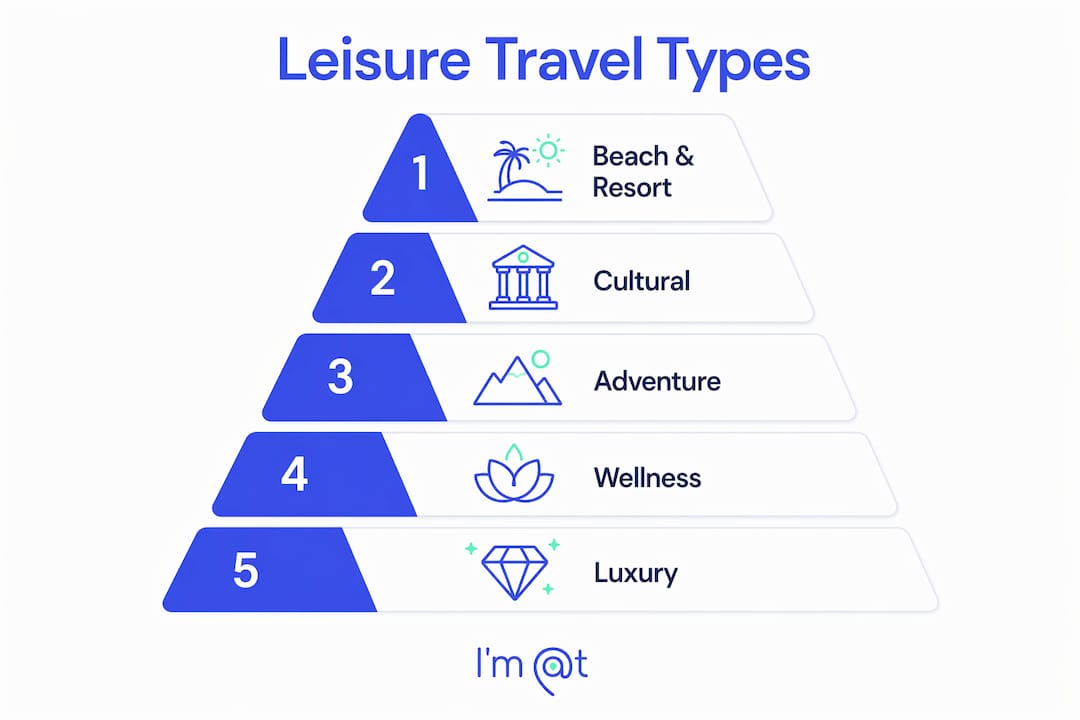
Cultural immersion travel prioritizes history, local food, language, and community. Cities like Kyoto, Marrakech, and Cape Town draw travelers who want to plan cultural experiences that go beyond surface-level sightseeing.
Adventure travel involves physical challenge and outdoor environments. Hiking, trekking, safaris, and water sports fall here. This category has grown sharply as travelers seek experiences that feel earned rather than passive.
Wellness and spiritual travel focuses on mental and physical restoration through yoga retreats, spa stays, meditation centers, or pilgrimage routes. About 10% of travelers now participate in purpose-driven formats like wellness and spiritual tourism. That share is growing as burnout becomes a mainstream concern.
Slow travel means staying longer in fewer places. Instead of hitting six cities in ten days, a slow traveler spends two weeks in one neighborhood, shops at local markets, and builds a temporary routine. It reduces travel fatigue and deepens the experience.
Luxury travel prioritizes comfort, exclusivity, and service quality. Private guides, boutique properties, and curated itineraries define this style.
| Type | Defining characteristic | Best for |
|---|---|---|
| Beach and resort | Passive rest, sun, minimal planning | Burnout recovery, families |
| Cultural immersion | History, food, local community | Curious, detail-oriented travelers |
| Adventure travel | Physical challenge, outdoor settings | Active travelers, thrill-seekers |
| Wellness and spiritual | Mental restoration, structured programs | Stressed professionals, seekers |
| Slow travel | Depth over breadth, longer stays | Remote workers, retirees |
| Luxury travel | High service, exclusivity, comfort | Milestone celebrations, couples |
Experienced travelers rarely stick to one category. Stacking travel experiences means combining cultural, adventure, and wellness elements into one trip. A traveler might hike Table Mountain in the morning, visit a township on a guided tour in the afternoon, and end the day at a wine farm. That layered approach produces richer memories than any single-style trip.
Pro Tip: Pick one primary travel style before you book anything. Use it as your filter. Every activity, accommodation, and day plan should support that core goal. Add secondary experiences only after the primary one is locked in.
How does leisure travel differ from business and blended travel?
The clearest difference between leisure and business travel is who controls the trip. Business travel follows a fixed schedule set by an employer or client. Leisure travel follows your preferences.
| Factor | Leisure travel | Business travel |
|---|---|---|
| Purpose | Personal enjoyment and rest | Work meetings, conferences, sales |
| Payment | Traveler pays | Employer reimburses |
| Schedule control | Full traveler control | Employer or client sets agenda |
| Flexibility | High | Low |
| Decision driver | Personal preference | Business need |
Blended travel, often called "bleisure," sits between the two. More than 50% of business travelers now add leisure extensions to their work trips. Remote and hybrid work made this mainstream by removing the pressure to return to an office immediately after a conference. A traveler flies to Lisbon for a three-day client meeting, then stays four more days to explore the Alentejo wine region. The business portion is reimbursed; the leisure extension is personal.
Leisure travelers tend to be price-sensitive and rely heavily on online reviews and social media when making decisions. Business travelers, by contrast, often use corporate booking tools with pre-negotiated rates. That behavioral difference shapes how destinations, hotels, and activity providers market to each group. For more on how these categories compare, this breakdown covers the key distinctions in practical terms.
What trends are shaping leisure travel right now?
Solo travel is the defining demographic shift in leisure travel today. Participation rates vary widely by region and survey, but solo travel sits between 18% and 39% of all leisure trips, with Millennials and Gen Z leading the category. Solo travelers prioritize flexibility, safety, and social experiences that allow them to meet others without committing to group tours.
Multigenerational travel is growing on the opposite end of the spectrum. Families spanning three generations now plan trips together, requiring destinations and itineraries that work for a six-year-old and a seventy-year-old simultaneously. Resorts and activity providers that accommodate this range are capturing a loyal, high-spending segment.
Domestic and regional travel surged after global disruptions and has not fully reversed. Travelers discovered that compelling experiences exist close to home. Day trips and weekend getaways now compete seriously with international vacations for leisure budgets.
Wellness and purpose-driven travel continue to accelerate. Travelers are no longer satisfied with passive rest. They want trips that produce measurable outcomes: better sleep, reduced anxiety, a spiritual reset, or a new physical skill. Retreat centers, guided meditation programs, and digital detox packages are filling that demand.
Pro Tip: Check the latest travel trends for 2026 before finalizing your destination. Trending locations often have new activity providers, better infrastructure, and more competitive pricing than established tourist hotspots.
How can you plan a leisure trip that actually delivers?
Effective leisure trip planning starts months before departure. Pre-trip logistics include securing time off work, setting a realistic budget, arranging pet or childcare, and handling household tasks. Skipping these steps creates background stress that follows you on the trip.
Start by defining your primary travel goal. Are you chasing rest, cultural depth, physical adventure, or social connection? Every planning decision should serve that goal. A traveler who wants deep rest should not book a city-hopping itinerary with four flights in seven days.
- Set your primary goal. Write it in one sentence. "I want to rest and disconnect from work" is a valid goal. Use it to filter every activity and booking.
- Build your budget first. Include flights, accommodation, activities, food, and a 15% buffer for unexpected costs. Budget constraints clarify choices faster than any other tool.
- Book flexible dates when possible. Midweek flights and shoulder-season travel consistently cost less and attract smaller crowds. That flexibility directly improves the experience.
- Plan your anchor experiences. Identify two or three non-negotiable activities and book them in advance. Leave the rest of the schedule open. Rigid hour-by-hour itineraries are the fastest route to burnout.
- Stack experiences logically. Combining travel styles works best when the activities share a geographic area or a common energy level. Pairing a morning hike with an afternoon cooking class makes sense. Pairing a full-day safari with a late-night concert does not.
Over-planning high-energy activities is the most common planning mistake. Travelers return home more exhausted than when they left because they treated vacation as a productivity challenge. Build in at least one unscheduled half-day per three days of travel. That buffer is where the best memories often happen.
Pro Tip: Use Im-at to find and book local activities after you arrive. Locking in every activity before departure removes the spontaneity that makes leisure travel feel free. Browse types of travel activities for inspiration, then decide on the ground.
Key Takeaways
Leisure travel delivers the most value when you define a clear personal goal, plan logistics early, and resist the urge to fill every hour with scheduled activities.
| Point | Details |
|---|---|
| Leisure travel definition | Personal trips for enjoyment and rest, fully funded and controlled by the traveler. |
| Types vary widely | Beach, cultural, adventure, wellness, slow, and luxury travel each serve different needs. |
| Blended travel is mainstream | Over 50% of business travelers now add leisure extensions to work trips. |
| Solo and multigenerational travel are rising | Both formats are growing fast and reshaping how destinations and providers operate. |
| Plan logistics early, schedule loosely | Book anchor experiences in advance and leave unstructured time to avoid burnout. |
Why I think most people plan leisure travel backward
Most travelers I have observed spend 80% of their planning energy on flights and hotels, then scramble to fill the days once they arrive. That is the wrong order. The experience is the trip. The logistics are just the container.
The travelers who come back genuinely refreshed are the ones who decided what they needed before they opened a booking site. A person running on empty for six months does not need a packed cultural itinerary. They need a beach, a book, and three meals a day with no decisions attached. Choosing a travel style based on how you actually feel, not on what looks impressive in photos, is the single biggest factor in trip satisfaction.
Leisure travel is about the freedom to decide how you spend your personal time. That freedom is wasted when you hand it back to a rigid schedule. The best trips I have seen leave room for the unexpected: a local festival you stumbled into, a restaurant with no English menu, a hiking trail that was not in any guide. Those moments do not happen in a fully booked itinerary.
Travel that recharges you is sustainable. Travel that exhausts you is just expensive stress in a different location. Choose the style that fits your current state, not the one that fits your aspirational self-image.
— Mikahil
Curated leisure experiences worth booking now
Im-at connects travelers with activities that match every leisure travel style, from cultural deep-dives to outdoor adventures, all bookable in minutes.
If you are planning a trip to South Africa, the Cape Town 3-day cultural attraction covers a township tour, the Cape Peninsula, and wine tasting in one curated package. For adventure travelers, hiking Table Mountain delivers one of the most iconic trekking experiences on the continent. Im-at also features The Unholy Secrets, a unique cultural experience that blends local storytelling with immersive exploration. Browse the full Im-at catalog to find activities that match your travel goal before you land.
FAQ
What is the leisure travel definition in simple terms?
Leisure travel is any trip taken for personal enjoyment, rest, or recreation that the traveler plans and funds independently. It is the opposite of business travel, where an employer sets the agenda and covers costs.
What are the most popular types of leisure travel?
The most common types include beach vacations, cultural immersion trips, adventure travel, wellness retreats, slow travel, and luxury travel. Most experienced travelers combine two or more of these styles in a single trip.
How is blended travel different from leisure travel?
Blended travel, also called bleisure, combines a business trip with a personal leisure extension. More than 50% of business travelers now add leisure days to work trips, making blended travel one of the fastest-growing travel formats.
What are the main benefits of leisure travel?
Leisure travel reduces stress, improves mental health, and provides experiences that build perspective and creativity. The freedom to control your own schedule is the core benefit that separates it from every other travel category.
How far in advance should you plan a leisure trip?
Planning several months ahead covers the critical logistics: time off work, budget, accommodation, and anchor activities. Booking too late limits options and increases costs, particularly for popular destinations during peak seasons.