

TL;DR:
- Hosting a successful tour requires thorough preparation, including legal compliance, audience definition, and route scouting.
- Effective guides focus on genuine connection, storytelling, and adaptability to ensure memorable guest experiences.
- Regular evaluation and feedback help hosts improve continuously, transforming challenges into engaging storytelling opportunities.
Hosting a tour sounds exciting until you're standing in front of twelve strangers, your printed map is blowing down the street, and someone asks a question you didn't prepare for. That gap between imagining a smooth, engaging tour and actually pulling one off is where most first-time hosts stumble. The good news is that the gap closes fast when you follow a structured approach. This article walks you through every phase of hosting, from the paperwork and gear to the storytelling moments that make guests say, "That was unforgettable."
Table of Contents
- What to know before you begin
- The essentials: Tools and materials for running a tour
- Step-by-step process: Hosting your first tour
- Avoiding common mistakes and troubleshooting
- Measuring your tour's success and improving over time
- What seasoned hosts wish they knew before their first tour
- Ready to host memorable tours? Explore curated experiences
- Frequently asked questions
Key Takeaways
| Point | Details |
|---|---|
| Know your requirements | Check legal, logistical, and market prerequisites before your first tour. |
| Be prepared | Organize all essential tools, information, and contingency plans in advance. |
| Follow clear steps | Breaking the tour process into step-by-step phases ensures nothing is overlooked. |
| Expect the unexpected | Proactive troubleshooting and real-time adaptability are key for enjoyable tours. |
| Learn and improve | Regularly gather feedback and refine your tours for future success. |
What to know before you begin
Once you understand the importance of a structured approach, let's look at what you should prepare before your first tour.
Know the legal landscape
Before you announce your tour publicly, spend time researching local regulations. Most regions require some form of business registration, and many require specific permits for guided tours, especially if you're operating in national parks, heritage sites, or protected urban areas. Event liability insurance is often mandatory, and for good reason: it protects both you and your guests if something goes wrong. Contact your local tourism board or chamber of commerce to get a clear checklist.
Ignoring this step is the single most common mistake new hosts make. You don't want to build a reputation only to shut down after one event because of a compliance issue.
Define your audience clearly
Who is this tour for? That question drives every decision you make afterward. Families with young children need shorter walks, restroom access, and engaging activities for kids. Adventure seekers want physical challenges, surprising locations, and authentic local knowledge. Cultural travelers prioritize storytelling, history, and interaction with locals. Pick one primary audience and design around them.
When curating local experiences, the most successful hosts describe their ideal guest in detail before writing a single itinerary point. Think about age range, fitness level, attention span, and what they want to leave with, whether that's knowledge, photos, food memories, or a sense of discovery.
Scout your route before day one
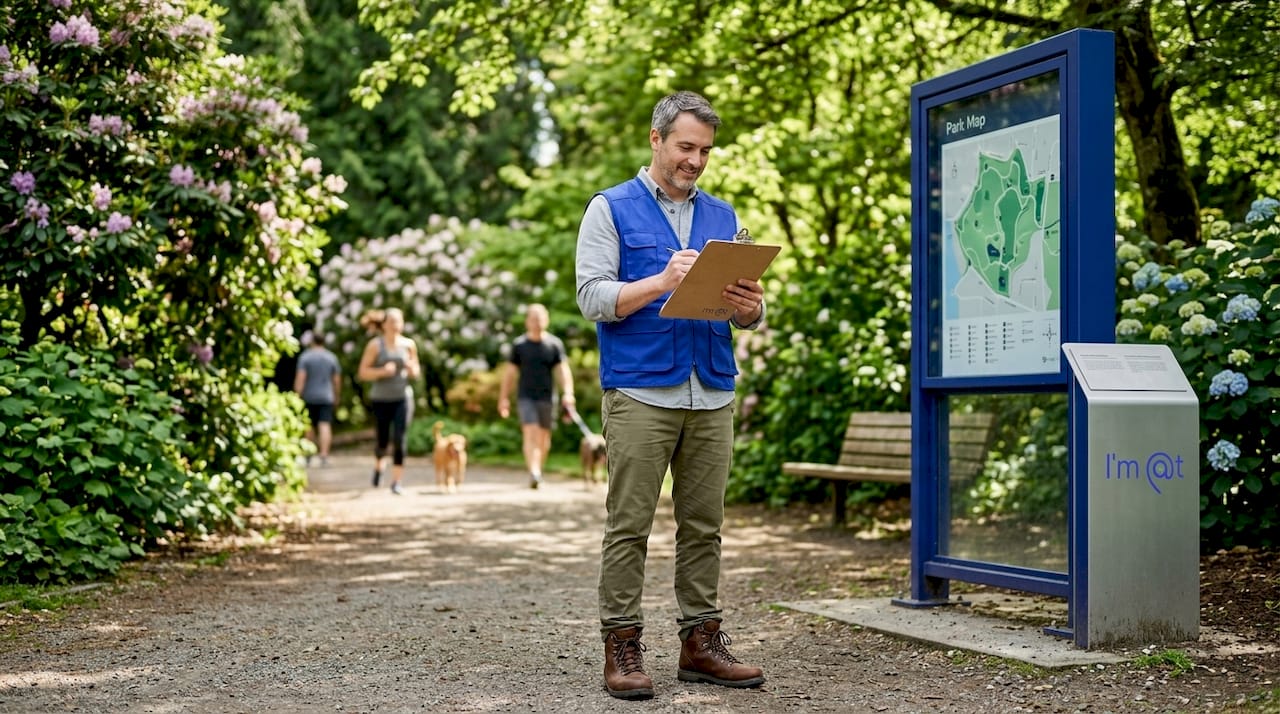
Walk the entire tour route at the same time of day you plan to run it. Note sun position, crowd levels, noise, and natural rest spots. Test public transport or parking if guests are traveling to you. Check for seasonal closures, construction zones, or accessibility barriers.
| Preparation area | Key questions to answer |
|---|---|
| Legal and permits | Do I need a guide license, business registration, or event insurance? |
| Audience profile | Who is my guest, and what do they want to experience? |
| Route scouting | Are all stops accessible, timed correctly, and weather-resilient? |
| Competitive research | What makes my tour different from existing offerings? |
| Admin tools | Do I have registration forms, waivers, and a communication platform? |
Pro Tip: Run a soft-launch tour with friends or family first. Their feedback will reveal blind spots in pacing, storytelling, and logistics that you simply cannot spot alone.
Essential tools to have ready before launch:
- Guest registration forms with emergency contact fields
- A signed waiver template reviewed by a local legal professional
- A communication platform, such as WhatsApp or email, for pre-tour updates
- A clear refund and cancellation policy shared upfront
The essentials: Tools and materials for running a tour
Having covered initial preparations, you'll now want to organize all tools and materials needed to deliver a top-notch tour.
The role of tour guides extends far beyond knowing the route. Guides are coordinators, storytellers, safety officers, and mood managers, all at once. That breadth of responsibility means your toolkit needs to match.
Your standard day-of checklist
- Printed guest list with names and any special needs flagged
- Personal ID badge and any required operator permits
- A fully charged communication device with backup battery
- Basic first aid kit: bandages, antiseptic, pain relievers, and any relevant allergy supplies
- Cash and a mobile payment option for incidental purchases
- Weather-appropriate personal gear: rain jacket, sun protection, sturdy footwear
Tech tools that make a real difference
| Tool type | Recommended use | Why it matters |
|---|---|---|
| Navigation app | Offline maps with saved route | Eliminates internet dependency mid-tour |
| Guest management | Booking and check-in software | Reduces manual errors and speeds check-in |
| Payment processing | Mobile card reader or app-based payments | Removes awkward cash exchanges |
| Communication | Group messaging platform | Fast updates for weather or last-minute changes |
Build your backup plans now, not later
Every experienced host keeps a mental "plan B" for every major stop. If a restaurant you planned to visit is closed, have an alternative two blocks away. If rain hits, know which indoor spaces are welcoming and interesting. If a guest has mobility challenges you weren't told about in advance, know which route variations still work.
Pro Tip: Save three to five "bonus" stories or facts about your tour area that you haven't included in the main script. These are your secret weapon when a stop runs short or a guest asks something unexpected.
Organization is not about perfection. It's about giving yourself enough breathing room that when something goes sideways, you remain calm and confident in front of your group.
Step-by-step process: Hosting your first tour
When you're fully equipped with requirements, it's time to walk through each actionable step of delivering a great tour.
The step-by-step hosting sequence
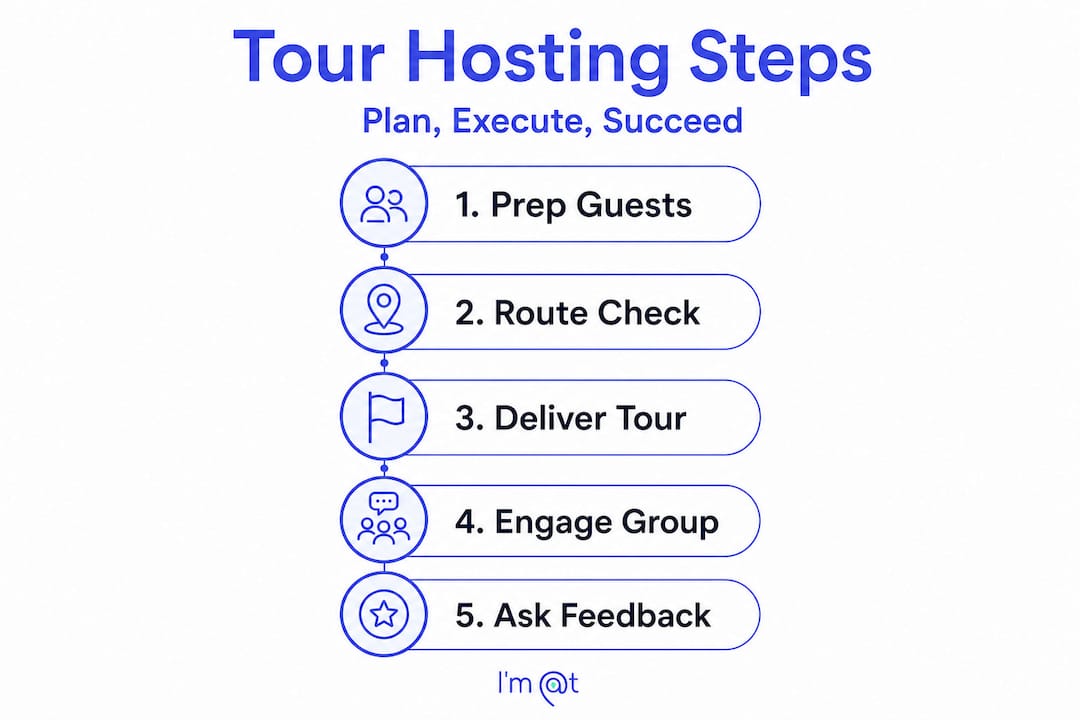
- Confirm all logistics 48 hours before. Send a reminder to guests with the meeting point, start time, what to wear, and what to bring. Test your communication channels. Check the weather forecast and adjust plans if needed.
- Arrive early and set the scene. Be at the meeting point at least 20 minutes early. This gives you time to settle nerves, check your materials, and greet early arrivals warmly.
- Nail your opening. The first five minutes set the emotional tone for everything that follows. Introduce yourself with confidence, share a brief, surprising fact about the destination, and tell guests what to expect. Humor helps, but authenticity works better.
- Keep pace intentional. Move from stop to stop with purpose. At each location, anchor your content around one strong story or insight rather than reciting a list of facts. Stories are remembered; catalogs are forgotten.
- Run comfort checkpoints. Every 45 to 60 minutes, offer a short break. Remind guests to hydrate. Ask if anyone needs to adjust pace. These micro-moments build trust and make guests feel genuinely cared for.
- Close with impact. End the tour at a memorable location, not just wherever you ran out of time. Summarize two or three key themes, invite questions, and thank guests genuinely.
- Post-tour debrief. Log what worked, what fell flat, and any guest comments you remember. Send a follow-up message within 24 hours thanking guests and sharing any relevant links or resources.
"The best tour I ever took didn't have the most facts. It had the best host. Someone who made me feel like I was discovering something private, something real." — Common guest sentiment captured across traveler reviews
Using a step-by-step tour guide framework for your own planning helps you see the experience from the guest's perspective, which is the only perspective that matters.
| Phase | Key focus | Common mistake |
|---|---|---|
| Pre-tour | Confirmation and preparation | Skipping weather and logistics check |
| Welcome | Tone-setting and connection | Reading from notes instead of engaging |
| During tour | Pacing and storytelling | Rushing between stops or over-explaining |
| Comfort breaks | Guest wellbeing | Skipping breaks to "stay on schedule" |
| Closing | Memorable wrap-up | Ending abruptly without a clear close |
Avoiding common mistakes and troubleshooting
Even with a plan, new hosts often face unexpected challenges. Here's how to avoid and address the most common ones.
The most frequent mistake is cramming too much into a single tour. Hosts feel pressure to provide maximum value, so they pile in ten stops, eight facts per stop, and two restaurant recommendations. Guests end up overwhelmed and retain almost nothing. Quality over quantity is not just a cliche here. It's the actual key to reviews that mention "enriching" and "memorable."
Common pitfalls and how to fix them:
- Overloaded itinerary: Cut your stop list by 20% before launch day. You can always add if time allows; you cannot undo an exhausted group.
- Poor pacing: If guests look disengaged, shorten the current stop. Attention is your most valuable currency.
- Ignoring guest input: When a guest asks a question mid-tour, treat it as gold. That question tells you what the group cares about. Follow it.
- Freezing during the unexpected: A local protest, a closed street, a sudden downpour. Stay visibly calm, announce the change with confidence, and pivot to your backup.
"Experienced hosts don't avoid problems. They recover from them so smoothly that guests assume it was planned."
When designing immersive tour experiences, the best operators treat every surprise as a storytelling opportunity. A detour through an unplanned alley might become the highlight of the tour if you frame it as a "secret route."
Pro Tip: Keep a small notebook or voice memo app handy during your tour. Any unexpected moment, guest reaction, or spontaneous story that lands well should be recorded immediately. Those unplanned gems often become your best recurring content.
Measuring your tour's success and improving over time
Mastering troubleshooting leads directly into evaluating the results of your tours and making ongoing improvements.
Success is not just whether guests smiled at the end. It's measurable, and the best hosts track it consistently.
What to measure after every tour:
- Attendance vs. registered guests (shows your no-show rate)
- Verbal satisfaction signals and any written comments shared on the day
- Repeat booking rate, meaning guests who sign up for your next tour
- Online reviews left within 48 hours of the event
- Referrals, meaning new guests who came because a previous guest recommended you
Collecting feedback that's actually useful
Surveys work well when they're short. Three to five questions maximum. Ask guests what they loved, what they'd change, and whether they'd recommend the tour to a friend. Use a simple rating scale for benchmarking over time. Informal post-tour chats often reveal the most honest feedback, so linger a few extra minutes at the end of each tour.
| Feedback method | Best use | Timing |
|---|---|---|
| Short digital survey | Quantitative benchmarking | Send within 24 hours via email |
| In-person conversation | Qualitative insights and depth | Last 10 minutes of the tour |
| Online review platforms | Public reputation building | Prompt guests at tour close |
| Social media mentions | Brand awareness and organic reach | Monitor weekly |
Building a practice of reviewing your own performance after every single tour is what separates hosts who plateau from those who grow. Change one element per tour, such as the opening story, the pacing at stop three, or the closing statement, and measure whether it improves guest response.
When guests can book seamless tours, the ease of the booking experience itself influences their overall perception of quality before the tour even begins.
What seasoned hosts wish they knew before their first tour
Here's the uncomfortable truth that most beginner guides never hear: your script is not your most important asset. Your ability to read a room is.
Experienced hosts consistently say the same thing when asked what changed between their first tour and their tenth: they stopped performing and started connecting. The difference is subtle but felt immediately by guests. A host who is "delivering content" feels like a teacher. A host who is genuinely curious about what the group finds interesting feels like a friend who happens to know a lot.
Empathy is a practical skill here, not just a virtue. When you notice two guests lagging behind, check in. When the group lights up at an unexpected detail, pause and explore it. When someone seems uncomfortable, address it quietly and with care. These moments create the emotional memories that guests talk about afterward.
Adaptability matters more than preparation beyond a certain point. You can prepare for most things. You cannot prepare for everything. The hosts who seem effortlessly polished are actually just very good at recovering quickly and reframing problems as moments. A missed turn becomes "the scenic detour." A closed attraction becomes "an excuse to show you something even better."
One great story is worth more than ten facts. Every stop on a tour should be anchored by a single story with a beginning, a conflict, and a resolution. Facts give guests information. Stories give them something to repeat to their friends that evening. That repetition is your best marketing.
The most transformative moments on tours often come from unexpected guest contributions. When you invite someone to share a memory or opinion connected to a stop, and they do, the whole group leans in. That moment of human connection is what no competitor can replicate and no algorithm can generate.
If you're exploring new destinations as part of building your tour content, let genuine curiosity drive you. Guests can always tell the difference between a host who loves the subject and one who simply knows it.
Ready to host memorable tours? Explore curated experiences
You've got the framework. Now see it in action. One of the fastest ways to sharpen your hosting instincts is to experience excellent tours from the guest's seat.
At Im-at, you can browse and book a wide range of curated experiences that demonstrate exactly the kind of quality, pacing, and engagement your guests will expect. Explore the atmosphere and storytelling behind unique tour experiences, or study how multi-day logistics work with a Cape Town 3-day tour that blends cultural depth with practical flow. For a masterclass in sensory storytelling, the Douro Valley wine tour is a brilliant benchmark. Join as a guest, take notes as a host, and bring those insights back to your own planning.
Frequently asked questions
What legal permits do I need to host a tour?
Legal requirements vary by region but typically include a business license and event liability insurance. Always verify specifics with your local tourism board before your first event.
How do I determine the best price for my tour?
Research similar local tours, then factor in your operating costs, the uniqueness of your experience, and your target guest's budget to set a competitive and sustainable price.
What should I do if the weather turns bad during my tour?
Have a backup plan ready before the tour starts, including indoor alternatives or weather-appropriate gear options for guests. Announce changes calmly and with confidence.
How many guests is ideal for a beginner-hosted tour?
Starting with 6 to 12 guests lets you manage logistics comfortably while delivering a genuinely personalized experience for everyone in the group.
Is guest feedback important after a tour?
Absolutely. Guest feedback is one of the most direct tools you have for improving your tour quality, building your reputation, and increasing repeat bookings over time.