

TL;DR:
- Thoughtful curation creates authentic, sensory-rich travel experiences that foster real connections.
- Preparation with local insights, vetted platforms, and flexible planning enhances satisfaction.
- Engaging with local guides and avoiding tourist traps ensures genuine discovery and meaningful memories.
Most travelers return home with photos of the same monuments, meals at the same tourist-facing restaurants, and a vague feeling that something was missing. The difference between a forgettable trip and one you talk about for years almost always comes down to one thing: curation. Not a packed checklist, not a pre-set group tour, but a thoughtfully designed sequence of local moments that reflect where you actually are. This guide walks you through a clear, step-by-step process for finding, planning, and experiencing the kind of travel that feels genuinely personal. Whether you are heading somewhere new or revisiting a familiar city, the framework here works.
Table of Contents
- What makes a local experience truly memorable?
- How to prepare for local experience curation
- Step-by-step: Curating your personalized local itinerary
- Verifying, adjusting, and maximizing your curated journey
- Why thoughtful curation beats 'living like a local' fads
- Start your curated adventure with expert support
- Frequently asked questions
Key Takeaways
| Point | Details |
|---|---|
| Start with authenticity | Local stories, expert advice, and insider tips set curated experiences apart from tourist checklists. |
| Curate with purpose | Planning around themes and using technology helps personalize and enrich every trip. |
| Adapt and reflect | Flexibility and post-trip reflection help travelers improve curation skills for future journeys. |
| Balance is key | Mix must-see highlights with unique, local finds for the most rewarding adventures. |
What makes a local experience truly memorable?
Generic excursions feel flat because they are designed for everyone, which means they are truly made for no one. A bus tour that stops at six landmarks in three hours gives you a surface-level impression of a city rather than any real sense of it. Curation flips this. It starts with intent, local knowledge, and a desire to connect with a place on its own terms.
What separates a memorable local experience from a forgettable one comes down to a few consistent ingredients:
- Local input: Activities shaped by people who actually live and work there, not imported itineraries
- Sensory engagement: Experiences that involve touch, taste, smell, and sound, not just sightseeing
- Authentic stories: Narratives that explain why a neighborhood, dish, or tradition matters, not just what it looks like
- Insider routes: Paths that skip the overcrowded main streets and reveal where residents actually spend their time
- Thematic connection: A thread linking your activities together so the day feels intentional, not random
Research confirms this approach works. Curating local experiences involves engaging local experts, taking a holistic view of a destination across its natural, cultural, and culinary layers, creating thematic itineraries with mapped routes, and using technology for personalization and real-time updates.
"Tell local stories, engage the senses, treat guests like locals with insider tips, and curate themes that connect activities." These four curation principles consistently produce the kinds of experiences that visitors actually remember.
The common pitfalls are worth naming directly. Overtourism pushes travelers toward the same worn-out spots, making genuine discovery harder. Forced interactions, like staged cultural performances or scripted "authentic" meals, often feel hollow. And ignoring local wisdom, whether that means showing up during a community festival without context or booking an activity that is ethically questionable, undermines the whole experience.
Thoughtful curation treats you as a welcomed participant rather than a paying spectator. The goal is to walk away with the authentic travel rewards that only come from real connection. Those who chase real travel experiences consistently report stronger memories and greater satisfaction long after the trip ends.
How to prepare for local experience curation
Good curation does not happen spontaneously. It requires a small investment of preparation time before you ever step off a plane. Think of this phase as building your toolkit.
Tools you will need:
- Digital maps with offline capability (Google Maps, Maps.me)
- Local guide platforms and vetted review aggregators
- Translation apps for non-English-speaking destinations
- Travel blogs written by residents or long-term visitors, not just passing tourists
- A notes app to track ideas, contacts, and observations
Data to gather before you plan:
- Weather windows and seasonal patterns for your destination
- Opening hours and local holidays that could affect availability
- Cultural norms around dress, tipping, photography, and behavior
- Real reviews from verified travelers, ideally filtered by recency
The personalized travel market is growing from $169.33 billion in 2025 to a projected $370.73 billion by 2030, with custom itineraries delivering 40% higher satisfaction than standard packages. That statistic is not just impressive. It tells you that the effort you put into preparation pays off in ways that generic booking never will.
Choosing your theme early keeps the process focused. Some travelers center everything around food and markets. Others prioritize outdoor adventure, heritage architecture, or contemporary art. Multi-theme itineraries work well for longer trips but require more careful sequencing.
| Theme | Best sources | Key considerations |
|---|---|---|
| Food and culinary | Local food blogs, market guides | Seasonal availability, dietary needs |
| Outdoor and nature | Ranger stations, hiking forums | Weather, fitness level, permits |
| Heritage and history | Local museums, academic guides | Opening hours, guided options |
| Art and culture | Gallery listings, community boards | Special exhibitions, entry fees |
| Multi-theme | Curated platforms, local guides | Sequencing and pacing |
The right mindset matters as much as the right tools. Curiosity, flexibility, and genuine respect for local customs will take you further than any spreadsheet. Refer to a solid experience curation guide and combine it with practical trip enrichment tips to stay grounded as you build.
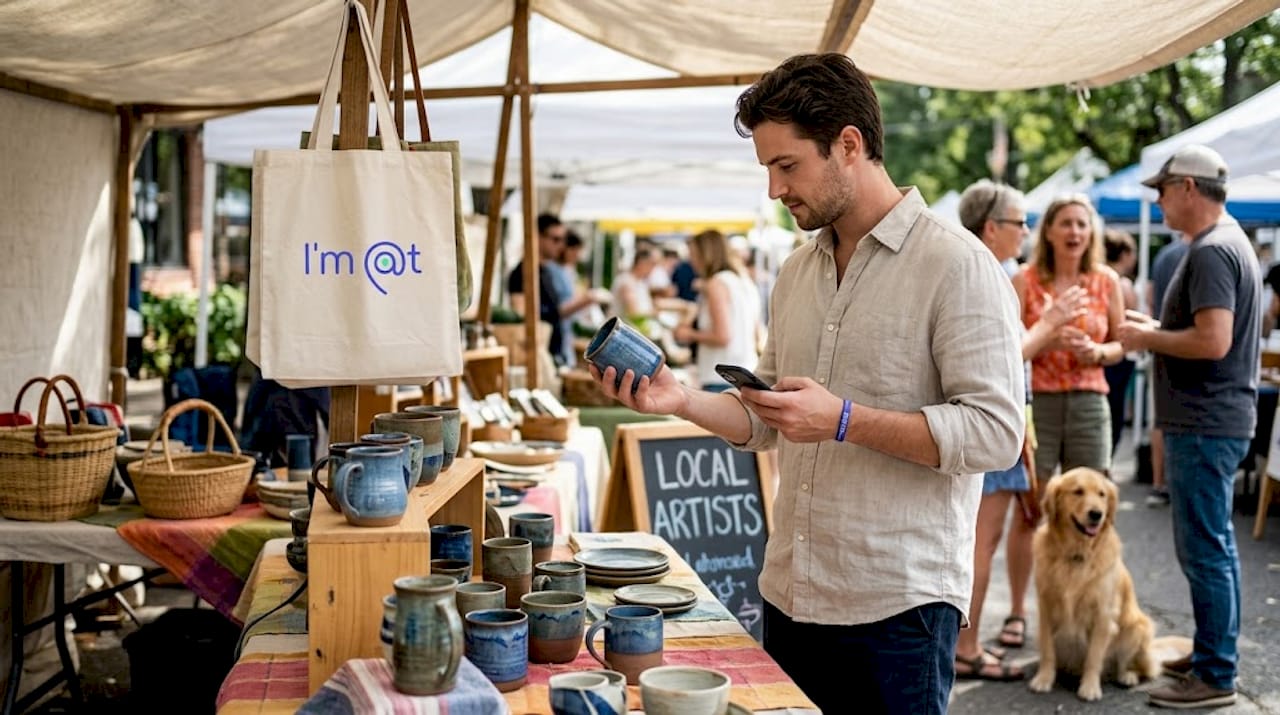
Pro Tip: Start with at least two trusted local contacts or community-based platforms before finalizing any booking. One person or source is a starting point. Two independent confirmations give you a real signal.
Step-by-step: Curating your personalized local itinerary
With your resources assembled, here is the actual sequence for building an itinerary that surprises you without falling apart.
- Define your trip theme and priorities. Write down three to five things you genuinely want to experience, not what you feel obligated to see. This becomes your filter for every decision that follows.
- Research and shortlist local activities. Use platforms, local blogs, and community boards to identify ten to fifteen options. More than that creates decision fatigue. Fewer limits your flexibility.
- Validate each activity. Check recent reviews, confirm the host's local credentials, and verify that the experience is actually operated by community members rather than repackaged by a third party.
- Map your route and sequence experiences. Group activities by neighborhood or geography so you are not spending half your day in transit. Morning light and crowd patterns matter, so plan accordingly.
- Book with reputable local hosts where possible. Direct booking supports local economies and often unlocks conversations and extras that platform-only bookings miss.
- Integrate technology for on-the-go adjustments. Use alert systems for weather changes, real-time crowd data, and local event listings so you can pivot without stress.
Custom itineraries deliver 40% higher satisfaction, and top-rated U.S. local experiences average a 4.76 out of 5 rating from over 1.5 million reviews, with nearly half priced under $100. Quality and value are not mutually exclusive here.
| Approach | Avg satisfaction | Avg cost range | Flexibility |
|---|---|---|---|
| Standard group tour | Moderate | $80 to $250 | Low |
| Custom local itinerary | High | $30 to $150 | High |
| Self-guided with local tips | Moderate to high | $0 to $80 | Very high |
Exploring popular local activities across different destination types gives you a strong baseline. For deeper inspiration, look at immersive cultural tours from destinations around the world.
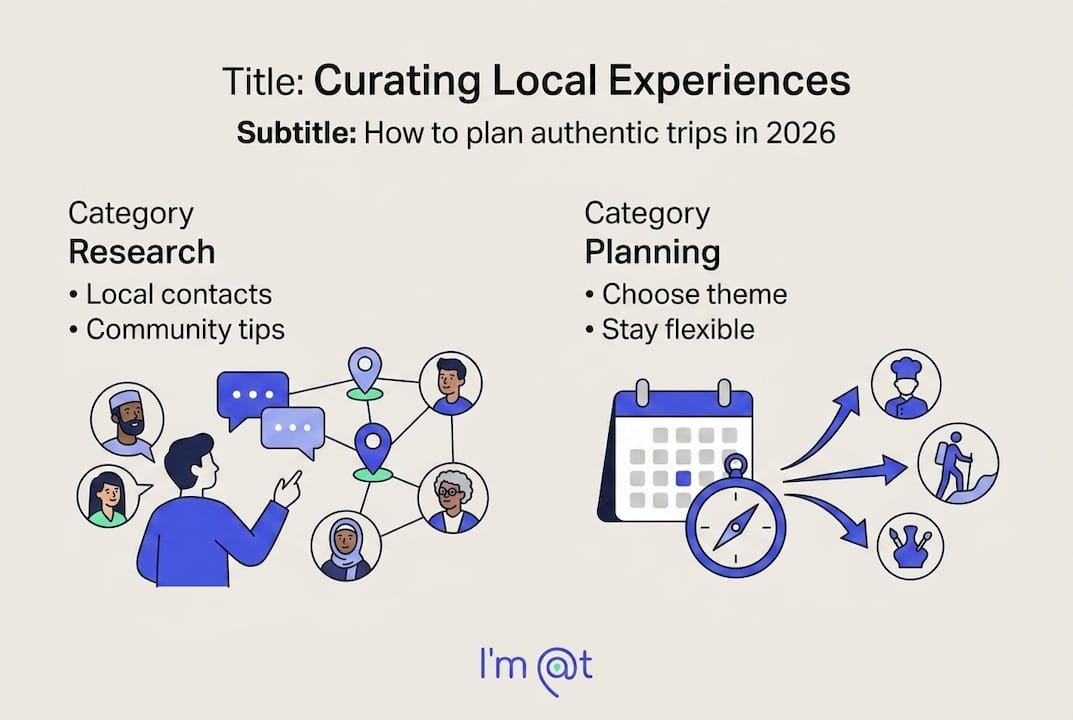
Pro Tip: Build at least one fully unscheduled half-day into every itinerary. The best moments of most trips happen when plans dissolve and curiosity takes over.
Verifying, adjusting, and maximizing your curated journey
Putting together a strong itinerary is only half the work. What you do before and during your trip determines how it actually plays out.
How to spot authentic versus staged experiences:
- Authentic activities involve real community participation, not just performance for visitors
- Hosts speak from personal knowledge, not a script
- The setting is where locals actually go, not a replica built for tourists
- Pricing reflects local market rates, not inflated visitor fees
When and how to pivot:
- Monitor weather apps and local news the evening before each day
- Follow community social media accounts for real-time event updates
- Keep one backup activity per planned experience, ideally in the same area
- Ask your accommodation host for current, on-the-ground recommendations
Common mistakes that derail curated itineraries include overbooking (fitting too many activities into a single day), ignoring local festival schedules that change access and crowd levels, and refusing to adapt when conditions shift. Flexibility is not a failure of planning. It is a feature of smart planning.
Post-trip reflection is underrated. A few notes about what worked, what felt forced, and what you wish you had done differently become the foundation for every future trip.
"Forcing interactions can be invasive; thoughtful tourism respects visitor status over pretending integration." Staging authenticity for travelers without genuine community involvement does not create connection. It creates theater.
Understanding how locals shape travel gives you the perspective to tell real from performative quickly. And for practical ideas you can use immediately, local excursions remain one of the most reliable ways to build authentic travel days.
Why thoughtful curation beats 'living like a local' fads
The phrase "live like a local" is everywhere in travel marketing, and it has become almost meaningless. At its worst, it encourages visitors to imitate residents without understanding the context, history, or social dynamics that shape daily life in a place. That is not connection. It is cosplay.
What actually works is something quieter and more respectful. It is showing up with curiosity rather than a script. It is choosing experiences that reveal local stories without claiming to fully understand them. It is recognizing that authenticity persists in the spatial and cultural organization of a place despite global homogenization, and that overtourism overlays but does not erase local character.
The travelers who come home with the most genuine memories are not the ones who tried hardest to blend in. They are the ones who engaged thoughtfully, asked real questions, and let the destination speak for itself. Curation that prioritizes local stories and contexts creates real connection. Imitation rarely does.
For a practical foundation on going deeper, mastering immersive travel is the skill that separates meaningful trips from expensive sightseeing.
Start your curated adventure with expert support
You now have the framework. The next step is putting it to work on a real trip. Im-at brings together handpicked local experiences across destinations worldwide, making it easy to move from plan to booking without losing the personal touch.
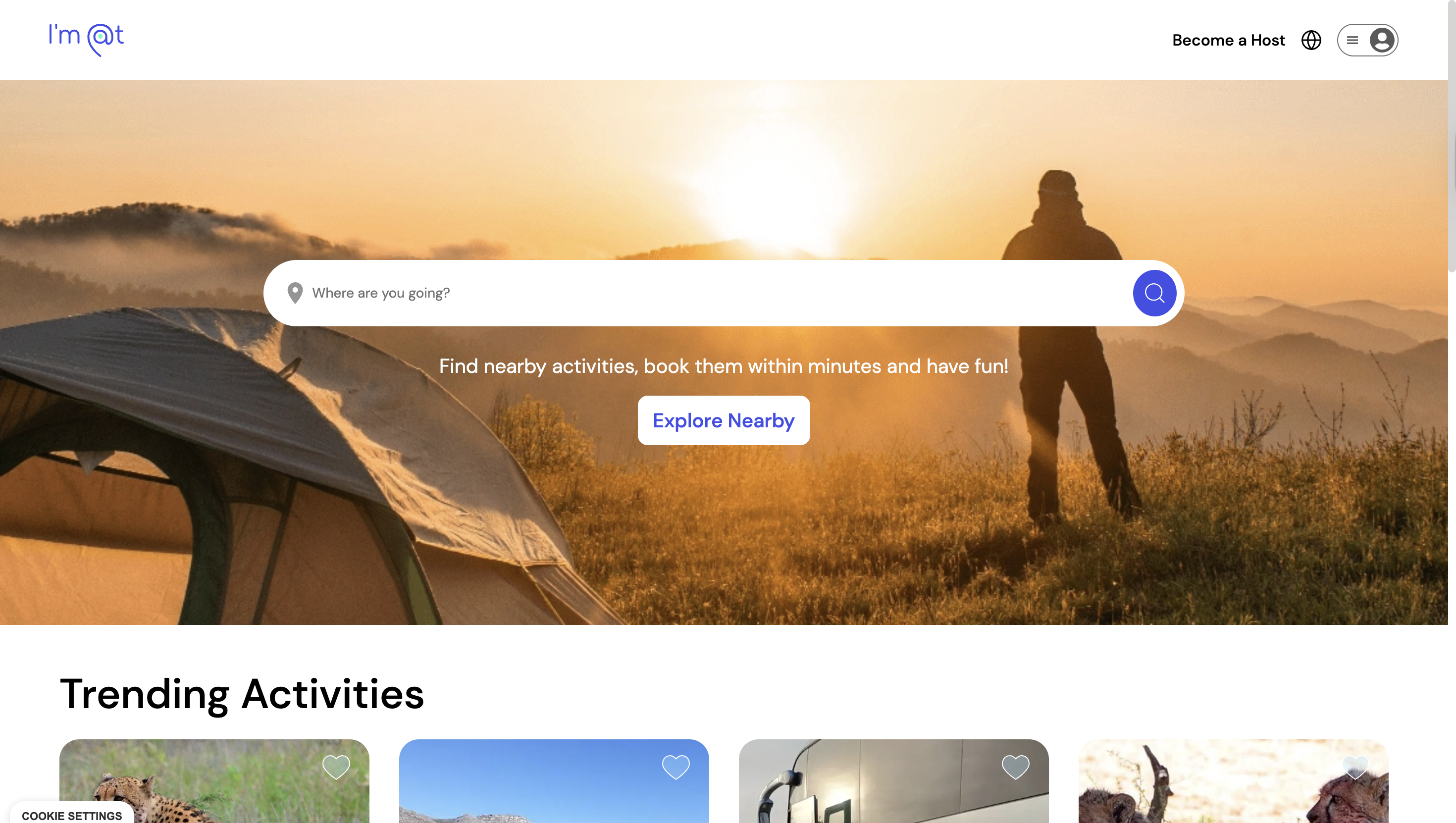
Whether you want to discover something unexpected through an Exclusive Discovery Moment, take in the best viewpoints of Portugal's capital on a Lisbon Tuk Tuk tour, or push your sense of adventure with a Funchal Skywalk adventure, every option is vetted, locally grounded, and ready to book. Use the curation skills you have built here to choose the experiences that fit your theme, your pace, and your curiosity.
Frequently asked questions
What is the fastest way to find authentic local experiences?
Tap into local guides, small group activities, and platforms that feature vetted real-world hosts. Involving local experts is the core mechanic of genuine experience curation.
How do I avoid tourist traps when curating my own itinerary?
Prioritize recommendations from residents, look at reviews beyond the top-ranked attractions, and stay flexible enough to skip crowded generic spots. Insider tips from community members consistently outperform algorithm-ranked suggestions.
Are curated travel experiences expensive?
Not necessarily. Nearly half of top-rated U.S. local experiences are priced under $100, offering strong value for the level of personalization involved.
Can technology really improve personal experience curation?
Yes. Apps and real-time tools for personalization and updates handle translation, itinerary mapping, and live schedule changes, giving you flexibility without losing structure.