

TL;DR:
- No single platform suits every type of traveler or activity, so choice depends on trip goals and timing. Im-at provides an integrated marketplace for easy search and booking across various activity types in one place. Using the right platform and verifying listings can help travelers find authentic, reliable local experiences efficiently.
For most U.S. travelers, the shortlist comes down to a handful of platforms: Im-at for integrated search-and-book discovery, GetYourGuide for a massive verified catalog, Viator (Tripadvisor Experiences) for review depth, Airbnb Experiences for host-led intimacy, Klook for Asia-heavy itineraries with strong U.S. city coverage, ToursByLocals for private guide access, Context Travel for small-group expert-led tours, and Peek for activity operators with real-time availability.
No single platform wins every scenario. The right pick depends on your trip type, how much lead time you have, and whether you want a vetted professional guide or a spontaneous community meetup.
Quick picks by traveler type:
- Last-minute planner: Im-at or Peek (real-time availability, fast checkout)
- Family with kids: Viator or GetYourGuide (filter by age suitability, clear cancellation)
- Private or custom tour: ToursByLocals or Airbnb Experiences
- Expert-led small group: Context Travel
- Budget or niche activity: Im-at or Klook
- Community or free events: Meetup or LocalDayOut (outside the paid-tour stack)
Im-at functions as an integrated marketplace where you search, compare, and book in one place, making it a strong default for travelers who want a single tab open instead of five.
Table of Contents
- Which tools for booking local experiences actually compare well?
- How do you choose the right booking app for your trip?
- How to search, compare, and book efficiently
- Why free and community experiences deserve a spot in your itinerary
- Consumer booking platforms vs. tour-operator software: what's the difference?
- Key Takeaways
- Why an integrated marketplace approach makes sense
- Im-at puts search and booking in one place
- Useful sources and further reading
Which tools for booking local experiences actually compare well?
The table below maps each platform across the dimensions that matter most when you're choosing where to book.
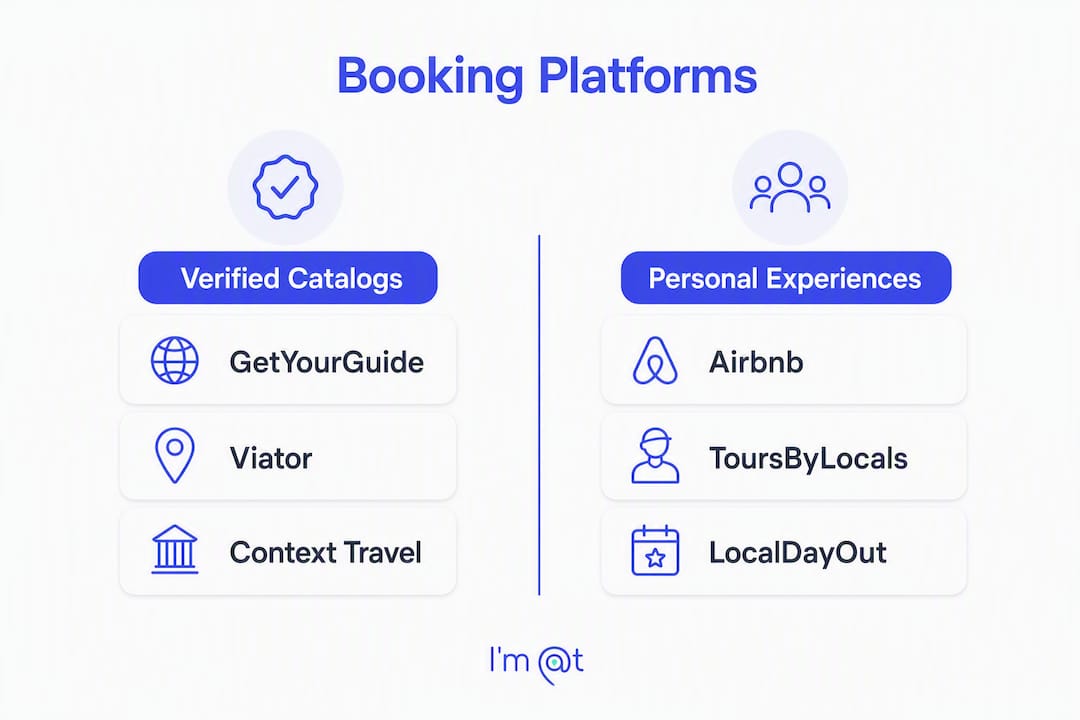
| Platform | Best for | U.S. coverage | Traveler booking fees | Verification & trust | Payments & refunds | Mobile UX | Customer support |
|---|---|---|---|---|---|---|---|
| Im-at | Integrated discovery + booking, diverse activity types | Global, including U.S. cities | Commission-based; no separate traveler fee listed | Vetted operator listings; user reviews | Secure online payments; cancellation per listing | Clean, minimal app | Available via platform |
| GetYourGuide | Large verified catalog, popular attractions | Strong U.S. + global | Service fee added at checkout | Identity-verified guides; high review volume | Free cancellation on most; secure checkout | Polished app, strong filters | 24/7 multilingual support |
| Viator | Review depth, Tripadvisor integration | Extensive U.S. coverage | Service fee at checkout | Tripadvisor-backed reviews; operator vetting | Flexible cancellation tiers; major cards | Solid app, review-heavy UX | Email + chat support |
| Airbnb Experiences | Host-led, intimate small-group activities | U.S. cities + rural hosts | No separate booking fee; host sets price | Host identity verified; guest reviews | Airbnb refund policy applies | Seamless within Airbnb app | Airbnb standard support |
| Klook | Asia-Pacific focus; U.S. city activities | Growing U.S. presence | Occasional promo discounts; fees vary | Operator verification; review system | Instant confirmation; credits system | App-first, fast checkout | Chat support; multilingual |
| ToursByLocals | Private guides, custom itineraries | Global guides, U.S. cities | No booking fee; guide sets rate | Background-checked local guides | Secure payment; guide-specific refund policy | Web-first; functional mobile | Dedicated support team |
| Context Travel | Expert-led small groups (scholars, chefs) | Select U.S. cities | Premium pricing; no hidden fees | Credentialed experts (PhDs, professionals) | Clear cancellation policy | Web-focused; clean UX | Direct email support |
| Peek | Real-time availability, activity operators | U.S.-focused | No traveler fee; operator sets price | Operator-verified listings | Instant booking; operator refund terms | Operator-branded, fast | Operator-level support |
Platform profiles worth knowing
GetYourGuide runs one of the largest verified catalogs of any booking service for local attractions, with identity checks on guides and a review system that flags recent activity. The service fee appears at checkout, so always check the final price before confirming.

Viator leans on Tripadvisor's review infrastructure, which means you get genuine volume and recency signals on most U.S. listings. Cancellation tiers vary by operator, so read the specific policy on each listing rather than assuming a blanket free-cancel rule.
Airbnb Experiences works best when you want something personal: a cooking class with a local chef, a neighborhood walk with a longtime resident. The host-verification system is solid, and because hosts set their own prices, you can sometimes find genuinely unusual activities that no commercial tour company offers.
ToursByLocals and Context Travel both cater to travelers who want depth over volume. ToursByLocals connects you directly with background-checked local guides for private, custom itineraries. Context Travel goes further by recruiting credentialed experts — historians, architects, culinary professionals — for small groups, typically capped at six people. Expect premium pricing on both.
Im-at sits in a different lane: it's a marketplace that combines a search engine with a booking portal, so you can browse guided tours, safaris, city excursions, workshops, and outdoor adventures without switching between sites. Operators list their activities directly, and the platform handles payment and confirmation. For travelers who want one place to compare options across activity types, that integrated model saves real time.
Trust signals to check on any platform:
- Guide identity verification or operator vetting process
- Recent reviews (within the last 90 days, not just a high aggregate score)
- A written cancellation and refund policy on the listing itself
- Secure payment processing (look for PCI-compliant checkout)
- Accessible customer support before and after booking
- Clear meeting point and logistics in the listing description
How do you choose the right booking app for your trip?
The platform that works for a solo traveler booking a last-minute food tour in New Orleans is not the same one that works for a family planning a private national park hike six weeks out. Run through this checklist before you commit.
Must-have features checklist
- Search filters that match your constraints — date, group size, duration, price range, activity category, and accessibility needs. A platform with weak filters wastes your time.
- Cancellation policy visible before checkout — free cancellation windows range from 24 hours to 7 days depending on the operator. Never book without reading it.
- Payment options you trust — major credit cards, PayPal, or Apple Pay. Avoid platforms that ask for wire transfers or off-platform payments.
- Guide or operator verification — look for identity checks, background screening, or a credentialing process. A listing with zero verification details is a yellow flag.
- Language support — if you're booking for non-English speakers in your group, confirm the guide's language before paying.
- Recent reviews — a 4.8-star rating built on reviews from three years ago tells you almost nothing about today's experience quality.
Questions to ask the host or operator before booking
- What is the exact meeting point, and how do I reach it?
- What happens if weather cancels an outdoor activity?
- Is the group size capped, and who else might be in my group?
- Does the price include equipment, entry fees, or meals?
- What is your refund process if I need to cancel within 48 hours?
Apps like Showaround let you filter local guides by language and interests and message them directly before booking, which is useful when you want to vet the guide personally before committing.
Red flags in listings and reviews
- Fewer than five reviews, or no reviews dated within the past six months
- No refund policy stated anywhere on the listing
- Price listed as "contact for quote" with no range given
- Reviews that mention logistics problems (wrong meeting point, no-show guide) more than once
- Listing photos that look stock or unrelated to the actual activity
Pro Tip: For family trips, filter first by cancellation flexibility, not price. A non-refundable $40 activity that gets rained out costs more than a $55 one with free cancellation 24 hours out.
How to search, compare, and book efficiently
A good booking workflow takes about 15 minutes once you know the steps. Here's the sequence that avoids price surprises and missed logistics.
- Start with filters, not browsing. Set your date, group size, and activity category before you scroll. On platforms with large catalogs, unfiltered browsing leads to decision fatigue fast.
- Check availability for your exact date. Some listings show up in search results even when they're fully booked. Confirm real-time availability before you read the full description.
- Read the cancellation policy on the listing page, not the platform's general FAQ. Operators set their own terms, and they vary significantly even within the same platform.
- Verify the meeting point and logistics. Copy the address into your maps app before you book. A meeting point listed as "main entrance" with no street address is a problem you want to catch now, not the morning of.
- Check the review recency, not just the score. Sort by most recent and read the last five reviews. Look for mentions of guide quality, punctuality, and whether the experience matched the description.
- Confirm your booking and save the confirmation details offline. Screenshots work. Don't rely on a data connection to pull up your booking at the meeting point.
Timing: when to book and when to wait
For peak-season activities (summer weekends, holiday periods, popular national parks), book at least two to three weeks ahead. Guides and small-group tours fill up faster than most travelers expect, especially for experiences capped at six to twelve people.

Off-peak and shoulder-season bookings give you more flexibility. Some operators release last-minute discounts 24–48 hours before an activity to fill remaining spots. Tools like Tomo surface real-time, short-notice activities within walking distance, which is useful when your plans change on the day.
For culinary experiences specifically, reservation windows at popular food tours and tasting events often mirror restaurant booking patterns: two weeks minimum for weekend slots, same-week availability mid-week.
Pro Tip: When your travel dates are uncertain, book a provisional spot on a platform with free cancellation rather than waiting. You can always cancel; you can't always rebook a sold-out tour.
Why free and community experiences deserve a spot in your itinerary
Paid tours are not the whole picture. Public markets, neighborhood festivals, community hikes, and recurring local meetups often deliver more authentic contact with a place than any guided tour, and most of them cost nothing.
The challenge is that mainstream discovery apps concentrate on major tourist hubs and commercial listings. To surface genuine local life, you need to search by neighborhood rather than city center, check public event calendars, and actively filter for free or low-cost options.
Meetup organizes thousands of local groups and recurring events across interests — hiking clubs, language exchanges, photography walks, food enthusiast groups — and most events are free or low-cost. It's one of the most underused tools for travelers who want to spend an afternoon with actual locals rather than other tourists.
LocalDayOut takes a different approach: it produces handpicked short lists for neighborhoods and smaller towns where mainstream apps return thin or irrelevant results. If you're visiting a mid-sized city or a suburb rather than a major metro, it's worth checking before you default to a bigger platform.
FunAroundMe lets you enter a zip code and get nearby hiking trails, scenic viewpoints, and local events alongside commercial listings, which makes it useful for blending paid and free options in a single search. For curated editorial picks on local events, Experience by Locals publishes hyper-local guides for specific interests and dates.
The deeper point is that authentic local experiences often live in the spaces between commercial tours. A Saturday farmers market, a free outdoor concert, a neighborhood art walk — these don't show up on GetYourGuide, but they're often what travelers remember most.
Pro Tip: Pair one paid guided tour with one free community event in the same neighborhood. The tour gives you context; the free event gives you contact. Together, they produce a much richer picture of a place than either does alone.
Consumer booking platforms vs. tour-operator software: what's the difference?
Travelers sometimes land on software built for tour operators rather than for the people booking tours. The distinction matters because the two types of tools work very differently.
Consumer-facing booking platforms are what this article is about: apps and websites where travelers search, compare, and pay for experiences directly. They show real-time availability, handle payment, send confirmation, and manage cancellations. Im-at, GetYourGuide, Viator, and Airbnb Experiences all fall into this category.
Tour-operator and back-office software is what the guide or activity company uses behind the scenes to manage their calendar, process payments from multiple channels, track bookings, and handle staff scheduling. Platforms like FareHarbor, Rezdy, and Checkfront are operator tools. Travelers never interact with them directly, but they power the availability and confirmation you see on consumer platforms.
Why does this matter to you as a traveler? Because when you book through a consumer platform, your refund and cancellation request goes through that platform's support system, not the operator's private software. If you book directly through an operator's website powered by back-office software, you deal with the operator directly for any changes.
Traveler-facing features (consumer platforms):
- Public search and discovery interface
- Real-time availability calendar
- Secure online payment processing
- Booking confirmation and itinerary delivery
- Platform-managed cancellation and refund handling
- Review and rating system visible to all users
- Customer support accessible to travelers
Operator/back-office features (not traveler-facing):
- Multi-channel booking management
- Staff and resource scheduling
- Yield management and pricing tools
- Channel manager integrations
- Internal reporting and analytics
- Direct operator-to-customer communication tools
Im-at operates as a marketplace that sits on the consumer side: it aggregates operator listings and handles the booking and payment flow, so travelers get a single interface for discovery and checkout without needing to visit each operator's own site. For a deeper look at how activity platforms shape local leisure options, the Im-at blog covers the mechanics in detail.
Key Takeaways
The best tool for booking local experiences depends on your trip type: use a verified-catalog platform for popular attractions, a private-guide app for custom itineraries, and community tools like Meetup or LocalDayOut to surface free experiences mainstream apps miss.
| Point | Details |
|---|---|
| Match platform to trip type | Verified catalogs (GetYourGuide, Viator) suit popular attractions; private-guide platforms suit custom itineraries. |
| Always read the listing's cancellation policy | Operator terms vary widely; the platform's general FAQ does not override individual listing rules. |
| Add free community events | Meetup, LocalDayOut, and FunAroundMe surface authentic local experiences that paid platforms miss. |
| Check review recency, not just score | Reviews older than six months are weak signals; sort by most recent before booking. |
| Im-at for integrated discovery | Im-at combines search and booking in one marketplace, covering guided tours, outdoor adventures, workshops, and more. |
Why an integrated marketplace approach makes sense
There's a version of experience booking that looks like this: you open GetYourGuide for tours, Airbnb Experiences for something personal, Meetup for a free event, and three operator websites for activities you found on a blog. You spend 45 minutes comparing cancellation policies across four different checkout flows. That's not a booking process — it's a research project.
The case for a marketplace that combines discovery and booking isn't about convenience for its own sake. It's about reducing the friction that causes travelers to either overbuy (booking the first thing they find) or underbuy (giving up and doing nothing). When search, comparison, and checkout live in the same interface, you actually see more options and make better decisions.
Im-at is built around that logic. The platform treats discovery and booking as one continuous action rather than two separate tasks. You search by activity type, location, or interest; you compare operators and listings; you book and pay without leaving the interface. For travelers who want to find local tours worth their time without opening a dozen tabs, that matters.
The shortlist in this article reflects real tradeoffs, not a single winner. Context Travel is better than Im-at for a credentialed expert-led walking tour in a specific city. ToursByLocals is better for a fully custom private itinerary. But for a traveler who wants to browse a wide range of activity types, compare options, and book in one place, an integrated marketplace is the most practical starting point.
Im-at puts search and booking in one place
Most booking platforms make you choose between a wide catalog and a smooth checkout. Im-at doesn't ask you to choose. The marketplace covers guided tours, outdoor adventures, safaris, cultural experiences, workshops, and day trips, with operator listings vetted and bookable directly through the platform.
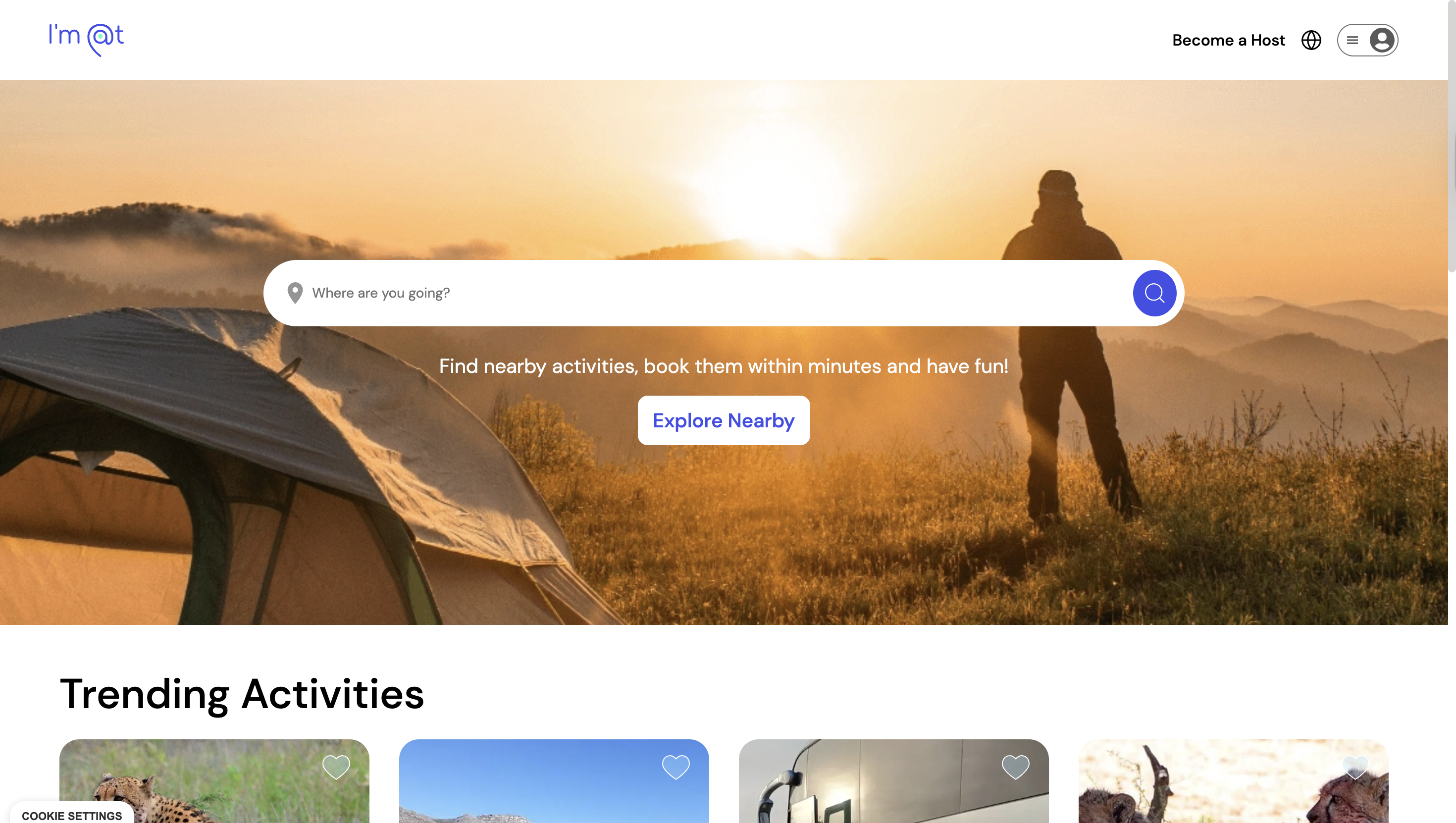
For travelers who want to stop switching tabs and start actually planning, Im-at gives you a single interface to search by location or activity type, compare listings, and confirm your booking in minutes. Whether you're after a custom 4x4 tour or a multi-day city itinerary, the listings are there.
What Im-at saves you:
- Separate searches across multiple platforms
- Duplicate payment flows and account logins
- Uncertainty about whether a listing is actively managed
Search Im-at's activity catalog now and book your next local experience without the tab overload.
Useful sources and further reading
Research and partner resources referenced in this article:
- Meetup — local groups and community events: the strongest free tool for finding recurring local activities and community-hosted events by city and interest.
- LocalDayOut — neighborhood activity discovery: handpicked short lists for mid-sized towns and suburbs where mainstream apps underperform.
- FunAroundMe — zip-code activity search: blends hiking trails, local events, and commercial listings in a single zip-code search.
- Showaround — local guide finder: filter local guides by language, price, and interests for private city tours.
- Tomo — real-time local plans: surfaces short-notice, community-driven activities within walking distance.
- Experience by Locals — curated local picks: editorial guides for specific traveler interests and local events.
- Wild Foodz — culinary experience tactics: practical how-to content for food-focused local experiences and reservation basics.
- Arival — tour operator software guide: explains the difference between consumer booking platforms and operator back-office tools.
- Im-at blog — nearby attractions guide: practical tactics for neighborhood-level activity discovery.
- Im-at blog — authentic local experiences guide: deeper reading on what makes a local experience worth booking.