

TL;DR:
- Digital travel planning streamlines organizing trips through online tools, AI, and real-time data, transforming the travel experience. It centralizes bookings, creates personalized itineraries, and enables continuous engagement before, during, and after trips. However, travelers must manage app fatigue and prioritize offline access to enjoy seamless, stress-free journeys.
Forget printing out MapQuest directions or calling a travel agent to piece together a two-week itinerary. What is digital travel planning, exactly? It's the shift to using online tools, apps, and AI to organize, book, and manage every part of your trip from a single screen. And it's not just convenient. It's fundamentally changing how travelers experience the world. Whether you're planning a solo safari in South Africa or a multi-city European backpacking route, digital planning puts real-time data, personalized recommendations, and instant booking at your fingertips.
Table of Contents
- Key takeaways
- What is digital travel planning?
- How AI transforms the planning process
- Key digital travel tools to know
- Benefits and challenges of digital travel planning
- How to get started with digital travel planning
- My honest take on digital travel planning
- Take your digital plans off the screen
- FAQ
Key takeaways
| Point | Details |
|---|---|
| Digital planning centralizes everything | One platform handles flights, hotels, activities, and budgets instead of juggling ten tabs. |
| AI builds itineraries in minutes | AI tools analyze your preferences and real-time data to create personalized trip plans fast. |
| App fatigue is a real risk | Using too many tools fragments your data; one core platform with offline backup is the smarter move. |
| Planning is now continuous | Travelers engage with digital tools before, during, and after trips, not just at booking time. |
| Activities need dedicated discovery | General booking sites often miss local experiences; specialized platforms surface the best on-the-ground options. |
What is digital travel planning?
Digital travel planning is the practice of using internet-connected tools, apps, and platforms to research, organize, book, and manage a trip. Instead of visiting a physical travel agent or manually comparing prices across dozens of websites, you work inside a connected ecosystem where flights, hotels, tours, and activities talk to each other.
The core components of a digital travel platform typically include:
- Aggregated booking options for flights, accommodations, and local activities pulled from multiple providers
- Itinerary builders that let you sequence your days, add reservations, and share plans with travel companions
- Budget trackers that calculate costs in real time as you add elements to your trip
- Real-time alerts for flight changes, price drops, or travel advisories
What separates digital planning from simply "searching Google" is data aggregation. Travel-as-a-Service models unify fragmented travel APIs and providers, giving you end-to-end trip management in one place instead of scattering your information across unconnected services.
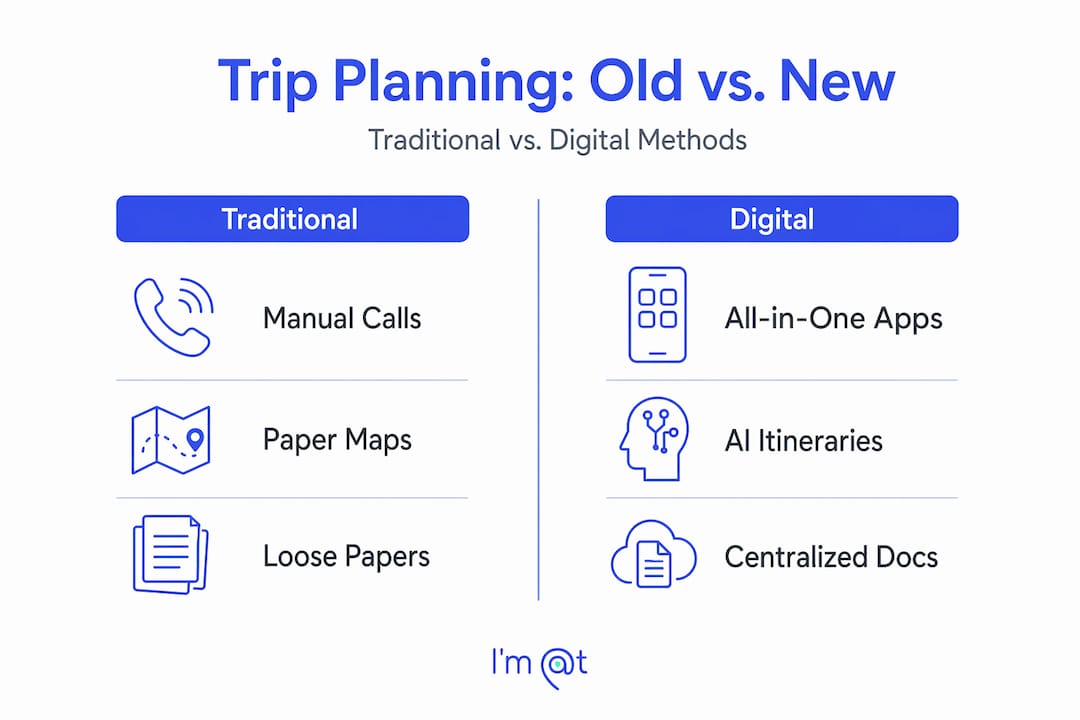
Here is a quick comparison of traditional versus digital planning to make the difference concrete:
| Planning Element | Traditional Method | Digital Method |
|---|---|---|
| Flight research | Call agents or visit airline sites | Aggregator compares hundreds of options instantly |
| Itinerary building | Handwritten or Word document | App auto-sequences activities with map view |
| Activity discovery | Guidebooks, word of mouth | Platform surfaces rated local experiences |
| Budget tracking | Spreadsheet or mental math | Real-time cost calculator inside the platform |
| Trip updates | Phone calls or check-ins | Push notifications with live alerts |
Modern platforms go well beyond listing reservations. Digital platforms now act as full "trip architects," sequencing activities and optimizing routes so your days flow logically rather than leaving gaps or backtracking across a city.
How AI transforms the planning process
Artificial intelligence is where digital travel planning gets genuinely exciting. Instead of spending hours cross-referencing reviews, prices, and schedules, AI tools do that work in the background and surface a plan tailored specifically to you.
AI-powered travel planners can create personalized itineraries in as little as 2 minutes by synthesizing your preferences, budget, and real-time data simultaneously. That's not a minor efficiency gain. That's the difference between an evening spent planning and a Saturday afternoon kept free.
Here's what AI actually does inside a modern travel planning tool:
- Ingests your preferences including travel style, budget ceiling, dietary needs, and activity interests
- Pulls real-time data from APIs covering weather forecasts, local events, crowd levels, and pricing trends
- Generates a sequenced itinerary with optimized routing so you aren't zigzagging across a destination unnecessarily
- Adapts dynamically when conditions change, like a monsoon hitting your planned hiking day, by swapping in indoor alternatives automatically
- Provides 24/7 support through integrated chatbots that can answer visa questions, translate menus, or find last-minute restaurant reservations
AI trip planners process huge volumes of data from APIs, social media, and real-time sources to deliver hyper-personalized and adaptable itineraries. That last point matters more than people realize. Personalization elevates your experience beyond what a generic guidebook ever could because the plan reflects your actual trip, not a statistical average of what most tourists do.
Pro Tip: Before you let an AI build your itinerary, spend five minutes filling out every preference field available. The more context you give it, such as "I prefer small group experiences over crowded tourist sites" or "I want one slow morning per day," the more accurate and usable the output.
Key digital travel tools to know
Understanding the categories of digital tools available helps you build a planning stack that actually works for your travel style without overwhelming you.
Itinerary builders like online itinerary creation tools let you drag and drop reservations, add notes, attach confirmation numbers, and share the full plan with travel partners. They turn a chaotic mix of email confirmations into a readable daily schedule.

Travel aggregators scan hundreds of airlines, hotel chains, and car rental companies simultaneously and rank results by price, flexibility, or user ratings. These are the tools most travelers already know, but they work best when paired with a dedicated itinerary tool rather than used alone.
Activity discovery platforms are where many planners fall short. General booking giants focus on flights and hotels but often miss the local guided tour, the neighborhood food walk, or the off-road safari that makes a trip memorable. Specialized platforms fill that gap by surfacing curated activity options that general aggregators bury or ignore entirely.
Budget tracking tools integrated inside planning platforms let you set a trip budget at the start and watch it update in real time as you add bookings. Some tools even flag when a segment of your plan is eating disproportionately into your total, giving you room to rebalance.
App fatigue and data fragmentation are common pitfalls that experts consistently flag. When your flight is in one app, your hotel confirmation is in your email, and your activity tickets are in a third app, you spend your trip hunting for information instead of enjoying the destination.
Pro Tip: Pick one platform as your single source of truth and forward all confirmation emails there. Redundancy is fine for safety backups, but your active planning should live in one place.
Benefits and challenges of digital travel planning
The benefits of digital travel planning are real and well-documented, but so are the trade-offs. Knowing both helps you use these tools effectively rather than being caught off guard.
The advantages:
- 32% of travelers now book at least part of their trip influenced by social media content, showing that digital research is already deeply embedded in how people discover destinations
- Centralized organization means you have one document, one app, one source for every confirmation, address, and timing detail
- Real-time updates keep you informed about delays, price drops, and local conditions without requiring you to refresh multiple tabs
- AI tools automate booking, optimize budgets, and provide 24/7 support, all of which reduce the cognitive load of travel significantly
- Collaborative features let groups share and edit itineraries together, replacing the chaotic group chat with an actual shared document
The challenges you should prepare for:
- Internet dependency is the biggest vulnerability. If your entire itinerary lives in the cloud and you land somewhere with poor connectivity, you're stuck
- Privacy concerns are legitimate. Many platforms collect detailed behavioral and location data; it's worth reading the privacy policy of any tool handling your passport details or payment information
- The learning curve for new tools can eat into time you'd rather spend planning actual experiences
- Travel planning is now a continuous daily activity, not just a pre-trip task, which means the right tools need to support you before, during, and after the trip, not just at the booking stage
The practical fix for most of these challenges is simple: download offline versions of your maps and itinerary before you leave, use two-factor authentication on travel accounts, and pick platforms that have solid offline functionality built in.
How to get started with digital travel planning
Getting started does not require a tech background. It requires about an hour of setup before your next trip and a willingness to consolidate your planning into fewer, better tools.
- Define your trip parameters. Destination, dates, rough budget, travel style, and the types of experiences you prioritize. This information feeds directly into AI planning tools and filters booking options to what actually fits your trip.
- Choose a central platform. Pick one app or web-based tool to serve as your itinerary hub. Digital travel guides can help you evaluate which platforms best match your planning style before you commit.
- Use AI features for itinerary generation. Input your parameters, let the tool generate a draft, then edit based on your actual priorities. Treat the AI output as a strong starting point, not a locked plan.
- Add all bookings to the central hub. Forward confirmation emails, input reservation codes, and attach any digital tickets so everything is searchable in one place.
- Set up offline access. Download maps, your itinerary PDF, and any critical documents before departure. This takes ten minutes and saves enormous stress if connectivity fails.
- Invite collaborators for group travel. Most modern platforms support shared itineraries. Use that feature instead of managing a group trip through text messages.
Pro Tip: Check whether your chosen platform has a browser extension that auto-imports bookings from your email. Several major tools offer this, and it eliminates the manual step of copying confirmation numbers by hand.
My honest take on digital travel planning
I've been planning trips both ways, and the honest truth is that the shift to digital tools did not just save me time. It changed the quality of the trips themselves.
Before proper digital tools, I would spend two weeks building an itinerary in a Google Doc that inevitably fell apart by day three because I hadn't accounted for travel time between activities or checked actual operating hours. I once spent a full afternoon in Lisbon walking between restaurants I'd picked from a blog, only to find two of them closed and one with a two-hour wait. That's not a planning failure on my part. That's what happens when your information isn't live.
What I've learned after years of using digital travel tools is that the real value isn't the booking convenience. It's the reduction of in-trip anxiety. When you know your day is organized, your confirmation is accessible offline, and your backup option is one tap away, you actually relax. You stop managing logistics and start experiencing the place.
That said, I'd caution anyone against treating AI-generated itineraries as final answers. The best trips I've had used digital planning as a skeleton and left deliberate gaps for spontaneous decisions. Technology should inform your choices, not remove your judgment from the equation. Over-relying on a platform's suggestions without local knowledge or personal curiosity is its own kind of trap.
My recommendation: use technology to transform your planning up front, then be willing to deviate once you're on the ground. The tools are there to serve your trip, not run it.
— Mikahil
Take your digital plans off the screen
Digital planning gives you the structure. What actually makes a trip worth taking is what happens once you arrive.
Im-at is built specifically for that gap between "I've booked my flights" and "I know exactly what I'm doing when I land." The platform lets you discover, compare, and book local experiences instantly, from guided safaris and township tours to multi-day adventures like tailor-made 4x4 tours that fit directly into your existing itinerary. You can also browse expertly curated options like the Cape Town 3-day attraction covering Township tours, Cape Peninsula, and wine tasting, which pairs perfectly with a digitally organized trip. Pair your online itinerary with experiences designed by people who actually know the destination.
FAQ
What is digital travel planning, exactly?
Digital travel planning is using online tools, apps, and AI platforms to research, book, and organize all elements of a trip in one connected system rather than managing separate bookings manually.
What is a digital travel platform?
A digital travel platform is a web or app-based service that aggregates flights, hotels, activities, and itinerary tools in one place, often powered by APIs that pull live pricing and availability from multiple providers.
How long does it take to plan a trip using digital tools?
AI-powered planners can generate a full personalized itinerary in as little as 2 minutes, though thorough trip setup including booking confirmation and offline prep typically takes one to two hours.
What are the main benefits of digital travel planning?
Key benefits include centralized organization, real-time updates, AI-generated personalized itineraries, collaborative planning for groups, and significant time savings compared to traditional manual methods.
How do I avoid app fatigue when planning a trip digitally?
Experts recommend choosing one source-of-truth app for your itinerary and forwarding all confirmations there, rather than spreading information across multiple disconnected tools.