

TL;DR:
- Creating a flexible travel itinerary allows travelers to enjoy more spontaneous experiences while maintaining essential logistics. It functions as a personalized blueprint that balances anchor activities with free time, reducing stress and maximizing enjoyment. Incorporating key elements like destinations, activities, transportation, and safety details ensures a well-organized yet adaptable adventure.
Most travelers assume that building a travel itinerary means locking yourself into a minute-by-minute schedule with no room to breathe. That idea keeps many adventurous people from planning at all, which often leads to missed opportunities, wasted hours, and genuine frustration on the road. A well-built itinerary is actually the opposite of a cage. It is a framework that gives you more freedom, not less, because you spend less time figuring out logistics and more time enjoying the experience. In this article, you will learn exactly what a travel itinerary is, why it matters, what goes into one, and how to build your own without sacrificing spontaneity.
Table of Contents
- What is a travel itinerary?
- Why use a travel itinerary?
- Core elements of an effective itinerary
- How to create your own travel itinerary
- Why flexible itineraries work best for real travelers
- Explore with ease: Book top tours and local experiences
- Frequently asked questions
Key Takeaways
| Point | Details |
|---|---|
| Travel itineraries explained | A travel itinerary is a flexible plan outlining destinations and activities with times and logistics. |
| Itinerary benefits | Travelers with itineraries generally save time, experience more, and stress less during their trips. |
| Key elements | Effective itineraries always include destinations, activities, timeframes, and essential logistics. |
| Balance structure and freedom | The best itineraries feature both anchor activities and unscheduled time for spontaneous discoveries. |
What is a travel itinerary?
Think of a travel itinerary as your personal travel blueprint. According to its core definition, a travel itinerary is a schedule of travel-related events, typically listing destinations to visit at specified times and the transportation needed to move between them. It is not a rigid script you must follow word for word. It is more like a GPS route that recalculates when you take a detour.
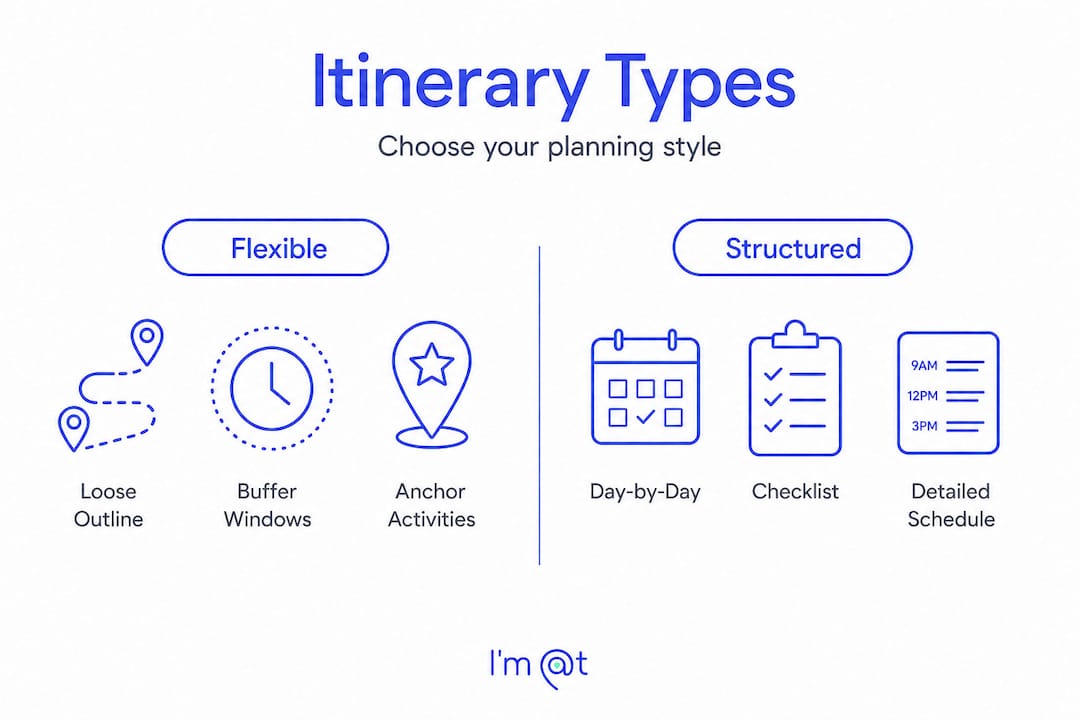
In everyday language, an itinerary is a plan of a journey that includes the route and the places you will visit. That simple definition leaves a lot of room for personal style. Some travelers prefer a loose outline with just a few anchors, while others like a more detailed day-by-day breakdown. Both approaches count as an itinerary.
Here is a quick look at the core elements most travel itineraries include:
| Element | What it covers | Why it matters |
|---|---|---|
| Destinations | Cities, attractions, landmarks | Sets your geographic scope |
| Activities | Tours, excursions, cultural experiences | Defines how you spend your time |
| Timings and dates | Check-in times, tour slots, transit | Keeps logistics from overlapping |
| Transportation | Flights, trains, car rentals, transfers | Connects every part of the journey |
| Accommodation | Hotels, hostels, rentals | Ensures you have a place to land |
| Emergency info | Local contacts, embassy numbers | Adds a critical safety layer |
"A travel itinerary is your trip's backbone. It does not tell you how to feel or what to love. It simply makes sure you show up at the right place at the right time so you can have those feelings."
Common forms include digital apps on your phone, shared Google Sheets, printed PDF documents, or dedicated travel platforms. Each format has its strengths. Digital tools allow real-time updates and sharing. Printed sheets work beautifully in areas with no internet. The format is secondary. What matters is that it captures the essentials in a way that is easy to reference on the go. You can learn more about structuring your planning through this itinerary checklist steps guide, which walks you through the process in a logical order.
The biggest myth to bust right now is that an itinerary locks you in. In reality, the opposite is true. When you already know where you are sleeping and how you are getting to your next destination, you are completely free to wander the back streets, linger over lunch, or stumble into a local market without any nagging anxiety about what comes next.

Why use a travel itinerary?
Now that you understand what a travel itinerary is, let us focus on why it makes travel so much more enjoyable. The benefits go well beyond just staying organized.
The biggest advantages of using a travel itinerary:
- Time savings: You eliminate hours of on-the-spot decision making, which is especially draining in unfamiliar places.
- Maximized experiences: When you pre-identify your top priorities, you avoid the trap of spending your best energy on forgettable activities.
- Reduced stress: Knowing your accommodation, transport, and key activities in advance removes the anxiety that bogs down even the most easygoing traveler.
- Better budgeting: A mapped-out plan makes it easier to estimate costs and avoid surprise spending.
- Group coordination: When traveling with others, an itinerary becomes the shared reference point that keeps everyone aligned without constant debate.
- Backup planning: If one activity falls through, your itinerary reveals what can be swapped in without scrambling.
One of the smartest ideas you can borrow from experienced travelers is the concept of "anchor activities." A practical approach to building an itinerary is to balance structure with flexibility by planning key anchor activities and leaving breathing room rather than over-scheduling every minute. An anchor activity might be a morning safari, an afternoon cooking class, or a sunset boat tour. Everything around that anchor stays flexible, giving you the feeling of spontaneity within a clear structure.
Consider a real-world example. Two travelers visit the same city for five days. Traveler A has no plan. They spend the first morning wandering, eat at a random restaurant, miss a popular gallery because the line is too long, and return to their hotel exhausted without seeing much. Traveler B books one anchor activity per day, leaves the rest loose, and ends up discovering a neighborhood market, a live jazz bar, and a rooftop viewpoint, all spontaneous finds made possible by not stressing over logistics.
These smart planning tips are the kind of subtle strategies that separate memorable trips from disappointing ones. You can also explore how planning activities for stress-free travel can reshape the way you approach your next trip.
Pro Tip: Always build at least one 30 to 60 minute buffer window between activities. Travel delays, longer-than-expected waits, and simply falling in love with a view are all common. That buffer is what keeps your whole day from unraveling when one thing runs long.
The payoff from saving time with planning tools is real. Travelers who plan their key activities in advance consistently report higher satisfaction with their trips than those who wing it entirely.
Core elements of an effective itinerary
With the value clear, let us explore which elements should always make their way into your travel itinerary and how they fit together like pieces of a well-designed puzzle.
A strong itinerary is built in layers. Each layer adds information that makes the next decision easier. Here is how to think about them:
-
Destinations and routes: Start with the big picture. List every city or region you plan to visit and roughly how long you will spend in each. This step prevents the common mistake of planning too many locations for the available time.
-
Activities (anchor vs. optional): Separate your must-do experiences from your nice-to-have ones. Anchor activities get a confirmed time slot. Optional activities fill in the gaps. This two-tier system is what makes a schedule both organized and flexible.
-
Timings and dates: Assign specific dates to anchor activities and lock in any bookings that require reservations. Leaving timing vague almost always creates problems, especially for popular attractions that sell out days or weeks in advance.
-
Transportation logistics: Note how you are getting between each destination. Include flight numbers, departure times, bus or train details, and any pre-booked transfers. A travel itinerary that lists destinations without transportation details is only half-built.
-
Accommodation details: For every night of your trip, record the name, address, check-in time, confirmation number, and a contact number for your accommodation. This sounds basic, but it becomes invaluable when you are exhausted after a long travel day and just need to find your bed.
-
Emergency and contact information: Add the local emergency number, your country's embassy contact, your travel insurance details, and a trusted person back home. This section is easy to skip and essential to have.
| Itinerary type | Structure level | Best for |
|---|---|---|
| Loose outline | Low | Long-term solo travelers |
| Day-by-day plan | Medium | City breaks and group trips |
| Hour-by-hour schedule | High | Cruise itineraries, packed short trips |
Using a step-by-step itinerary checklist ensures you do not accidentally skip a layer that will matter later. The best itineraries feel natural when you are using them, not like homework.
How to create your own travel itinerary
Armed with an understanding of what makes an effective itinerary, here is how you can confidently build one for your next adventure without overcomplicating the process.
-
List your must-see destinations and high-priority activities first. Write down everything you want to experience, then ruthlessly narrow it to the realistic top priorities based on your available days. This filtering step prevents the over-packing trap that ruins so many trips.
-
Map out travel logistics and timeframes. Estimate travel time between each location honestly. A two-hour train ride plus airport time plus check-in is rarely a half-day. Use maps, transit apps, and real booking times to get accurate estimates.
-
Add accommodation details and confirmation numbers. For each destination, fill in where you are staying and how to reach them. Drop this info into your itinerary document so it is always one tap away.
-
Block out your anchor activities with confirmed bookings. Choose one or two standout experiences per day and lock them in with reservations. These are your non-negotiables, the reason you are visiting this place.
-
Leave open slots deliberately. Resist the urge to fill every gap. Those open windows are where the most memorable moments tend to happen, the local chef who invites you into the kitchen, the night market you stumble upon, the sunset you almost missed.
-
Save your itinerary in multiple formats. Keep a digital copy on your phone, share it with someone at home, and consider printing a backup. Connectivity is never guaranteed.
A practical approach to building any great itinerary is that anchor-plus-flexibility formula, and it applies whether you are planning a quick weekend city break or a month-long overland adventure.
Pro Tip: Use a travel planning app to drag and drop activities into days. Visual itinerary builders make it far easier to spot over-scheduling at a glance and adjust before you are already on the road.
If you tend to book at the last minute, do not assume planning is not for you. There are great resources on last-minute flexible travel that show you how to build a quick but effective itinerary even with just 24 to 48 hours notice. For those planning outdoor adventures specifically, this planning outdoor adventures resource walks through the unique logistics that make nature-based trips work smoothly.
Why flexible itineraries work best for real travelers
Here is a perspective most travel guides will not share directly: the travelers who have the richest stories are rarely the ones with the tightest schedules.
Over-planning is one of the most common mistakes first-time and even repeat travelers make. It comes from a good place, enthusiasm, wanting to see everything, not wanting to waste a moment. But cramming eight activities into a single day creates a very specific kind of misery where you are technically seeing the world while barely experiencing any of it.
The best travel moments are often found in the margins. A conversation with a shopkeeper who points you to the best local restaurant not in any guide. An unexpected festival happening in the plaza outside your hotel. A trail you notice while walking between sites that leads to a view you will remember for years. None of these show up on an over-packed schedule because there is no room to notice them.
What actually works, based on experience from thousands of real traveler stories, is the anchor activity model. Pick one or two confirmed experiences each day, the safari, the walking tour, the cooking class. Then let the hours around them breathe. You will move through your trip feeling in control without feeling rushed, which is the exact sweet spot that turns a good trip into a genuinely great one.
The building an itinerary insight that sticks with most experienced travelers is this: leave breathing room. It sounds simple. It is surprisingly hard to do. But every traveler who practices it comes home with better stories than the one who optimized every hour.
Explore with ease: Book top tours and local experiences
Your itinerary is only as good as the experiences inside it, and that is where Im-at steps in to make planning genuinely exciting.

At Im-at, you can browse and book hundreds of curated tours, guided safaris, cultural excursions, and outdoor adventures across locations worldwide. The platform is designed to slot experiences directly into your travel plans with minimal effort, so you spend less time researching and more time anticipating. Whether you are building a day-by-day city itinerary or looking for a single standout experience to anchor your trip, Im-at gives you access to top-rated activities you can book in minutes. Explore the catalog, pick your anchors, and leave the logistics to us. Your next great adventure is already waiting.
Frequently asked questions
Is a travel itinerary necessary for every type of trip?
While not mandatory, most trips benefit from a basic itinerary, especially when time or logistics are complex. Even a loose travel schedule with confirmed accommodation and one or two key bookings can prevent costly stress on the road.
How detailed should my travel itinerary be?
The best itineraries balance must-do items with free time, and you should avoid planning every minute. A practical building approach recommends anchoring one or two activities per day and leaving the remaining hours open.
Can I use apps to organize my travel itinerary?
Yes, many travel planning apps let you drag activities into day slots, sync with booking confirmations, and share your plan with fellow travelers. Digital tools make updating and reorganizing your itinerary quick and simple.
What's the difference between an itinerary and a checklist?
A travel itinerary is a time-organized schedule of destinations and activities during your trip, while a checklist is a task or packing list you complete before you go. Both are useful but serve entirely different purposes.