

TL;DR:
- Heritage tourism connects visitors to authentic history, culture, and traditions through meaningful engagement.
- It encompasses personal ancestry travel and broader site visits, emphasizing real experiences over staged ones.
Heritage tourism is defined as travel to places, artifacts, and living traditions that authentically connect visitors to the history, culture, and stories of a people or place. The National Trust for Historic Preservation recognizes it as one of the fastest-growing segments in global travel, drawing visitors who want more than scenery. Unlike general sightseeing, heritage tourism demands genuine engagement. It asks you to understand, not just observe. This guide covers what heritage tourism means, the forms it takes worldwide, its real economic and cultural benefits, and how you can participate in it responsibly.
What is heritage tourism, and what forms does it take?
Heritage tourism has two distinct dimensions: personal heritage travel, which is ancestry-based and identity-driven, and cultural heritage tourism, which centers on historically significant sites, monuments, and living traditions. Both share the same core motivation. Travelers want authentic contact with the past, not a staged version of it.

Cultural heritage tourism is the broader category. It includes visiting UNESCO World Heritage Sites like Machu Picchu in Peru, Stonehenge in England, and Angkor Wat in Cambodia. These destinations attract millions annually because they offer physical proof of how civilizations built, believed, and organized their worlds. The architecture, engineering, and spatial logic of these sites communicate history more directly than any textbook.
Personal heritage travel is narrower and more emotionally charged. Services like 23andMe and AncestryDNA have made ancestry tourism far more accessible, enabling travelers to trace their lineage to specific villages, regions, or countries. A traveler from the United States discovering Irish or Nigerian roots and then visiting those ancestral communities is practicing personal heritage travel. The trip becomes an act of self-discovery as much as sightseeing.
Both forms also divide between tangible and intangible heritage. Tangible heritage includes buildings, ruins, and artifacts. Intangible heritage covers oral traditions, crafts, music, and culinary practices. The 500-year-old Phuoc Tich village in Vietnam and Riab village in Cambodia are strong examples of destinations where both types coexist. Visitors there experience ancient communal house architecture alongside traditional pottery demonstrations and local cooking.
| Destination | Heritage type | Visitor experience |
|---|---|---|
| Machu Picchu, Peru | Tangible, archaeological | Inca citadel exploration, guided historical interpretation |
| Stonehenge, England | Tangible, prehistoric | Ceremonial site visits, archaeoastronomy tours |
| Angkor Wat, Cambodia | Tangible, religious architecture | Temple complex tours, Khmer cultural programs |
| Phuoc Tich village, Vietnam | Tangible and intangible | Communal house tours, pottery crafts, traditional cuisine |
| Riab village, Cambodia | Intangible, community-led | Homestays, traditional weaving, oral history sessions |
What are the economic and cultural benefits of heritage tourism?
Heritage tourists stay longer and spend more than typical leisure travelers. Studies show returns as high as 5-to-1 in economic impact from heritage tourism investment. That ratio matters because it means every dollar a government or community puts into preserving a heritage site can generate five in local economic activity. No other tourism category consistently delivers that multiplier.
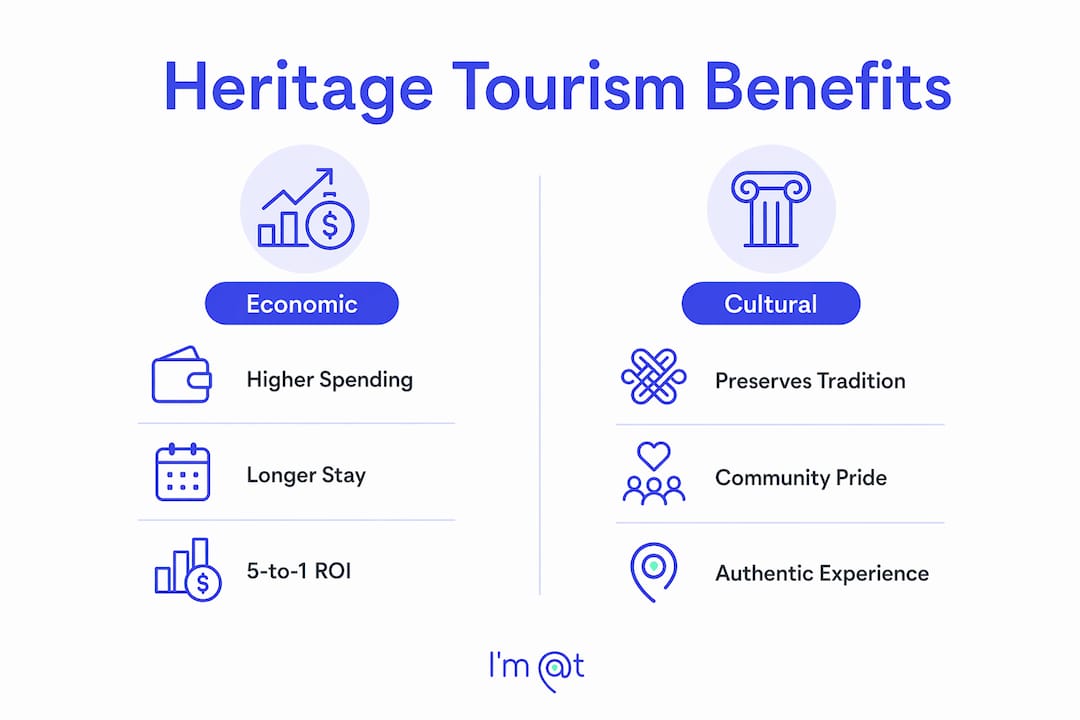
The economic benefits extend well beyond ticket sales. Modern heritage tourism integrates artisan demonstrations, culinary experiences, and homestay accommodations that channel revenue directly to residents. Phuoc Tich village generated approximately $123,000 USD in 2024 to 2025 from heritage tourism efforts. For a rural Vietnamese village, that figure represents a meaningful economic shift driven entirely by cultural authenticity.
The cultural benefits are equally significant:
- Preservation funding: Tourism revenue finances the restoration of buildings, archives, and craft traditions that would otherwise disappear without external support.
- Cultural revitalization: When communities teach visitors traditional skills, they reinforce those skills internally. Young residents who might otherwise abandon local crafts find economic incentive to continue them.
- Education and diplomacy: Heritage tourism functions as sustainable cultural learning, building cross-cultural understanding that formal diplomacy rarely achieves at the individual level.
- Identity reinforcement: For diaspora communities, visiting ancestral homelands strengthens personal and collective identity in ways that are difficult to quantify but deeply felt.
Perceived authenticity is the decisive competitive advantage in this sector. Travelers consistently reject mass-market destinations in favor of genuine, slow, experiential travel. Communities that preserve and honestly present their heritage attract higher-value visitors who return and recommend.
What challenges come with promoting heritage tourism sustainably?
Heritage tourism carries real risks when managed poorly. The same economic forces that fund preservation can also distort and ultimately destroy what made a place worth visiting. Understanding these tensions is not optional for anyone serious about this form of travel.
The core risks include:
- Displacement: Rising property values and commercial pressure can push original residents out of heritage neighborhoods, hollowing out the very community that gave the place its character.
- Cultural dilution: When performances and crafts are simplified for tourist consumption, they lose their original meaning. A ceremony performed three times daily for tour groups is no longer a ceremony in any meaningful sense.
- Commodification: Practitioners face difficult curatorial choices about which stories to tell, which artifacts to display, and which traditions to perform. Every selection is also an omission, and commercial pressure tends to favor the picturesque over the accurate.
- Infrastructure overload: Sites like Angkor Wat and Machu Picchu have faced serious degradation from visitor volume, requiring strict access controls and ongoing conservation investment.
Community-led governance is the most reliable solution to these risks. Bottom-up models, where local residents control tourism policy, pricing, and narrative, consistently produce better cultural and economic outcomes than top-down approaches managed by national governments or foreign operators. Riab village and Phuoc Tich both demonstrate this principle. Their tourism programs grew from community decisions, not external mandates.
Pro Tip: Before booking a heritage tour, research whether the operator is locally owned or managed. Tours run by community cooperatives or local guides return a far greater share of revenue to residents than those operated by international travel companies.
How can you engage authentically in heritage tourism?
Authentic engagement in heritage tourism requires deliberate choices before and during your trip. The difference between a meaningful heritage experience and an expensive disappointment usually comes down to preparation and attitude.
-
Choose specialized, locally guided tours. Generic group tours rarely go deep enough. Look for heritage advisors, cultural specialists, or community-run programs that offer context beyond the standard script. Im-at lists curated cultural tour options that connect travelers with local expertise rather than mass-market itineraries.
-
Participate, don't just observe. Attend a pottery workshop in Phuoc Tich rather than watching from a distance. Join a cooking class in a heritage village rather than eating at the tourist restaurant nearby. Intangible heritage — songs, crafts, oral histories — provides the authentic experiences modern travelers value most, and those experiences require your active involvement.
-
Use genealogy technology for personal heritage travel. If ancestry is your motivation, platforms like AncestryDNA can map your lineage to specific regions before you travel. Arriving in a village knowing your great-grandparents lived there transforms the experience entirely. The authentic travel rewards of this kind of personal connection are unlike anything a standard itinerary delivers.
-
Slow down. Heritage tourism rewards patience. Spending three days in one village produces more genuine understanding than three hours at five different sites. Slow travel also distributes your spending more evenly into the local economy rather than concentrating it at major commercial attractions.
-
Support local artisans directly. Buy crafts from the maker, not from a souvenir shop at the airport. Eat at family-run restaurants, not hotel buffets. These choices determine whether your visit contributes to cultural preservation or simply extracts value from it.
Pro Tip: Read one book about a destination's history before you arrive. Travelers who arrive with historical context consistently report richer, more memorable experiences than those who learn everything from a tour guide on the day.
Key takeaways
Heritage tourism delivers its greatest value when communities control the narrative, travelers engage actively, and authenticity is treated as a non-negotiable standard rather than a marketing claim.
| Point | Details |
|---|---|
| Two core dimensions | Heritage tourism splits into personal ancestry travel and broader cultural heritage tourism at historic sites. |
| Strong economic returns | Studies show heritage tourism generates up to a 5-to-1 return on investment for local communities. |
| Authenticity drives value | Perceived authenticity is the decisive competitive advantage; travelers reject staged or mass-market experiences. |
| Community governance matters | Bottom-up, locally managed tourism models produce more sustainable cultural and economic outcomes than top-down approaches. |
| Intangible heritage is irreplaceable | Traditions, crafts, and oral histories provide the authentic experiences that monuments alone cannot deliver. |
Why authenticity is the only metric that matters in heritage tourism
I have spent years researching and traveling through heritage destinations across Southeast Asia, Europe, and sub-Saharan Africa. The single observation that holds across every context is this: the moment a community starts performing its culture rather than living it, the heritage tourism product begins to die.
The most powerful heritage experiences I have encountered were not at UNESCO-listed monuments. They were in places like Riab village, where a local elder explained the meaning of a weaving pattern that her grandmother taught her, or in a Portuguese hill town where a family invited me to their Sunday lunch because I had spent two days learning the history of their region. Those moments are not reproducible at scale, and that is precisely what makes them valuable.
The commercial pressure to scale heritage tourism is real and understandable. A village that earns $123,000 from tourism wants to earn more. But the path to earning more cannot be to dilute what made the place worth visiting. The communities that understand this, and that have the governance structures to enforce it, are the ones building durable heritage tourism economies.
My honest caution to travelers is this: if a heritage experience feels like a theme park, it probably is one. The authentic travel experiences that stay with you for decades are the ones where you were a guest in someone's living culture, not an audience member at a performance of it. Seek those out, and spend your money there.
— Mikahil
Discover heritage and cultural tours through Im-at
Im-at connects travelers with curated, locally grounded experiences that go beyond standard sightseeing. Whether you want to explore South African township history and Cape Peninsula landscapes on the Cape Town 3-day heritage tour, trace wine-making traditions along Portugal's Douro Valley, or take a tailor-made 4x4 tour through culturally rich terrain, Im-at's catalog is built for travelers who want genuine engagement with place and people.

Every experience listed on Im-at is bookable in minutes, with local guides and operators who know their heritage firsthand. If you are planning a trip where history and culture matter as much as the destination itself, Im-at is where that planning starts.
FAQ
What is the difference between heritage tourism and cultural tourism?
Heritage tourism focuses specifically on historically or personally significant sites, traditions, and artifacts, while cultural tourism is broader and includes contemporary arts, festivals, and lifestyle experiences. Heritage tourism always involves an element of the past; cultural tourism does not require it.
What are the best heritage tourism destinations in the world?
Machu Picchu in Peru, Angkor Wat in Cambodia, Stonehenge in England, and Phuoc Tich village in Vietnam rank among the most recognized heritage destinations globally. Each offers a distinct combination of tangible monuments and living cultural traditions.
How does heritage tourism benefit local communities?
Heritage tourism generates economic returns as high as 5-to-1 on investment and funds cultural preservation when managed well. The greatest benefits flow to communities that control their own tourism governance rather than ceding it to outside operators.
Can genealogy tools enhance a heritage travel experience?
Yes. Platforms like 23andMe and AncestryDNA allow travelers to trace ancestry to specific regions before visiting, transforming a general cultural trip into a deeply personal identity journey.
What makes heritage tourism sustainable?
Sustainable heritage tourism depends on community-led governance, limits on visitor volume at sensitive sites, and a commitment to presenting heritage honestly rather than simplifying it for commercial appeal. Sites that prioritize authenticity over scale consistently outperform those that do not.