

TL;DR:
- Traveling off-peak offers significant savings, fewer crowds, and access to unique seasonal events that are unavailable during peak periods.
- Choosing shoulder seasons or midweek departures allows travelers to enjoy better prices and authentic cultural experiences while reducing congestion at destinations.
Off-peak travel is defined as visiting destinations during periods of below-average demand, when airlines, hotels, and tour operators lower prices to fill empty capacity. The off-peak model, sometimes called shoulder season travel in industry terms, delivers three compounding advantages: lower costs through dynamic pricing, fewer crowds at major attractions, and access to cultural events that peak-season visitors simply miss. Sources including Navan, NerdWallet, and Travel Market Report consistently confirm these benefits across destinations worldwide. If you have ever wondered why travel off-peak makes sense for your next trip, the answer starts with understanding how demand shapes every dollar you spend and every minute you wait in line.
Why off-peak travel saves you real money
The price gap between peak and off-peak travel is not accidental. Airlines, hotels, and car rental companies all use revenue management systems that adjust rates in real time based on occupancy forecasts and booking velocity. When demand drops, prices follow automatically.
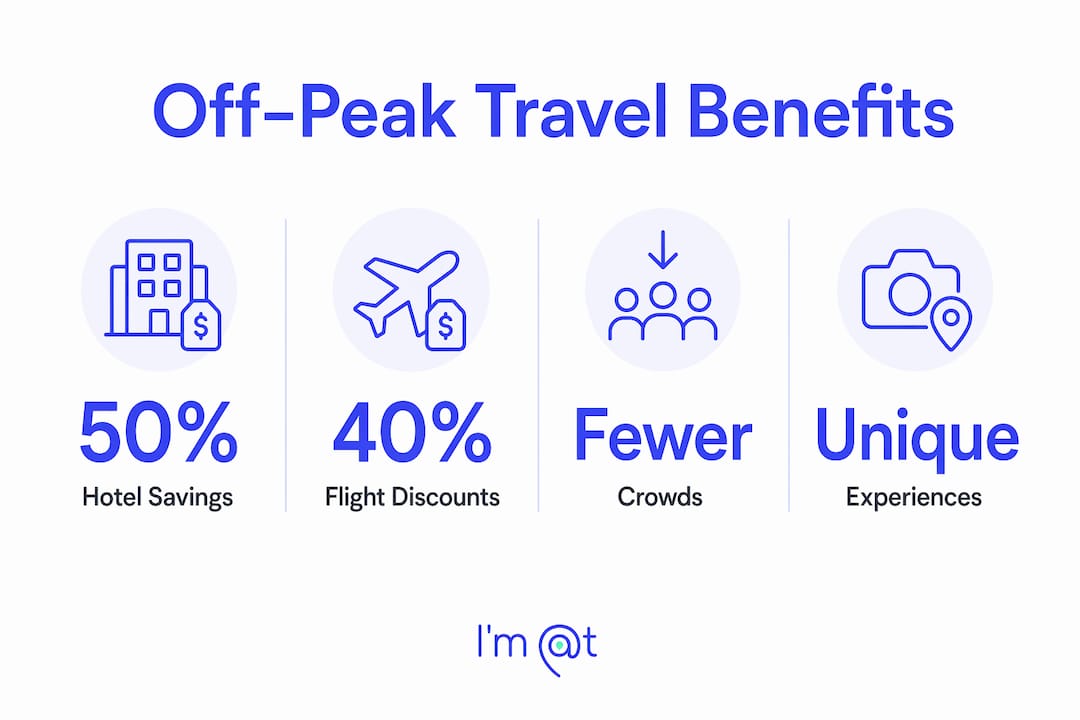
Hotels are the clearest example of this mechanism. Dynamic pricing models create price gaps of 40 to 60 percent between peak and off-peak stays, and even small shifts in booking dates can yield 15 to 25 percent savings within the same week. That means moving your check-in from a Saturday to a Tuesday at the same property can cut your lodging bill by a quarter without changing a single activity on your itinerary.
Airfare follows the same logic. Shoulder season flights carry discounts of 30 to 50 percent compared to peak weeks, with availability remaining high because carriers have not yet sold out inventory. That discount compounds when you combine it with hotel savings, meaning a week-long trip can cost hundreds less for the exact same experience.
Three variables determine how much you save:
- Booking timing: Advance booking shifts travelers into lower-demand windows where prices and availability are both favorable.
- Departure flexibility: Midweek flights and early morning or evening departures consistently price lower than Friday evening or Sunday afternoon options.
- Destination cycle: Some destinations have a single peak season; others have two. Knowing which applies to your target location tells you exactly when prices bottom out.
Pro Tip: Use Google Flights' price calendar view to visualize the full month at once. The cheapest dates stand out immediately, and you can cross-reference them with hotel rate calendars on Booking.com to stack both savings simultaneously.
The deeper insight here is that off-peak advantages come from booking against actual demand curves, not just avoiding summer or December. Micro-timing matters as much as month selection. A flight on the Tuesday after Labor Day can cost 40 percent less than the same route on Labor Day itself.
How fewer crowds change the entire travel experience
Crowd reduction is the off-peak benefit that travelers underestimate most before they experience it. The difference between visiting the Colosseum in Rome in August versus October is not just shorter lines. It is a fundamentally different quality of attention, movement, and memory.

Yahoo Travel experts confirm that reduced visitor numbers during shoulder season improve trip logistics significantly, from wait times at attractions to ease of restaurant reservations. When a restaurant is not turning tables every 45 minutes, servers have time to explain the menu, recommend local dishes, and treat you like a guest rather than a transaction.
The practical improvements stack up quickly:
- Theme parks, museums, and historic sites have shorter lines and more approachable service, with guests facing less competition for reservations and upgrades.
- Popular hiking trails are navigable without bottlenecks, meaning you reach viewpoints without a crowd already occupying every inch of space.
- Photography becomes possible. Iconic shots that require a 5 a.m. alarm in peak season are achievable at a reasonable hour when visitor volume drops.
- Hotel staff have bandwidth to fulfill special requests, and front desk teams are more likely to offer room upgrades when occupancy is not at 98 percent.
Pro Tip: Book restaurant reservations the moment you land, not weeks in advance. Off-peak kitchens often hold tables for same-day bookings that peak-season travelers would never see.
Fewer crowds also change your mental state. Shoulder season travel is described by expert travel planners as the sweet spot that combines favorable conditions with a more authentic atmosphere. When you are not managing crowds, you shift from survival mode to genuine curiosity. That shift is where the best travel memories actually form.
What unique experiences only off-peak travel unlocks
Peak season delivers the greatest hits. Off-peak delivers the album cuts that serious travelers remember for decades.
Off-peak seasons include cultural events and natural phenomena that are simply unavailable during high-demand months. These are not consolation prizes for missing peak season. They are distinct experiences with their own value.
Consider these specific examples:
- Santorini grape harvest (September to October): The island's famous vineyards run harvest festivals after the August peak crowd clears. You get wine tastings, local food events, and the same Aegean views at a fraction of the cost.
- Tokyo autumn foliage (mid-November): Japan's koyo season draws far fewer international visitors than cherry blossom season, yet the visual spectacle is equally dramatic. Hotels in Kyoto and Tokyo price 35 to 45 percent lower during this window.
- Iceland Northern Lights (September to March): The Aurora Borealis is invisible during Iceland's peak summer months because the sun never fully sets. Off-peak is the only time this experience exists.
- Caribbean local carnivals (January to April): Most Caribbean islands hold their national carnivals outside the December to January tourist peak. Travelers who time their visit correctly attend events designed for locals, not tourists.
"Low-season travel gives advisors and travelers access to a version of a destination that peak visitors never see. The culture is less performed and more lived." — Travel Market Report
Traveling off-peak also promotes sustainable tourism by distributing visitor flows across the calendar, reducing congestion at fragile sites, and improving economic outcomes for local communities outside the peak window. When you visit Machu Picchu in May rather than July, you contribute to a more balanced tourism economy while getting a better experience. That is a rare case where self-interest and community benefit point in the same direction.
For travelers who want to go beyond the standard itinerary, offbeat destinations often align naturally with off-peak timing, offering cultural depth that crowded peak-season routes cannot match.
Off-peak vs. peak travel: what the trade-offs actually look like
Off-peak travel is not universally superior. The honest comparison requires acknowledging real trade-offs alongside the advantages.
| Factor | Peak season | Off-peak season |
|---|---|---|
| Airfare and hotels | Highest prices, limited availability | 30 to 60 percent lower, strong availability |
| Crowd levels | High congestion at major sites | Relaxed access, shorter waits |
| Weather | Optimal for most destinations | Variable; research required per destination |
| Flight frequency | Maximum direct routes | Fewer direct options; connections more common |
| Local events | Tourist-focused festivals | Authentic local events and seasonal phenomena |
| Business hours | All attractions fully operational | Some seasonal closures; verify in advance |
The weather variable is the one most travelers get wrong. Off-peak does not mean bad weather universally. In Southeast Asia, the shoulder months of April and October offer lower humidity and fewer tourists than the December to February peak. In Portugal, October delivers warm temperatures, golden light, and wine harvest events while summer crowds have already departed. Expert travel planners consistently describe shoulder season as the sweet spot precisely because weather remains favorable while crowds thin out.
The flight frequency issue is real but manageable. Fewer direct routes during off-peak periods mean longer travel days for some destinations. The mitigation is straightforward: book earlier, use travel planning tools to identify connection options, and build one extra buffer day into your itinerary. The money saved on airfare and hotels more than covers the cost of that additional night.
Pro Tip: Always verify operating hours for specific attractions before booking off-peak trips. Some museums, national parks, and tour operators reduce hours or close entirely during low season. A five-minute check on the official website prevents a wasted travel day.
Crowd management research adds a nuanced layer here. Studies on transport congestion show that staggered discount structures smooth demand transitions more effectively than blanket off-peak pricing, which means the best savings windows are often the weeks immediately before and after peak season rather than the deepest low-season months. Booking the second week of September rather than mid-January for a European destination often delivers better weather, better prices, and better access simultaneously.
For travelers who want maximum flexibility without sacrificing experience, booking activities online during off-peak periods gives you access to tour slots that would be waitlisted in peak season, often at lower rates.
Key takeaways
Off-peak travel delivers lower costs, fewer crowds, and exclusive seasonal experiences that peak-season trips cannot replicate, making it the smarter choice for travelers who prioritize value and authenticity.
| Point | Details |
|---|---|
| Dynamic pricing creates real savings | Hotels and airlines drop rates 30 to 60 percent during off-peak periods; micro-timing amplifies those savings. |
| Fewer crowds improve every aspect of a trip | Shorter waits, better service, and more flexible itineraries define the off-peak experience. |
| Unique events exist only off-peak | Northern Lights, harvest festivals, and local carnivals are inaccessible during peak season. |
| Trade-offs are manageable with preparation | Verify business hours, book early, and use a buffer day to offset reduced flight frequency. |
| Sustainable travel aligns with off-peak timing | Distributing visitor flows benefits local communities and preserves fragile destinations. |
Why I keep choosing off-peak, even when I could go any time
I have stood at the base of the Eiffel Tower in July surrounded by 40,000 other people, and I have stood there on a Tuesday in early November with room to breathe and a clear view of the Seine. The November version was not a compromise. It was better in every measurable way.
What changed my thinking permanently was realizing that peak season is largely a social convention. People travel in July and December because school calendars and corporate leave policies cluster there. The destinations themselves are not better in those months. In many cases, they are worse. The Amalfi Coast in late September has the same water, the same cliffs, and the same food. It has a third of the traffic.
The practical shift I made was treating flexibility as a travel asset. When you can move your dates by two weeks in either direction, you gain access to a completely different pricing tier. Pair that with last-minute trip planning skills and you can sometimes capture off-peak prices even when you book close to departure.
My honest advice: pick one destination you have always wanted to visit during peak season and research its shoulder season equivalent. Check the weather data, look up local events for that period, and price out flights and hotels. The comparison will likely surprise you. The off-peak version will cost less, feel less rushed, and give you access to something the peak-season version cannot.
— Mikahil
Discover off-peak experiences worth booking now

Im-at connects you directly to guided tours, cultural experiences, and adventure activities that shine brightest when crowds are thin. The Cape Town 3-Day Attraction package covers Township tours, Cape Peninsula scenery, and wine tasting across three days, and it runs year-round with off-peak availability that peak-season travelers rarely find open. For wine country travelers, the Douro Valley small-group tour pairs river cruises with harvest-season tastings at a pace that only off-peak timing allows. Browse the full Im-at catalog to find experiences that match your travel window, not just the crowd.
FAQ
What is off-peak travel?
Off-peak travel means visiting a destination during periods of below-average demand, typically including midweek departures, shoulder seasons, and low-season months. Providers lower prices during these windows to fill capacity, creating savings of 30 to 60 percent compared to peak periods.
When is the best time to travel off-peak?
The best off-peak windows vary by destination, but shoulder seasons, the weeks immediately before and after peak season, consistently offer the strongest combination of favorable weather, lower prices, and reduced crowds. For Europe, late September through October and April through May are widely cited as optimal.
Is off-peak travel better for families?
Off-peak travel works well for families with flexible school schedules, delivering lower costs and shorter attraction wait times. The main consideration is verifying that family-friendly services and attractions remain fully operational during the chosen low-season window.
How much can I save by traveling off-peak?
Airfare discounts of 30 to 50 percent and hotel rate reductions of 40 to 60 percent are documented during shoulder and low seasons. Combined savings on a week-long international trip can reach several hundred dollars per person depending on destination and booking timing.
Does off-peak travel mean worse weather?
Not necessarily. Many destinations offer their best weather during shoulder season, including Portugal in October, Southeast Asia in April, and Japan in November. Researching the specific climate data for your destination and travel window is more reliable than assuming peak season equals best weather.