

TL;DR:
- A co-hosted tour features a dedicated host who travels with the group throughout the entire trip to provide guidance and support. This format creates a curated, socially rich experience by managing logistics, building community, and handling disruptions behind the scenes. It differs from guided and self-guided tours by offering full-trip presence and flexible, community-focused activities.
A co-hosted tour experience is defined as a group travel arrangement where one or more dedicated hosts accompany travelers throughout the entire trip, providing expert guidance, logistical coordination, and personal support from departure to return. Unlike a standard guided tour, where local guides appear only at specific stops, a co-hosted format keeps a host present at every stage of the journey. The industry also calls this format a "hosted tour" or "creator-led trip," and the terms are used interchangeably across the travel sector. The result is a travel experience that feels curated, socially rich, and logistically effortless for the traveler.
What is a co-hosted tour experience and what makes it different?
A co-hosted tour experience is built around one core idea: the host never leaves. Dedicated hosts provide all-trip logistical management, personal support, and expert guidance, which separates this format from traditional tours where a guide appears only at a museum or landmark. That constant presence changes the entire character of the trip.

The host role goes well beyond pointing out attractions. Hosts coordinate departure times, manage vendor relationships, handle restaurant reservations, and absorb the stress of unexpected problems before travelers even notice them. Hosts act as human buffers through travel disruptions, managing issues behind the scenes so the group stays relaxed and focused on the experience. That logistical insulation is the defining value of the format.
The social dimension is equally significant. Co-hosted tours consistently turn groups of strangers into tight-knit communities. Many guests join solo and leave with lifelong friendships. The host actively builds that community by creating shared moments, facilitating introductions, and designing group activities that encourage connection. The social experience is frequently as valued as the destination itself.
Key features travelers can expect
- Bundled pricing: Co-hosted tours typically cover 70–90% of total trip costs upfront, including accommodations, ground transport, and curated activities. That structure removes the mental load of budgeting on the road.
- Ongoing host presence: The host travels with the group, not just at scheduled stops.
- Community building: Group activities are designed to create bonds, not just fill time.
- Cultural interpretation: Hosts provide context and storytelling that enrich every location visited.
- Problem absorption: Delays, cancellations, and vendor issues are handled by the host, not the traveler.
Pro Tip: Ask any tour provider how many hours per day the host is available to the group. A host who disappears after dinner is closer to a traditional tour manager than a true co-host.
How do co-hosted tours differ from guided or self-guided travel?
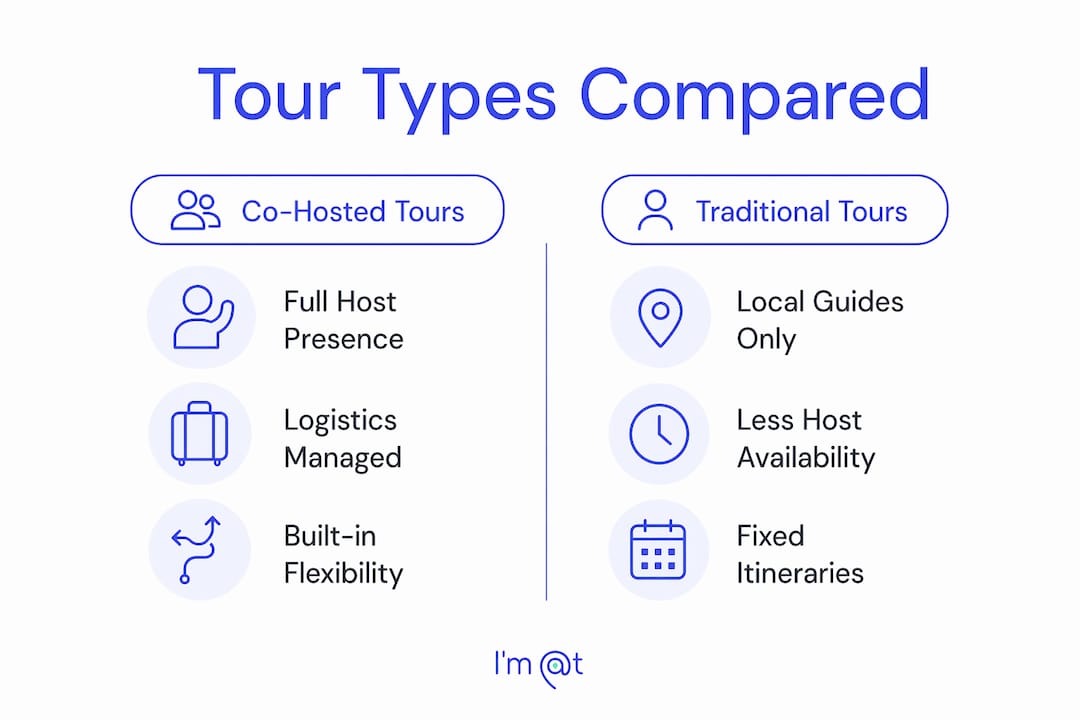
The differences between co-hosted, traditionally guided, and self-guided travel are real and practical. Understanding them helps travelers choose the right format for their personality and goals.
A traditionally guided tour uses local experts at specific sites. A guide meets the group at the Colosseum, delivers a two-hour commentary, and then leaves. The tour operator handles logistics separately, and no single person accompanies the group throughout. Self-guided travel puts every decision on the traveler: booking, routing, troubleshooting, and cultural navigation all fall to the individual. Co-hosted travel sits in a distinct third category.
| Format | Host presence | Logistics managed by | Social structure |
|---|---|---|---|
| Co-hosted tour | Full trip, all stages | Dedicated host | Group community, curated |
| Traditional guided tour | Site-specific only | Tour operator or traveler | Loose group, minimal bonding |
| Self-guided travel | None | Traveler entirely | Solo or personal group |
The biggest misconception about hosted tours is that they restrict freedom. Expert hosts balance structured group activities with unscheduled "white space" for personal exploration. A well-designed co-hosted itinerary might include a group morning excursion followed by a free afternoon where travelers wander independently. That structure gives travelers the best of both worlds.
Creator-led trips add another layer. When a travel creator or advisor serves as the host, they bring an existing audience, a personal style, and a level of social trust that a corporate tour operator cannot replicate. Creator-led trips convert at rates 29% higher than standard listings, largely because followers already trust the host's taste and judgment. That trust translates directly into a more cohesive group dynamic on the trip itself.
Pro Tip: If you value personal freedom, look for co-hosted tours that explicitly list "free time" blocks in the daily itinerary. A good host builds breathing room into the schedule by design.
What should travelers expect on a co-hosted tour?
Co-hosted tours are structured around pre-planned, multi-day itineraries with built-in flexibility. The host designs the program to balance group cohesion with individual autonomy. Travelers arrive knowing the broad shape of each day while retaining room to personalize their experience.
Pricing on co-hosted tours follows a bundled model. Most reputable operators cover accommodations, ground transport, and the majority of scheduled activities in a single upfront fee. That approach removes the anxiety of tracking daily expenses and lets travelers focus entirely on the experience. Meals and personal purchases are typically the only costs left to manage independently.
The social dynamics of a co-hosted trip are intentional, not accidental. Experienced hosts design itineraries to blend community-building group activities with unscheduled free time. Group dinners, shared excursions, and collaborative moments create the conditions for genuine connection. Travelers who join for the destination frequently stay loyal to the format for the community.
Content creation has also become a standard feature of many co-hosted trips. Professional or semi-professional filming during the trip serves as social proof for future marketing, and travelers are often invited to participate in branded moments. This collaborative content approach deepens the sense of community and gives participants a tangible record of the experience.
What a typical co-hosted day looks like
- Morning group activity led by the host, often a cultural site, outdoor adventure, or local market visit
- Midday meal, sometimes communal, sometimes free choice
- Afternoon free time or optional add-on activity
- Evening group dinner or social event organized by the host
- Host available throughout for questions, recommendations, and any issues
How to plan a co-hosted tour experience for your next trip
Choosing the right co-hosted tour starts with evaluating the host, not just the destination. The host's expertise, communication style, and group management approach shape the entire trip. Read reviews that specifically mention the host by name, not just the itinerary or locations.
- Define your travel style. Co-hosted tours work best for travelers who enjoy social interaction and are open to a structured daily rhythm. If you strongly prefer solitude, a self-guided format may suit you better.
- Check group size. Smaller groups of 8–16 travelers allow for more personal host attention and stronger community bonds. Larger groups can feel impersonal and reduce the host's ability to manage individual needs.
- Review the itinerary for free time. A good co-hosted program includes unscheduled blocks. If every hour is filled, the trip leans toward a rigid escorted tour rather than a true co-hosted experience.
- Ask about host availability. Confirm whether the host is present for meals, evenings, and unplanned situations, not just scheduled activities.
- Consider your travel goals. Co-hosted tours are particularly well-suited for solo travelers seeking community, milestone celebrations, and first-time visits to unfamiliar regions.
Pro Tip: Look for hosts who share content from past trips on social media. That content reveals their communication style, group energy, and how they handle real moments on the road, far more than any marketing description.
Platforms like Im-at make it straightforward to browse co-hosted and curated travel experiences across multiple destinations, filter by activity type, and book directly without navigating multiple providers.
Key Takeaways
A co-hosted tour experience delivers the most value when a skilled, present host combines logistical management, cultural expertise, and deliberate community building throughout the entire trip.
| Point | Details |
|---|---|
| Host presence is the defining feature | A true co-host travels with the group at every stage, not just at scheduled stops. |
| Bundled pricing reduces stress | Most co-hosted tours cover 70–90% of trip costs upfront, removing on-the-road budgeting. |
| Community is a core product | Hosts deliberately design group activities to build social bonds, not just fill the schedule. |
| Freedom is built in, not removed | Quality co-hosted itineraries include unscheduled free time alongside structured group activities. |
| Host evaluation matters most | Reviewing a host's past trips and communication style predicts trip quality better than the destination alone. |
Why I think co-hosted tours are underrated by experienced travelers
Most seasoned travelers I know dismiss co-hosted tours as something for beginners or people who cannot handle independent travel. That view misses the point entirely. The best co-hosted trips I have encountered are not training wheels. They are a deliberate choice to trade logistical friction for depth of experience.
The moment that changed my perspective was watching a host quietly reroute an entire day's program after a regional strike closed two major sites. The group never felt the disruption. They simply found themselves at an unexpected local market that turned out to be the highlight of the trip. That kind of invisible problem-solving is not something a solo traveler or a site-specific guide can provide.
The social element also deserves more credit than it gets. Travelers who join co-hosted trips for the destination often return for the community. The guest experience on a well-run co-hosted tour feels closer to a well-hosted dinner party than a packaged vacation. The host sets a tone, and the group rises to meet it.
My practical advice: treat the host selection as seriously as you treat the destination. A mediocre host in an extraordinary location produces a mediocre trip. An exceptional host in an ordinary location produces a memorable one. The host is the product.
— Mikahil
Co-hosted tours worth booking through Im-at
Im-at connects travelers with curated, host-led experiences across a range of destinations and adventure styles. Whether you are planning a cultural deep-dive or an outdoor expedition, the platform makes it easy to find a trip with a dedicated host who manages every detail.
The Unholy Secrets tour is one of Im-at's featured co-hosted experiences, offering an immersive format with a dedicated host guiding the group through every stage. For travelers seeking a multi-day adventure, the Cape Town 3-day tour covers township visits, the Cape Peninsula, and wine tasting under expert host guidance. Spots on hosted trips fill quickly, so browsing early gives you the best selection and the most time to prepare.
FAQ
What is the co-hosted tour definition in simple terms?
A co-hosted tour is a group trip where one or more dedicated hosts travel with the group from start to finish, managing logistics and enriching the experience throughout. This differs from traditional tours where guides appear only at specific sites.
How much do co-hosted tours typically cost?
Co-hosted tours use bundled pricing that covers roughly 70–90% of total trip expenses upfront, including accommodations, transport, and scheduled activities. Meals and personal purchases are usually the only additional costs.
Are co-hosted tours good for solo travelers?
Co-hosted tours are particularly well-suited for solo travelers because the host actively builds community among participants. Many guests join alone and form lasting friendships by the end of the trip.
How do co-hosted tours handle unexpected problems?
Hosts manage disruptions such as delays, cancellations, and vendor issues behind the scenes, often resolving problems before travelers are even aware of them. This logistical insulation is one of the primary reasons travelers choose the co-hosted format.
What is a collaborative tour compared to a co-hosted tour?
A collaborative tour and a co-hosted tour describe the same core format: a group experience with a dedicated host who coordinates logistics and builds community throughout the trip. The term "collaborative" emphasizes the shared, participatory nature of the experience.