

TL;DR:
- Online activity listings drive modern travel discovery by showcasing detailed experiences worldwide.
- Rich, verified content and reviews increase activity visibility and booking success through AI prioritization.
- Digital listings provide instant access, transparency, and authentic choices, transforming travel planning and experiences.
Most people assume that posting activities on the internet is strictly a business move, something guides and tour operators do to sell more tickets. That assumption misses the bigger picture entirely. Online activity listings are the engine behind modern travel discovery, and they serve adventurers just as powerfully as they serve providers. As AI-powered travel recommendations grow more sophisticated, platforms with rich, detailed listings are the first places travelers get pointed toward. This guide shows you exactly why online listings matter, how they shape your experiences, and what to look for when planning your next adventure.
Table of Contents
- How online listings revolutionize activity discovery
- Top benefits of listing activities online
- Online vs. offline: Who wins for adventure booking?
- How to make your activity irresistible online
- The real future of travel: Why online listings will shape every journey
- Ready for your next adventure? Discover and book top experiences now
- Frequently asked questions
Key Takeaways
| Point | Details |
|---|---|
| Online listings boost discovery | Listing activities online helps both travelers and providers connect more easily than ever before. |
| Trust through reviews | Detailed listings with user reviews give travelers confidence to book new adventures. |
| AI drives recommendations | Rich, data-driven listings are now favored by AI on leading travel platforms for personalized results. |
| Digital beats offline | Online activity booking offers more choice, convenience, and reliability than offline options. |
| Easy steps to stand out | Simple tweaks like better descriptions and reviews can make an activity much more attractive online. |
How online listings revolutionize activity discovery
Understanding travel discovery explained is the first step to unlocking what modern travel can offer you. Online activity listings are digital profiles where experiences, ranging from a sunrise kayak tour in Portugal to a full-day Maasai Mara safari in Kenya, are described, priced, photographed, and made available for instant booking. Platforms like Viator, GetYourGuide, and Im-at gather thousands of these listings, creating a searchable catalog that no printed brochure or hotel concierge could ever match.
The power of these platforms lies in how they surface niche and local experiences for a global audience. A small-group cooking class in Oaxaca, a midnight glacier walk in Iceland, or a hidden cenote snorkeling tour in the Yucatan Peninsula would be nearly impossible to find without an online listing. Travelers who explore nearby activities through these platforms consistently discover experiences that guidebooks simply overlook.
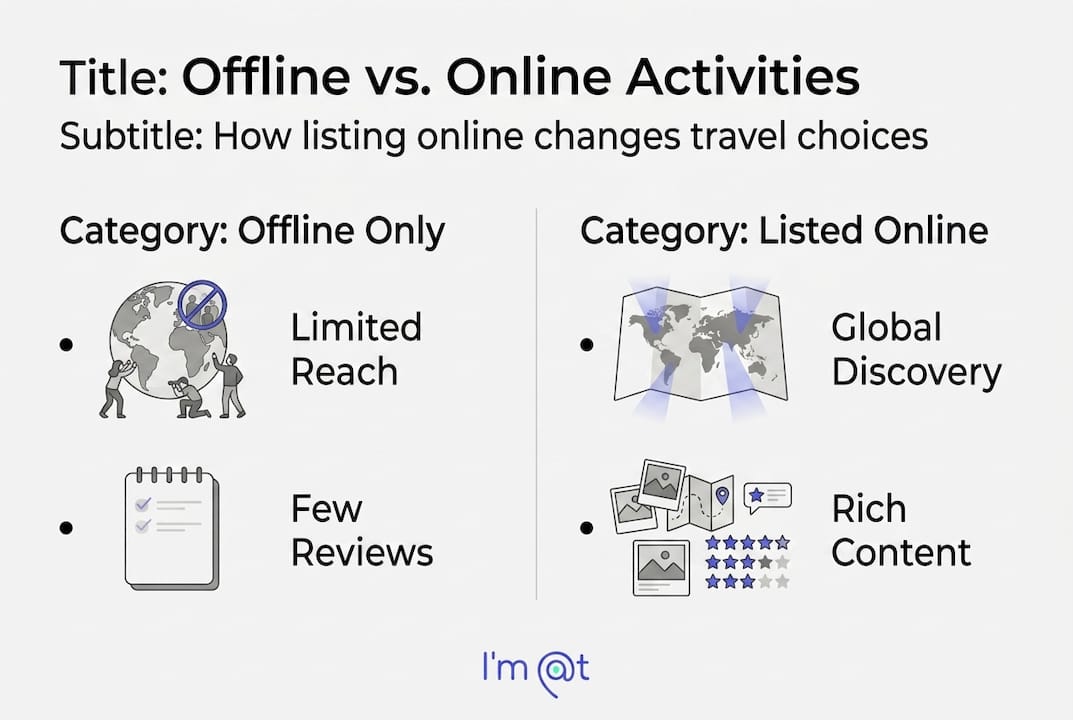
Artificial intelligence is now a major force in how listings get recommended. According to research on how operators get found in the AI age, platforms favored by AI like Viator and GetYourGuide rank higher in large language model recommendations because they carry rich data, verified reviews, and detailed activity descriptions. This means an activity with a complete listing gets suggested to more potential travelers than one with minimal information, regardless of how good the experience actually is.
Digital travel guides now function as dynamic discovery tools that adapt to your preferences, location, and travel history, something static resources simply cannot do.
"If your activity isn't listed with complete details and genuine reviews, you're essentially invisible to the algorithms and AI assistants that now drive travel decision-making." — Arival Travel Research
Here's how traditional listings compare to online ones:
| Feature | Traditional (offline) | Online listing |
|---|---|---|
| Accessibility | Limited to physical location or print | 24/7 from any device, anywhere |
| Information richness | Basic description, often outdated | Photos, videos, reviews, maps, full itineraries |
| Booking ease | Phone call or in-person only | Instant booking with confirmation |
| AI recommendations | Not applicable | Actively prioritized by AI and search engines |
| User reviews | Word of mouth only | Verified reviews from real past guests |
| Global reach | Local or regional audience | Worldwide traveler audience |
The difference is stark. Online listings transform an activity from a local secret into a globally accessible adventure.

Top benefits of listing activities online
The advantages of online activity listings touch every part of the travel experience, from the moment you start planning to the moment you return home. Here are the most important ones:
-
Instant 24/7 access. You can search and book a snorkeling tour in Thailand at 2 a.m. while sitting in your living room in Chicago. No office hours, no waiting on hold. The entire booking process, including payment and confirmation, happens in minutes.
-
Breadth of authentic choices. Online platforms aggregate hundreds or thousands of activities in a single destination. You're not limited to what your hotel recommends or what's advertised at the airport. You get access to authentic, community-driven experiences that reflect the real character of a place.
-
Transparency through reviews and ratings. Every listed activity carries a track record. Past travelers share detailed feedback covering everything from guide quality to pickup punctuality. This social proof dramatically reduces the uncertainty that used to make booking unfamiliar activities stressful.
-
Real-time availability and pricing. Online listings update in real time, so you see actual open slots and current prices without hidden surprises. The days of showing up to a fully booked activity or paying more than expected are largely behind us.
-
More visibility for providers, better options for travelers. When guides and tour operators list their activities online, they reach a global audience they couldn't access before. This increased competition pushes quality higher and keeps pricing fair, which directly benefits you as the traveler.
-
Flexible booking and cancellation policies. Most online platforms offer clear, written cancellation policies displayed upfront. You can book with confidence knowing your options if plans change, something that's rarely guaranteed with offline arrangements.
For activity providers, the numbers are equally compelling. Booking experiences through digital platforms dramatically improves occupancy rates for guides who previously relied on walk-ins or local referrals alone. Listing online connects a kayak guide in Croatia to a traveler planning from Seoul months in advance.
Using planning tools for travel alongside online listings helps you move from inspiration to confirmed itinerary without wasted time or second-guessing.
Pro Tip: When scanning listings, look for activities that include detailed day-by-day itineraries, multiple recent photos, and a response from the provider to negative reviews. These signals indicate a provider who is engaged, accountable, and genuinely invested in your experience.
Listings with rich content also benefit from AI prioritization, meaning the most detailed and honest listings float to the top of recommendations, making your search results inherently more curated.
Online vs. offline: Who wins for adventure booking?
The comparison isn't even close. But understanding specifically where offline bookings fall short helps you appreciate exactly what online platforms protect you from.
| Booking factor | Online booking | Offline booking |
|---|---|---|
| Average booking time | Under 10 minutes | 30 minutes to several hours |
| Variety of options | Hundreds to thousands | Typically 3 to 10 options nearby |
| Cancellation flexibility | Written policy, often free cancellation | Verbal agreements, often non-refundable |
| User satisfaction | Consistently higher due to reviews and transparency | Variable, often unpredictable |
| Price transparency | Full pricing shown upfront | Negotiated or unclear until arrival |
| Language accessibility | Multiple language options common | Depends heavily on guide's language skills |
Common pain points that offline travelers run into include:
- Missed hidden gems. Without digital listings, genuinely unique experiences like a private wine tour through an unmarked family vineyard or a cultural dance workshop in a remote village stay invisible unless someone physically tells you about them.
- Language barriers. Offline booking often requires speaking directly with local operators, which creates real challenges in countries where English is less common.
- No paper trail. Without a written booking confirmation, disputes about pricing, timing, or cancellations are nearly impossible to resolve.
- Outdated information. A flyer on a hostel board or a recommendation from a traveler you met three weeks ago may reflect an experience that no longer exists or has changed significantly.
- Limited comparison ability. Offline, you can only evaluate what's immediately in front of you. Online, you can compare 20 similar tours side by side in minutes.
Exploring activity platform alternatives and comparing options like activitygogo alternatives shows just how many choices now exist for digitally savvy travelers, each with their own strengths and niches.
Pro Tip: If you're in a destination with limited connectivity, download your booking confirmation, activity details, and provider contact information before you arrive. Online booking gets you the best experience, and a little offline preparation keeps it smooth even in remote areas.
The data is clear. AI-driven recommendation engines now factor into how millions of travelers make decisions, and they systematically favor platforms and listings with complete information. Future travel discovery will be digital-first. That shift is already well underway.
How to make your activity irresistible online
Whether you're a traveler trying to identify the best listings or a provider trying to attract more bookings, knowing what makes a listing stand out is genuinely useful. Here's what separates a forgettable listing from one that fills up weeks in advance:
-
Craft a specific, benefit-led title. "Sunset Dhow Sailing Tour with Dinner, Zanzibar" beats "Boat Trip" every single time. The title should tell travelers exactly what they'll get and create immediate desire.
-
Write descriptions that tell a story. The best listings describe what a traveler will feel, not just what they'll do. "Watch flamingos take flight over a pink lake at dawn" is more compelling than "visit a lake with flamingos." Emotion converts.
-
Use rich media intentionally. High-resolution photos that show real guests in action, short video clips of the highlights, and embedded maps all signal professionalism and build trust. Listings with strong visuals consistently outperform those without.
-
Let your reviews do the selling. Encourage every happy guest to leave a review immediately after the experience, while the memory is fresh. Respond thoughtfully to every review, positive or negative. This dialogue signals reliability to future travelers and boosts AI prioritization of your listing.
-
Keep availability and pricing current. Nothing erodes trust faster than a traveler attempting to book a "available" experience only to find it's actually closed for the season. Real-time accuracy is non-negotiable.
-
Use strategic keywords throughout. Think about how a traveler would search for your experience and use those exact phrases naturally in your description. "Family-friendly whale watching Cape Town" or "beginner surf lessons Bali" signal relevance to both search engines and AI tools.
The experiences that generate the most bookings reflect local experiences impact, rooted in genuine cultural knowledge and community connection. Travelers can smell authenticity in a well-crafted listing. They can also smell a generic template from a mile away.
Understanding the benefits of local experiences helps both travelers and providers align their expectations with what makes experiential travel genuinely valuable versus what merely looks good in a thumbnail.
Pro Tip: After every trip, leave a detailed review for every activity you booked online. Your specific, honest feedback helps future travelers make better decisions and rewards the providers who deliver exceptional experiences. It also keeps the ecosystem of online listings accurate and trustworthy for everyone.
The real future of travel: Why online listings will shape every journey
Here's an uncomfortable truth that most travel content glosses over: if your activity isn't listed online with rich detail and genuine reviews, you are invisible to the majority of today's adventure seekers. This isn't a marketing opinion. It's how the infrastructure of modern travel discovery actually functions.
We've watched travelers spend hours asking hotel staff for "local tips" while sitting with a smartphone that could have surfaced 50 highly reviewed, bookable experiences in their exact destination within seconds. The reluctance to use online listings often comes from a vague distrust of digital platforms or a romanticized idea that offline discovery is more authentic. That idea is worth challenging.
The most meaningful travel moments we encounter now almost always start digitally. A traveler in Berlin discovers a guided Cold War history walk through a listing with 400 five-star reviews. A couple planning their honeymoon finds a private catamaran sunset sail in Santorini through an AI recommendation. A solo adventurer in Patagonia books a multi-day trekking experience with a local guide who, without an online listing, would only reach travelers who physically walked into his small office in Puerto Natales.
Modern travel discovery is increasingly driven by AI curation that reads listing quality as a signal of experience quality. This matters because platforms prioritized by AI are now the first touchpoint in millions of travel planning journeys.
The challenge is not lack of options. It's intentionality amid abundance. Digital fatigue and over-choice are real. When a search returns 200 options for "Rome food tours," decision paralysis is a genuine risk. The solution is learning to filter by recency of reviews, specificity of the itinerary, and the quality of the provider's responses. These signals cut through the noise reliably.
Online listings are not optional infrastructure for the travel industry. They are the foundation on which personalized, meaningful, and genuinely adventurous travel is now built. Embracing them fully, as a traveler, is one of the smartest things you can do before your next departure.
Ready for your next adventure? Discover and book top experiences now
You now understand exactly why online activity listings matter and what makes the best ones stand out. The next step is putting that knowledge into action.
Im-at makes it effortless to browse, compare, and instantly book diverse experiences around the world. Whether you're dreaming of a rugged off-road adventure or an elegant river valley wine experience, the platform has you covered. The Tailor-Made 4×4 Tours let you design a custom safari-style journey on your own terms, while the Douro Valley tour experiences combine world-class wine tasting, local cuisine, and a scenic river cruise in one seamless day. Both are listed with full details, verified reviews, and real-time availability. Ready to stop researching and start experiencing? Discover more activities and book your next adventure today.
Frequently asked questions
What is an online activity listing?
An online activity listing is a digital profile where travel experiences are described, rated, and made bookable on discovery platforms, giving global travelers instant access to experiences they'd never find offline. These listings are increasingly favored by AI tools for recommendations due to their rich content and verified reviews.
How does listing activities online help travelers?
It allows travelers to find, compare, and book diverse experiences from anywhere at any time, backed by detailed reviews and live availability. AI recommendation engines also use listing data to surface the most relevant options for each traveler's preferences.
Are online listings more trustworthy than offline recommendations?
Online listings typically include verified reviews, ratings, and detailed itineraries, offering far more transparency than a hotel referral or a flyer on a hostel wall. Platforms with rich listing data also tend to enforce quality standards that offline sources cannot match.
What makes an activity listing stand out online?
Clear, story-driven descriptions, high-quality images, recent reviews, real-time availability, and strategic keyword use all combine to attract travelers and boost bookings. Listings that rank in AI recommendations consistently share these characteristics.
Do AI and travel platforms really favor activities with more information?
Yes, platforms like Viator and GetYourGuide are prioritized by AI systems precisely because their listings contain the detailed, structured data that large language models use to generate trustworthy travel recommendations. More information in your listing directly translates to more visibility and more bookings.