
TL;DR:
- Focusing on experiences rather than luxury accommodation creates lasting memories and boosts overall well-being.
- Research shows active participation in local activities generates long-term psychological benefits more than room upgrades.
Prioritizing experiences over accommodation gives you longer-lasting memories, bigger wellbeing gains, and more efficient use of your travel budget. The room you sleep in fades from memory within weeks. The cooking class in Oaxaca, the sunrise hike, the afternoon you got lost in a medina and ended up at a stranger's tea table — those stay.
Why experiences beat room upgrades, fast:
- Memory durability: Experiences form vivid, story-worthy memories; room quality rarely does.
- Eudaimonic wellbeing: Growth, connection, and novelty produce psychological benefits that outlast hedonic comfort boosts.
- Social value: Experiences give you something to share, retell, and bond over long after the trip ends.
- Budget efficiency: Shifting spend from a premium room to a guided tour or cultural workshop almost always delivers more perceived value.
- Authenticity: Active participation in local life beats passive comfort every time.
Exceptions exist. Safety, accessibility needs, long stays, and medical or business requirements can all make lodging the right first priority. Those cases are covered below.
Table of Contents
- Why experiences deliver lasting value, according to the research
- What the numbers say about the shift to experience-first travel
- What "experience" actually means when you are planning a trip
- How to plan a trip that protects experiences first
- When accommodation should still come first
- A quick worksheet to prioritize your next trip
- Key Takeaways
- The case for experience-led travel, from where we stand
- Find and book your next experience on Im-at
- Sources and further reading
Why experiences deliver lasting value, according to the research
The psychological case for experience-first travel is stronger than most people realize. Memorable tourist experiences are significantly and positively correlated with subjective well-being (β = 0.436, p < 0.001), with positive emotions playing a key mediating role. That is not a soft finding. It means the emotional charge of a meaningful trip actively shapes how good you feel about your life afterward.
The distinction between hedonic and eudaimonic benefits matters here. Hedonic gains come from comfort and pleasure: a plush mattress, a rooftop pool, a well-stocked minibar. They feel good in the moment but fade quickly. Eudaimonic gains come from growth, mastery, connection, and novelty. Research covered by New Scientist shows eudaimonic vacation experiences can produce wellbeing benefits that persist for weeks beyond the hedonic kind.
"A single novel experience can rewire the hippocampus through rapid synaptic plasticity... Travel loosens your identity's usual scaffolding — and that disruption brings clarity." Psychology Today
The neuroscience backs this up. Novel stimuli — new streets, unfamiliar sounds, food you have never tasted — flood dopamine neurons. Dopamine's primary role is not pleasure; it drives curiosity and the impulse to engage. Your brain, saturated with novelty, processes information more deeply and forms stronger memories. Researchers have also identified a form of brain plasticity called behavioral timescale synaptic plasticity (BTSP), in which the hippocampus can begin rewiring after a single novel experience, not weeks of repetition.
Wellbeing stat: A peer-reviewed study in Scientific Reports found that psychological resilience significantly moderates the relationship between positive travel emotions and subjective well-being (β = 0.261, p < 0.001), meaning travelers who engage actively with experiences compound their psychological gains.
The epistemic value of travel also deserves mention. Unfamiliar environments force you to treat more inputs as meaningful signals rather than background noise. You notice architecture, social customs, and sensory details you would filter out at home. That shift in perception persists after you return, making you more observant and cognitively flexible in daily life. The benefits of cultural experiences for long-term wellbeing are well documented, and they consistently point to active participation as the driver.
What the numbers say about the shift to experience-first travel
Travelers are not just talking about this shift. They are spending differently. Recent industry analysis shows a clear reallocation of travel budgets away from room class and toward activities, guides, and local experiences.
| Signal | Figure |
|---|---|
| Travelers planning to travel | 93% |
| Travelers making travel a budget priority | 49% |
| Framing of the trend | "Experience gap" — the gap between what travelers want to do and what they actually book |
Key datapoint: 93% of travelers are planning to travel, and 49% are actively making travel a budget priority, with the dominant shift toward experiences over accommodation class.
What this means practically: popular guided tours, cooking classes, and cultural workshops sell out weeks or months before a trip. A hotel room in the same city almost never does. If you wait to book experiences the way you wait to book a room, you will find yourself locked out of the things that would have made the trip memorable. Experiential travel trends show demand for immersive activities continuing to outpace supply in many popular destinations. The rise of experience-first travel has also pushed travelers to treat lodging as a supporting element rather than the centerpiece of planning.
What "experience" actually means when you are planning a trip
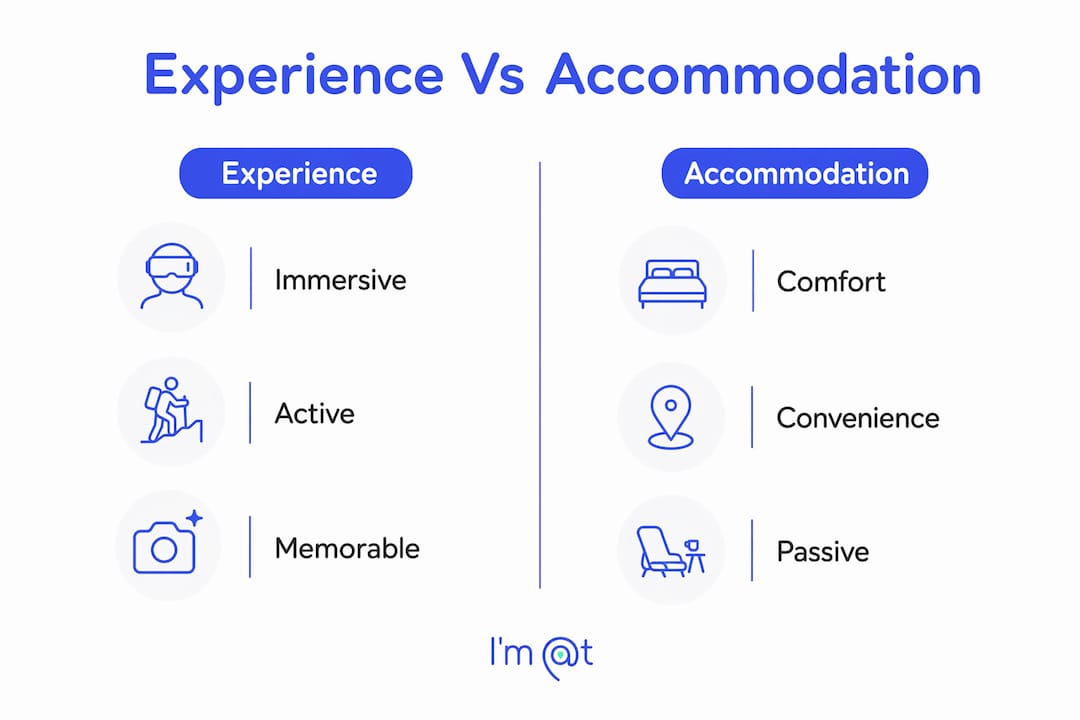
An experience, in travel terms, is any purposeful, memorable activity that creates connection, learning, novelty, or challenge. It is the opposite of passive. You are not watching a destination; you are participating in it.
Practical categories and examples:
- Cultural: A guided walk through a historic medina, attending a traditional ceremony, visiting a working artisan's studio.
- Culinary: A market tour followed by a cooking class, a culinary experience with a local family, a street food crawl with a knowledgeable guide.
- Adventure: A sunrise hike to a volcanic crater, a kayaking day through sea caves, a multi-pitch rock climb with a certified guide.
- Workshops and classes: Pottery, textile dyeing, language lessons, photography walks, traditional music sessions.
- Community: Volunteer days, farm stays, homestays that put you inside daily local life rather than adjacent to it.
- Restorative and nature: A forest bathing session, a solo dawn walk on a remote beach, a guided night-sky tour far from city lights.
The contrast with accommodation benefits is structural. A luxury room offers comfort and passivity. Experiences offer connection and agency. One is something that happens to you; the other is something you do. Immersive travel formats like homestays and volunteer exchanges take this further, trading standard lodging for cultural depth while often reducing accommodation costs at the same time.
How to plan a trip that protects experiences first
The method is simple: treat your experience budget as a protected line item, and book experiences before you book lodging. Everything else follows from that.
Step-by-step sequence:
- Name your trip purpose. What feeling or skill do you want to take home? Purpose-driven planning produces sharper itineraries than picking a destination and filling time.
- List your top 2–3 non-negotiable experiences. These are the anchors. Everything else is logistics.
- Set your dates around those experiences. Check availability before you commit to flights.
- Reserve the experiences first. Pay deposits, confirm slots, and lock in guides before you search for a room.
- Choose lodging by proximity to your anchors. A well-located mid-range hotel near your activity hubs beats a luxury property that adds 40 minutes of transit each way.
- Balance the remaining budget. What you save on room class goes directly toward a second guided experience, a longer tour, or a better local meal.
For budgeting, the practical split most experience-first travelers land on is spending more on one or two headline experiences than on room quality. A mid-range room near the action almost always outperforms a premium room far from it. Smart activity planning resources consistently reinforce this: the booking order matters as much as the budget split.
For lead times, book signature experiences 4–8 weeks out for popular destinations; 2–3 weeks is usually fine for less-visited spots. Hotels in most markets can wait until 1–2 weeks before arrival without penalty.

Pro Tip: Book your single most important experience the moment dates are confirmed. Sold-out tours do not reopen. A hotel room almost always does.
When accommodation should still come first
Lodging takes priority when the stakes of getting it wrong are high enough to compromise the trip itself.
- Safety and security: Unfamiliar destinations with inconsistent infrastructure, areas with documented safety concerns, or solo travel in regions where vetting accommodation carefully is non-negotiable.
- Accessibility needs: Travelers with mobility requirements, medical equipment, or specific physical needs must confirm lodging features before anything else. A great experience means nothing if you cannot physically access your room.
- Long stays (7+ days): Comfort, kitchen access, laundry, and living space matter far more on a two-week stay than on a three-night trip. Apartments and serviced stays make more sense here than hotels.
- Business and medical travel: When the trip's primary purpose is work or treatment, lodging near the office, hospital, or clinic is the logical anchor.
- Remote or extreme-weather destinations: When local transit is unreliable or conditions are harsh, the right lodging is a safety and logistics decision first.
Watch for these signals: no reliable local transit, a medical device that requires stable power, a destination where most activities are clustered in one neighborhood far from budget lodging, or a trip longer than a week where fatigue will accumulate. In those cases, accommodation quality becomes the foundation everything else rests on.
A quick worksheet to prioritize your next trip
Use this before you open a booking site. It takes five minutes and forces the decisions that matter.
Mini-exercise checklist:
- What is the single purpose of this trip? (Rest, adventure, culture, connection, skill-building?)
- What are my top 2–3 experiences I would regret missing?
- What is the realistic cost and time block for each?
- Which neighborhood or area puts me closest to all three?
- What lodging budget remains after I protect the experience budget?
Sample 2-day itinerary (experience-led):
Anchor experience: a full-day guided cultural tour (e.g., the Alexandria Day Tour covering the Catacombs, Citadel, and Library).
- Day 1: Arrive, check into a mid-range hotel within 15 minutes of the tour departure point. Light evening walk in the surrounding neighborhood. Early dinner at a local spot the hotel recommends.
- Day 2: Full-day guided tour (booked and paid before the hotel). Evening free for a second, shorter local experience (street food, a local market, a sunset walk along the waterfront).
Lodging cost: moderate. Experience cost: protected. Regret: zero.
Copy-and-use template:
Trip purpose: _______________
Experience 1: _______________ | Cost: ___ | Duration: ___
Experience 2: _______________ | Cost: ___ | Duration: ___
Experience 3: _______________ | Cost: ___ | Duration: ___
Best neighborhood for all three: _______________
Remaining lodging budget: _______________
Key Takeaways
Prioritizing experiences over accommodation consistently delivers stronger memories, longer-lasting wellbeing gains, and better value than upgrading your room.
| Point | Details |
|---|---|
| Experiences outlast comfort | Eudaimonic travel benefits persist for weeks; hedonic room upgrades fade quickly. |
| Book experiences first | Popular tours and workshops sell out; hotel rooms almost never do. |
| Lodging serves the experience | Choose where you sleep based on proximity to your anchors, not star rating. |
| Know the exceptions | Safety, accessibility, long stays, and medical needs can make lodging the right first priority. |
| Im-at makes it practical | Im-at's marketplace lets you search and book guided tours, cultural trips, and day experiences before you lock in a room. |
The case for experience-led travel, from where we stand
The conventional travel advice still defaults to "pick a destination, find a hotel, then figure out what to do." That order is backwards, and the research makes it hard to defend. A hotel room is infrastructure. An experience is the reason you went.
What gets underestimated is how much the sequence of planning shapes the outcome. When you book a hotel first, you anchor your entire trip to a location and a price point. Every experience decision that follows is constrained by that anchor. Flip the order and the whole trip recalibrates around what you actually came to do. The lodging becomes a tool, not a destination.

There is also a social dimension that rarely gets discussed. Experiences generate stories. A room upgrade does not. The value of travel is partly realized after the trip, in the conversations it produces, the identity shifts it creates, and the memories that surface months later without warning. None of that comes from thread count.
The one nuance worth holding: immersion does not require cheap lodging. Combining a well-located mid-range stay with locally led experiences often yields higher perceived value than paying for a luxury property far from where anything interesting happens. The goal is not austerity. It is alignment.
Find and book your next experience on Im-at
The single sharpest move you can make before your next trip is locking in the experience that anchors it, then building everything else around that.
Im-at is a global marketplace where you can search, compare, and book guided tours, cultural day trips, safaris, and local experiences across dozens of destinations, all in one place. No agency fees, no back-and-forth with providers. You browse real listings, check durations and cancellation policies, and book in minutes.
For a multi-day experience-led short break, the Cape Town 3-day attraction covering a township visit, Cape Peninsula, and wine tasting is exactly the kind of anchor experience worth protecting in your budget. Or start with a single-day cultural immersion like the Private Bagamoyo Day Trip with Lunch to see how experience-first planning feels in practice.
Browse the full catalog at Im-at and book the experience before you book the room.
Sources and further reading
The sources below were selected for research quality, survey credibility, and practical planning value.
- Memorable tourist experiences and subjective well-being — Scientific Reports
- How to maximize the mental health benefits of your vacation — New Scientist
- Travel doesn't just relax you, it breaks your identity — Psychology Today
- The epistemic value of travel — The Journal of Ethics, Springer Nature
- The rise of experience-first travel — Plymouth Rock Travel Partners
- Experience gap travel: why activities matter more — Plymouth Rock Travel Partners
- How to choose the right accommodation for any type of trip — Drift Travel
- What is immersive travel? — Im-at Blog
- Why pre-book travel activities — Im-at Blog
- Experiential travel trends 2026 — Im-at Blog
- Im-at experience marketplace — Im-at