
TL;DR:
- Immersive travel involves participating directly in local life, fostering authentic, multisensory experiences.
- It contrasts with traditional tourism by emphasizing community engagement, reciprocity, and genuine cultural exchange.
Immersive travel gets dismissed as a buzzword by people who haven't looked closely enough. It's not a marketing phrase invented by tourism boards to sell premium packages. The experiential travel market was valued at $2,814 billion in 2025 and is projected to reach $5,486 billion by 2034, reflecting a genuine, massive shift in what people want when they leave home. This guide cuts through the noise, explains what immersive travel actually means, shows how it differs from standard tourism, and gives you a practical framework to find experiences that are the real deal.
Table of Contents
- Defining immersive travel: More than just a buzzword
- Immersive travel vs. traditional tourism: What's the difference?
- How to find and vet immersive travel experiences
- Beyond hype: Opportunities, challenges, and pitfalls of immersive travel
- Our take: What most immersive travel articles miss
- Ready for real immersive travel? Unique experiences await
- Frequently asked questions
Key Takeaways
| Point | Details |
|---|---|
| Immersive travel defined | Immersive travel means engaging deeply with a place’s culture, people, and environment for a more meaningful experience. |
| Different from traditional tourism | It prioritizes interaction and reciprocity rather than just sightseeing from a distance. |
| Spot genuine opportunities | Look for trips that benefit local communities and invite active participation to avoid commodified experiences. |
| Beware potential pitfalls | Over-planned 'authenticity' can lead to exhaustion or harm if not mindful of local needs and realities. |
| Choose quality over quantity | Fewer, deeper connections create richer memories than a long checklist of destinations. |
Defining immersive travel: More than just a buzzword
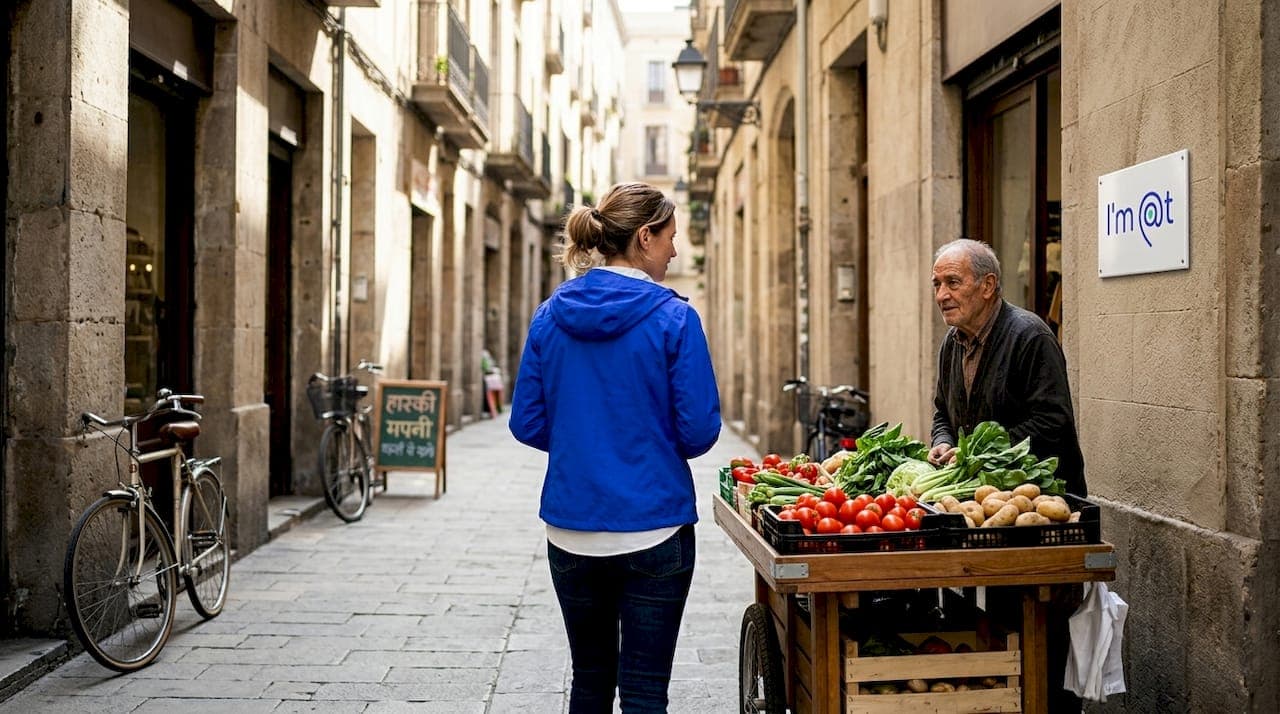
Immersive travel places you inside a destination rather than outside it looking in. Instead of observing a culture from a tour bus or photographing landmarks from behind a rope, you are participating. You're cooking with a family in their kitchen, joining a fishing crew at dawn, learning a traditional craft from the person who invented it, or walking a neighborhood with someone who grew up there. The experience wraps around all your senses and puts local people at its center.
This is not the same as "authentic" travel in the way the word gets overused. Authenticity has become a selling point on almost every travel website. What separates genuinely immersive experiences from the imitations is a combination of four core elements.
- Authenticity: The experience reflects real, current local life, not a performance staged for tourists.
- Local interaction: You engage with community members, not just paid actors or guides reading from scripts.
- Reciprocity: The experience creates value for the host community, not just memories for the traveler.
- Multisensory engagement: Smell, sound, texture, and taste are all part of the experience, not just what you see.
The data behind this shift is striking. According to experiential travel research, 78% of travelers now prioritize memorable, authentic experiences, 73% actively seek cultural immersion, and 86% of millennials favor experience-focused travel over material consumption. These aren't niche preferences. They represent the mainstream.
Our guide to experiential travel breaks down how this market has evolved, and the travel trends for 2026 show just how quickly the shift from "checklist" to "depth" tourism is accelerating.
"The best travel experience is one where the destination changes you as much as you temporarily change it. That exchange is the essence of immersion."
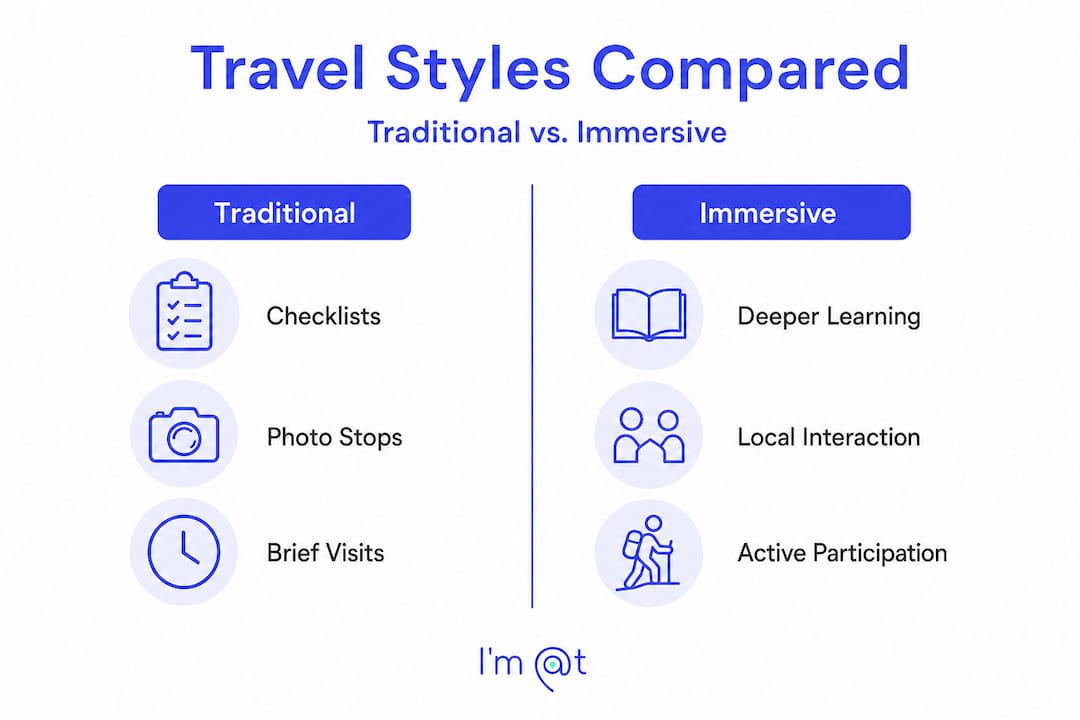
| Element | Surface-level tourism | Immersive travel |
|---|---|---|
| Local interaction | Transactional (buying, tipping) | Participatory (joining, learning) |
| Cultural exposure | Curated highlights | Daily rhythms and real life |
| Sensory depth | Visual, limited | Multisensory engagement |
| Community benefit | Indirect at best | Direct and intentional |
| Memory type | Photos and checkboxes | Stories, skills, relationships |
Immersive travel vs. traditional tourism: What's the difference?
Traditional tourism is built around access and convenience. You show up, you see the thing, you leave. It's efficient, it's comfortable, and it satisfies a certain kind of traveler. But it rarely changes you. You come home with photos and maybe a souvenir. The destination stays exactly as you found it, untouched by your presence in any meaningful way.
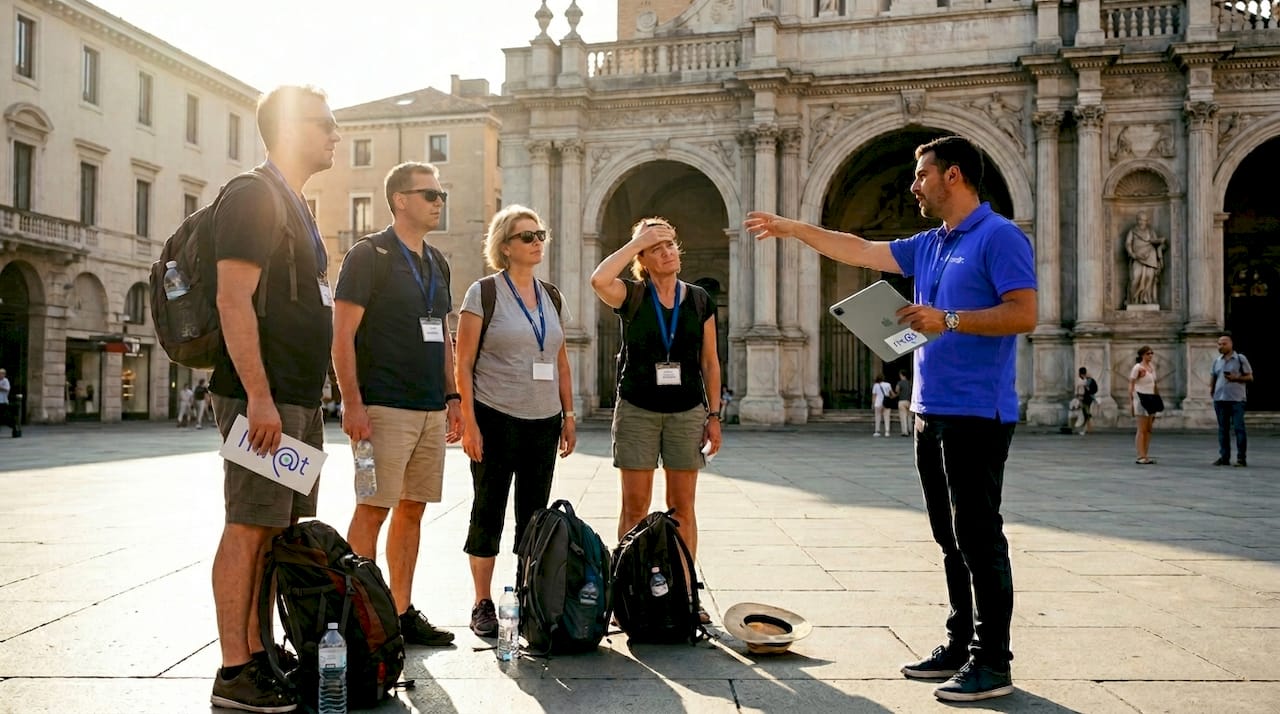
Immersive travel demands more from you. And that's precisely the point.
Here's a concrete comparison. A traditional tourist visiting Kyoto books a tea ceremony at a hotel demonstration center. An immersive traveler arranges to spend a morning at a centuries-old tea school, learning the philosophy behind the ritual, practicing the precise gestures under a master's guidance, and sharing the experience with local participants who aren't there for tourism at all. Both travelers visited Kyoto. Only one of them has a story worth telling for the rest of their life.
What makes a trip genuinely immersive:
- Experiences designed with local communities, not just for tourists
- Small group sizes that allow genuine conversation
- Activities that teach something functional: cooking, craft, agriculture, music
- Stays in locally owned accommodations rather than international chains
- Unscripted moments where real life bleeds into the experience
Now, edge cases are worth considering because they reveal the limits of immersive travel. Remote regions like Antarctica present a fascinating paradox: weather-dependent landings and repetitive expedition patterns can actually reduce immersion, since you're at the mercy of logistics rather than local culture. Heavily visited gems like Burano in Venice's lagoon face the opposite problem, where short visits exhaust novelty so quickly that genuine engagement becomes nearly impossible amid the crowds.
This tension is important. Not every destination or format lends itself to deep immersion, and recognizing that saves you from overpaying for a package that promises depth but delivers a surface experience.
Understanding what authentic experiences travelers seek helps you calibrate expectations, and learning how to master immersive cultural experiences means you arrive better prepared regardless of the destination.
Pro Tip: Before booking any experience labeled "immersive," ask three questions: Who leads it and where do they live? What percentage of your fee goes directly to local people or businesses? And what will you actually do rather than just watch?
How to find and vet immersive travel experiences
Finding real immersive experiences takes more than typing "cultural tour" into a search bar. The travel industry has caught on to the demand and responded with a wave of experiences that use the right vocabulary without doing the real work. Here's a practical framework.
1. Start with the guide, not the activity. Research who leads the experience before you look at the itinerary. A guide who lives in the community, has deep personal knowledge, and speaks about their home with genuine pride is a better signal of quality than any description in a brochure. Look for names, bios, and real stories, not generic profile photos.
2. Check who benefits financially. Locally owned operators, cooperatives, and community-run enterprises distribute income back into the community. When a large international operator runs a "village experience," the economics often tell a different story. Ask directly: who owns this business, and how does your payment circulate locally?
3. Look for small group sizes. Large groups are profitable but shallow. A group of four people in a family kitchen creates something genuinely different from a busload of tourists watching a cooking demonstration. Smaller numbers allow real conversation and spontaneous moments.
4. Prioritize participation over observation. The best immersive experiences require you to show up, try, fail, and learn. If the entire experience can be replicated by watching a YouTube video, it isn't actually immersive.
5. Read community-focused reviews. Look beyond star ratings. Search for reviews that mention local guides by name, describe unexpected conversations, or talk about moments that weren't on the official schedule. Those details signal genuine depth.
The risk here is real. As immersive travel experts warn, immersive travel risks becoming pure marketing hype without reciprocity, and travelers need to vet experiences for local ownership and measurable community benefits to avoid funding extractive tourism.
That's why understanding the difference between local experiences and authentic rewards matters before you book, and exploring how locals shape meaningful travel gives you the lens you need to evaluate what you're actually signing up for.
Warning signs of commodified "authenticity":
- Experiences described with heavy adjectives but no specific details
- Pricing that seems too low to realistically support local livelihoods
- Guides who recite scripted narratives without deviation
- No mention of the community's role in designing the experience
- "Traditional" performances that run multiple times daily for different tour groups
Beyond hype: Opportunities, challenges, and pitfalls of immersive travel
When immersive travel works as intended, the outcomes are remarkable. Cultural exchange goes both ways, travelers carry perspectives home that reshape how they see their own lives, and host communities receive economic support that strengthens local traditions rather than diluting them. In regions where extractive mass tourism has historically dominated, well-designed immersive experiences can redirect spending toward the people who actually carry those traditions.
But the picture isn't uniformly positive.
Opportunities created by immersive travel:
- Direct economic empowerment for artisans, farmers, guides, and small business owners
- Preservation of endangered crafts and practices through renewed demand
- Cross-cultural understanding that outlasts the trip
- Personal growth for travelers who step outside comfort zones
- Sustainable alternatives to over-touristed mainstream attractions
Real risks and pitfalls:
The uncomfortable truth about authentic travel trends is that over-planning authenticity leads to exhaustion, and experiences not led by communities can quietly perpetuate colonial dynamics. When a well-funded outside operator designs a "local experience" without meaningful community input, they extract cultural capital rather than support it.
Virtual reality and digital travel tools offer interesting complements, but they still lack the full sensory reality of genuine presence. Smell the market. Feel the temperature. Taste the dish the host actually eats at home. Technology replicates none of that, and immersive travel's core value lives precisely in that irreplaceable sensory and human reality.
"The risk isn't that immersive travel isn't real. It's that the label gets applied to experiences that are simply better packaged versions of the same old tourism."
Traveler self-awareness is your most important tool here. Before you commit to an experience, ask yourself honestly whether you're looking for a story to tell at dinner parties or a genuine encounter with the world. The motivation shapes the outcome. Those who explore nearby activities with genuine curiosity often find more depth in short trips than others find in month-long itineraries, and local excursions designed for authentic travel offer accessible starting points even for first-time immersive travelers.
Our take: What most immersive travel articles miss
Most content about immersive travel focuses on where to go and what to book. Almost none of it addresses the single biggest variable in the equation: you.
The checklist approach to immersion is where it most often backfires. You book the cooking class, the village homestay, the guided market walk, and the local music performance. You squeeze them into four days. You emerge exhausted, slightly overwhelmed, and holding a collection of experiences that feel more like items crossed off a list than genuine encounters. That's not immersion. That's premium checklist tourism with better optics.
Here's the uncomfortable reality: many "immersive" experiences on the market are still fundamentally top-down. They're designed by operators who benefit most, with local people filling roles in someone else's vision rather than sharing their own. The community participates, but doesn't lead. The traveler consumes, but doesn't truly exchange. That dynamic matters enormously, and most travel articles gloss over it because it complicates the sales pitch.
Real reciprocity is the test. Does your participation leave a genuinely positive trace in the community? Not a vague warm feeling, but a traceable positive impact: income that stays local, a tradition that gets documented, a relationship that continues after you've gone home, or a skill you carry forward in a way that honors its origin.
Choosing quality over quantity is the practical implication. One deeply engaged half-day experience with a master potter who has worked the same clay for forty years will stay with you longer than five Instagram-ready "authentic moments" in the same week. The top local activity types that consistently produce this depth are the ones where participation is genuinely required, where local knowledge is irreplaceable, and where the experience would happen without tourists anyway.
Slow down. Choose fewer experiences. Ask more questions. Leave more room for the unscripted.
Ready for real immersive travel? Unique experiences await
Understanding immersive travel at this level changes how you approach the booking process entirely. You're no longer scanning for attractive photos and competitive prices. You're looking for the right conditions: local leadership, genuine participation, and real community benefit.
Im-at curates experiences built around exactly these principles. Whether you're drawn to the mysterious and unconventional with The Unholy Secrets experience, eager for a layered cultural and landscape journey through the Cape Town attraction tour covering townships, the Cape Peninsula, and wine tasting, or ready to spend a day navigating the terraced vineyards of the Douro Valley wine tasting tour with a river cruise included, each option is built to create genuine connection. Browse the full catalog at Im-at and find the experience that matches your depth, not just your schedule.
Frequently asked questions
What makes a travel experience immersive?
An immersive travel experience involves deep, often participatory engagement with a destination's people, culture, and environment, going beyond passive observation. Research shows 78% of travelers now prioritize this kind of meaningful, authentic engagement over standard sightseeing.
How do I know if a trip is truly immersive, not just "authentic" in name?
Look for locally led, small-group experiences that directly benefit communities and require active participation from you. As vetted experience research confirms, immersive travel risks becoming marketing hype without reciprocity, so local ownership and measurable community benefits are your key filters.
What are potential downsides of immersive travel?
Some experiences labeled immersive can be exhausting, ethically problematic, or simply commodified if they weren't designed with genuine local input and community boundaries. Real-world accounts show that over-planning authenticity can perpetuate colonial dynamics or produce tourism that looks deep but isn't.
Is immersive travel possible in highly touristed or remote regions?
Immersion can be genuinely challenged by crowds in over-visited destinations or by logistical constraints in remote areas. Expedition-style travel to places like Antarctica shows that weather-dependent access and repetition can limit depth, but mindful planning and smaller group formats help you find genuine connection even in these contexts.