

TL;DR:
- Book-themed tours offer immersive, emotionally enriching experiences centered on literature and authors.
- These tours foster deep social connections and provide cultural context beyond standard sightseeing.
- They emphasize slow, reflective travel, promoting community, personal growth, and genuine engagement.
Most travelers assume all guided tours feel roughly the same: a bus, a flag-waving guide, a quick photo stop, and back to the hotel. Book-themed tours shatter that assumption completely. These literary journeys layer stories, emotions, and real human connection onto physical places, turning a city walk or countryside retreat into something genuinely memorable. While film tourism grabs headlines, literary travel quietly builds communities of passionate people who want more than a selfie. If you've been searching for a travel experience that feeds your mind, soothes your spirit, and introduces you to your kind of people, a book-themed tour might be exactly what's missing from your itinerary.
Table of Contents
- What are book-themed tours and who are they for?
- Top reasons people book themed literary tours
- How book-themed tours enrich your travel experience
- Potential challenges and how to choose the right themed tour
- Why book-themed tours are more than just a trend
- Ready to experience your own literary adventure?
- Frequently asked questions
Key Takeaways
| Point | Details |
|---|---|
| Deeper travel connection | Book-themed tours make each destination come alive with stories and meaning beyond sightseeing. |
| Social and wellness boost | Literary tours foster community and are perfect for travelers seeking relaxation and real connection. |
| Mindful, authentic experiences | These tours offer genuine cultural encounters and time to slow down and reflect. |
| Consider your needs | Check tour details for accessibility, cost, and pacing to match your best travel style. |
What are book-themed tours and who are they for?
A book-themed tour is any structured travel experience organized around an author's life, a novel's setting, or the broader culture of a literary movement. Think walking the moors that inspired the Brontës, visiting the Dublin pubs James Joyce described in Ulysses, or joining a reading retreat in a Tuscan villa. These aren't niche academic events. They're growing, vibrant experiences that travel activity types now recognize as a mainstream category of experiential travel.
Who books these tours? Primarily women in their 30s and above, but the audience is broadening fast. Solo travelers love them because the shared literary interest removes the awkward icebreaker phase instantly. Small friend groups book them to celebrate milestones like birthdays, retirements, or simply a shared obsession with a particular author. Reading clubs increasingly organize group trips built around a single title or writer. And post-pandemic, literary tourism has surged because travelers crave emotional engagement and genuine community over pure sightseeing.
Here's how these tours typically show up in the real world:
- Author heritage walks: Guided walks through neighborhoods, homes, and haunts tied to a specific writer
- Reading retreats: Multi-day stays at scenic locations with structured reading time, workshops, and author talks
- Festival-based tours: Travel packages built around major literary festivals like Edinburgh, Hay-on-Wye, or the Jaipur Literature Festival
- Novel setting tours: Itineraries that follow a specific book's geography, like tracing Tolkien's landscapes in New Zealand
- Writing workshops abroad: Tours that combine craft instruction with cultural immersion in storied locations
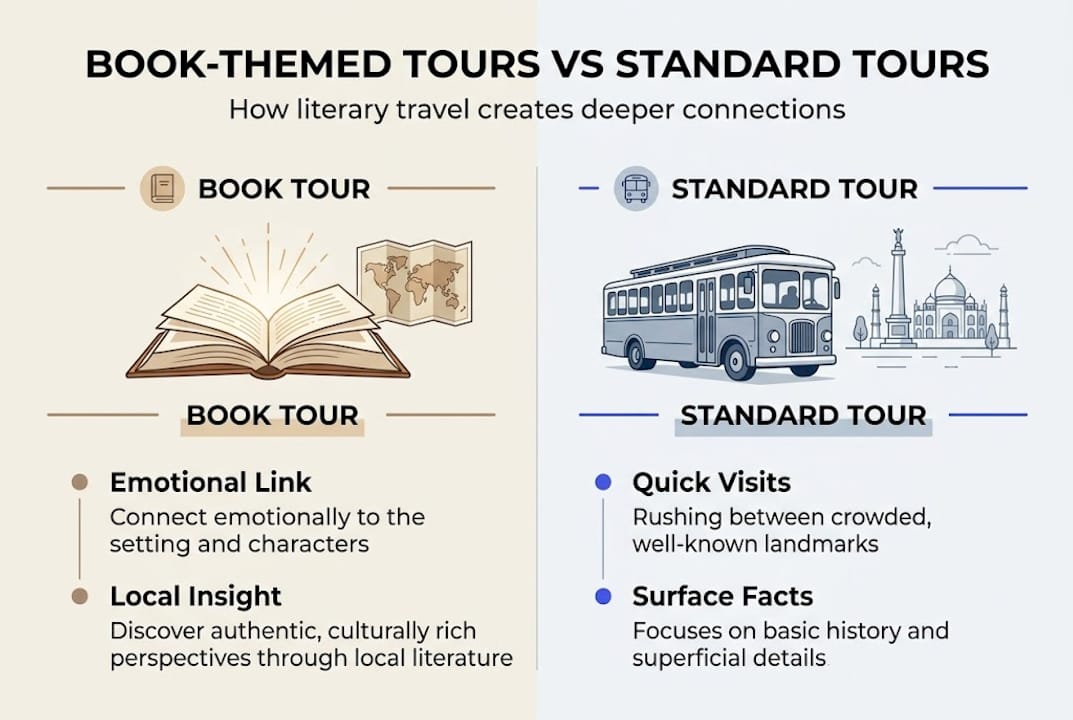
What sets these apart from, say, a Harry Potter film location tour? Film tourism moves fast, focuses on visual recognition, and often feels transactional. Literary tours slow everything down. They encourage you to read, reflect, and connect the written word to lived experience. The result, according to operators in the space, is something more lasting: people report forming real friendships on these trips that outlast the journey itself.
Top reasons people book themed literary tours
Let's be honest. Plenty of travel promises enrichment and then delivers a forgettable afternoon. Book-themed tours actually deliver, and here's why travelers keep coming back.
Emotional and intellectual enrichment tops the list. When you stand in the actual house where Louisa May Alcott wrote Little Women, the novel stops being a story on a page and becomes a lived reality. That emotional shift is hard to manufacture and nearly impossible to find on a standard group tour.

Wellness and digital detox are growing motivators. Reading retreats offer unstructured time for reading, relaxation, and genuine disconnection in beautiful settings, and that combination is increasingly rare in modern travel. Swapping your phone for a novel in a lakeside cottage isn't a sacrifice. It's the point.
| Outcome | Book-themed tours | Standard sightseeing tours |
|---|---|---|
| Emotional connection | High | Low to moderate |
| Social bonding | High (shared interest) | Moderate (random grouping) |
| Cultural learning | Deep and contextual | Surface-level |
| Wellness and relaxation | Structured into itinerary | Rarely prioritized |
| Pace | Slow and mindful | Fast-moving |
| Sense of belonging | Strong | Weak |
Deep social connection is another major draw. Sharing a favorite author with a stranger creates instant rapport. Many solo travelers join literary tours specifically because the community forms naturally and quickly.
Pro Tip: If you're traveling solo on a book-themed tour, bring a copy of the central book or author's work. It gives you an instant conversation starter and doubles as a personal souvenir once it's filled with notes and memories.
Finally, literary tours give you authentic cultural context. Walking Dublin with a Joycean scholar isn't just tourism. It's a lesson in Irish identity, language, and history that no museum exhibit can replicate. When you're ready to start booking immersive tours, knowing what outcome you want from your trip helps you choose wisely. For more creative options, explore unique travel ideas that go beyond the obvious.
How book-themed tours enrich your travel experience
So exactly what changes when you add a literary lens to your travels? Quite a lot, actually.
- Narrative immersion makes sites feel alive. A cathedral is impressive on its own. The same cathedral becomes electric when you know it's where a fictional character's fate turned, or where a real author sat and wrote. Context transforms perception.
- Unique access opens unexpected doors. Many literary tours offer behind-the-scenes entry to private libraries, author homes, or literary archives that aren't open to the general public.
- Slow travel becomes the default. Book-themed tours build in time for reflection, journaling, and conversation. That slower pace is where the real memories form.
- You build a travel community. The social connections formed on literary tours are notably deeper than those formed on standard group trips, because everyone showed up for the same reason.
- Personal growth happens naturally. Reading in the landscape that inspired a book changes how you relate to the text. Many travelers describe these trips as genuinely life-changing in a quiet, lasting way.
"Literary travel asks more of you than film tourism. It asks you to imagine, to feel, and to connect the written word to the world around you. That active engagement is exactly why it leaves a deeper mark." — Insight from the literary tourism industry
This kind of travel aligns with what the broader immersive travel guide describes as experiential travel: placing genuine human experience at the center of the journey rather than destinations alone. It also taps into community tourism insights that show shared purpose dramatically increases travel satisfaction and the likelihood of return visits.
Potential challenges and how to choose the right themed tour
Not every literary tour is a perfect fit for every traveler. Knowing the pitfalls ahead of time saves you from an expensive disappointment.
Physical accessibility is a real consideration. Many author heritage walks cover significant ground on uneven terrain. A detailed Oxford literary tour might involve several hours of walking across cobblestones, which isn't suitable for everyone. Always ask for the daily walking distance and surface type before booking.
Price varies widely. A single-day author walk in your home country might cost under $50. A two-week reading retreat in Tuscany can run into thousands. That range isn't a problem if you know what you're comparing.
Here's what to evaluate before you commit:
- Pace: Is the itinerary relaxed or packed?
- Group size: Smaller groups usually mean richer conversation and more guide attention
- Reading level required: Some tours assume deep familiarity with a text; others welcome curious newcomers
- Physical requirements: Daily walking distances, mobility aids accommodated, terrain type
- Inclusions: Meals, accommodation, entrance fees, author talks, and workshop materials all affect value
| Factor | Literary tour | Mainstream tour |
|---|---|---|
| Focus | Author, novel, literary culture | Broad landmarks and highlights |
| Pace | Slow, reflective | Fast, checklist-style |
| Price range | $50 to $5,000+ | $30 to $3,000+ |
| Accessibility | Varies; ask specifically | Generally well-documented |
| Community feel | High | Moderate |
Pro Tip: On a tight budget, look for literary festival day tours or author walk events attached to public festivals. They offer real depth at a fraction of the cost of a full retreat.
Choosing between group vs solo tours matters here too. Solo-friendly literary tours often have intentional social programming, while group bookings might offer discounts. For cultural depth, reviewing how to approach planning cultural activities can sharpen your decision-making before you spend a cent.
Why book-themed tours are more than just a trend
Every year, a new travel trend gets labeled the next big thing and then quietly fades. Literary tours are not that. They reflect something more fundamental: a growing exhaustion with passive, consumptive travel and a real hunger for meaning, community, and intellectual stimulation on the road.
Most mainstream tour operators still design experiences around efficiency. See the most famous sites in the least amount of time. Literary tours reject that framework entirely. They say the journey matters more than the checklist, and travelers are responding. That's not a trend. That's a values shift.
What major tour companies and popular travel guides consistently miss is that authentic travel rewards come from depth, not breadth. A single afternoon in a novelist's home library can leave a stronger impression than a week of rushed sightseeing.
"The travelers who come back from literary tours aren't just telling stories about places they visited. They're telling stories about who they met and who they became. That's the real marker of a transformative journey."
If that sounds like the kind of travel you want, the tools to find and book it already exist. The question is whether you're ready to slow down enough to let a story shape your journey.
Ready to experience your own literary adventure?
If reading this has stirred something in you, that pull toward slower, story-driven travel is worth following. Im-at makes it easy to find and book the kind of curated, immersive experiences that actually stay with you long after you've returned home.

From mystery-themed experiences like The Unholy Secrets tour to fully tailored literary adventures built around your reading interests, the platform puts the best story-driven journeys within reach for both solo travelers and groups. Browse the full range of unique tour options and find the trip that matches your next chapter.
Frequently asked questions
Do I need to be a serious reader to enjoy book-themed tours?
No. Most literary tours welcome all curiosity levels, and reading retreats are designed to feel relaxed and welcoming rather than academic. The setting and stories are enjoyable even without deep literary background.
What should I check before booking a themed tour?
Always review the pace, daily walking distances, and accessibility details before committing, since some tours involve significant walking or premium pricing that may not suit every budget or physical condition.
How do book-themed tours compare to film tourism?
Film tourism tends to grow faster and focus on visual landmarks, but literary tours offer a deeper emotional engagement and a stronger sense of community among participants.
Can I join a book-themed tour as a solo traveler?
Absolutely. Solo travelers are among the most enthusiastic participants because literary tours foster genuine friendships through shared interest, making it easy to connect with others from day one.